
DOG BLOG
Musings
Best to Grind Your Dogs Heartworm Pill!
Grind your dog’s and cat’s heartworm preventatives! If your pet does not chew the pill then it loses its effectiveness!
Just because we're entering into the Autumn season does not mean that dog owners can slack off about giving heartworm preventative. On my website, under Recommended Vaccinations & Wormers, I have advice from Dr. Jean Dodds, Hemopet.
She advises using heartworm preventatives for healthy dogs if the ambient temperature is above 57 degrees Fahrenheit (14 degrees Centigrade) for approximately two weeks and mosquitoes are prevalent. A basic rule of thumb is Mid-April through November for the majority of the country and basically year-round for the southern states.
However, we are experiencing climate change worldwide. Therefore, it would be wise for those living in the four-seasons regions to keep dosing with heartworm preventative through December just to be safe. This past late Autumn into early winter, I recall mowing my pastures despite the calendar being the end of December! At the same time, be prepared to begin dosing earlier than April if there is a much warmer than usual forecast. Still, first, you must have a heartworm blood test performed. I prefer Snap 4DX tests, which also screen for Anaplasma, Ehrlichia, and Lyme tick diseases.
The most important tip for everyone to know when dispensing heartworm preventatives is that the dog MUST chew the tablet. Since many heartworm preventatives are in chewables forms, people get complacent and think that when they give it to their dog, they'll munch on it. But, if your dogs are like mine, they simply swallow it without chewing. So my policy is to GRIND the pills into tiny pieces or even a powder in a small bowl and add it to a small handful of ground meat. Then I administer it to each of the hounds. This method guarantees that the pill has been crushed without chewing!
Why the big deal? Because pharmaceutical companies require dogs to chew and NOT to swallow their preventative whole for the effectiveness of the pill. Many, many dog owners are completely unaware of this issue. Over the years, I have heard stories about dogs diagnosed with the disease despite taking monthly preventatives. The owners contacted the company and were informed that, most likely, their dog never chewed the pill! That is not what you want to hear after the fact.
Lastly, I urge you to use heartworm preventative medicines. But choose carefully, as there are several options on the market with varying degrees of side effects for specific breeds. For example, some Herding Breed dogs have a genetic mutation that makes them dangerously oversensitive to ivermectin, as well as white colored-dogs, and dogs prone to seizures. Additionally, Sighthounds are very sensitive and are best suited with plain milbemycin oxime. I discuss heartworm preventatives and wormers in detail on my website, so please take a moment and visit Recommended Vaccinations & Wormers.
Recommended Heartworm Preventative for Irish Wolfhounds & Sighthounds
Heartworm preventative recommendations for Sighthounds by Dr. W. Jean Dodds, DVM, is and has been available via her popular Pet Health Resource Blog. If you missed it -- here is the abbreviated info from her "Quick Guide to Heartworm Preventives."
Heartworm preventative recommendations for Sighthounds by Dr. W. Jean Dodds, DVM, is and has been available via her popular Pet Health Resource Blog. If you missed it -- here is the abbreviated info from her her article "Heartworm: A real and present danger"
I took parts from the section "Quick Guide to Heartworm Preventives" to share with Sighthound fanciers.
- Foremost, I recommend administering heartworm preventive every 45 days instead of every 30 days, but only if this interval is strictly adhered to and if it’s difficult to keep track with a reminder calendar, then your dog may need to stay on the medication every month.
- Animals that have been taking monthly preventives for a relatively long time may develop subsequent product intolerance. Other preventatives should be sought out or rotated (Please see her blog and other articles for more details on alternatives).
- Dogs affected with autoimmune diseases and their immediate relatives should receive only plain daily heartworm preventive (Dimmitrol = diethylcarbamazine). This drug can be found in Canada. For more information about dogs who have autoimmune diseases, chronic thyroid or liver conditions, please visit my blog post, “General Recommendations for Heartworm Preventives.”
- Trifexis is an oral preventative for fleas and heartworm. Trifexis contains spinosads which are contraindicated in epileptic or seizure prone dogs and should not be given to these dogs. Unfortunately, this is generally unknown and should be shared with your veterinarian, friends and family.
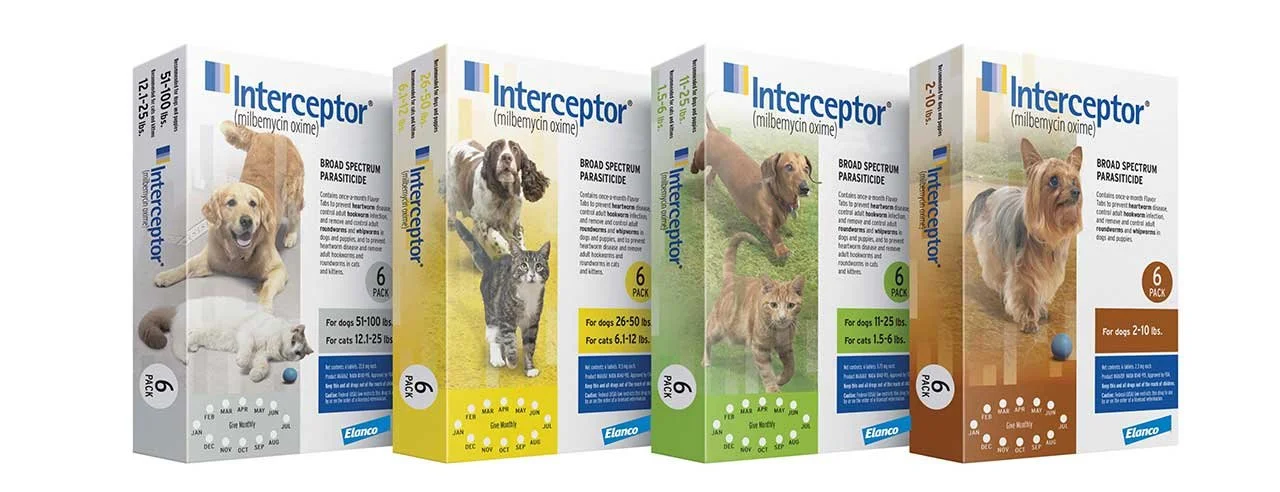
- Plain milbemycin oxime (Interceptor) is preferable as a heartworm preventive for certain groups of dogs, like sighthounds, smaller white breed dogs and those prone to seizures. (My bold font)

For my Wolfhounds, I now use Interceptor as my preferred brand of heartworm preventative and I administer it every 45 days throughout May to December.
Autoimmune Diseases and Heartworm Preventatives
As of late, we have been learning of Irish Wolfhounds afflicted with autoimmune diseases. For those who are unfamiliar, do not feel left out as up until the past two decades autoimmune maladies were somewhat exotic. Not any longer. We now hear of alarming incidences of dogs with an autoimmune disease, particularly in Irish Wolfhounds throughout the country. What does this have to do with heartworm preventative?
As of late, we have been learning of Irish Wolfhounds afflicted with autoimmune diseases. For those who are unfamiliar, do not feel left out as up until the past two decades autoimmune maladies were somewhat exotic. Not any longer. We now hear of alarming incidences of dogs with an autoimmune disease, particularly in Irish Wolfhounds throughout the country.
Autoimmune diseases are caused by the immune system attacking itself triggered either accidentally or by infection or another illness. Quoting Ernest Ward, DVM at VCAhospitals.com, "Autoimmune disease can affect a single system or multiple body systems. Autoimmune diseases can affect skin, connective tissues, nerves, muscles, the endocrine system (the system that controls hormones and other chemicals), red blood cells, and the digestive system."
Usually, the most recognized symptom of an autoimmune disease is skin problems, and they can be very complicated. A few examples that Dr. Ward discusses are:
Bullous Pemphigoid
Systemic lupus erythematosus
Discoid Lupus Erythematosus (DLE)
Pemphigus complex of which Pemphigus itself is a group of five autoimmune skin separate diseases. The Reader can do further research at VCAhospitals.com.
However, there seems to be no limit to the damage autoimmune diseases can inflict. According to Dr. Jean Dodds, DVM, who has written extensively on these subjects throughout the decades, autoimmune diseases affect the thyroid, blood, eyes, skin, muscles, joints and specific organs.
Most prominently, besides skin diseases, is the digestive system. It is one of the most commonly affected organs in which Irritable Bowel Disease, and Leaky Gut Syndrome or Intestinal Permeability occurs. See my Nutrition and Health Concerns pages about Leaky Gut Syndrome.
What does all this have to do with heartworm preventative? If your hound is suspected or diagnosed with an autoimmune disorder, then they should not be vaccinated! However, just as important is the type of heartworm preventative that can or cannot be used. Even more, the kind of Heartworm Preventative will vary depending on what breed of dog you have as well!
As Dr. Jean Dodds explains in her article, "Dr. Dodds’ Take on and General Recommendations for Heartworm Preventives"
"Some individual animals affected with autoimmune diseases and their immediate relatives have been shown to react adversely to commercial, monthly heartworm preventives. When an individual’s immune system is compromised, any regular exposure to particular kinds of drugs, chemicals or toxins can produce significant adverse effects, whereas these exposures are well-tolerated by animals by animals with healthy immune systems that do not carry the genetic susceptibility to these disorders. It is important to emphasize that the licensed drug or chemical is safe unless used in a genetically or physiologically susceptible companion animal. These adverse reactions usually occur within the first 10-14 days after the monthly product has been administered and typically begin after an animal has had 2-5 doses. Occasionally, animals that have been taking monthly preventives for a relatively long time will develop subsequent product intolerance. This usually indicates that some underlying disease process has emerged to explain the problem. Based on cumulative data, it is my recommendation that dogs affected with autoimmune diseases and their immediate relatives receive only plain daily heartworm preventive (Dimmitrol = diethylcarbamazine). If heartworm disease is not prevalent where the animals live, routine use of heartworm preventives is not recommended. This is especially important for dogs suffering from chronic diseases of the skin, hair and coat, or those with bone marrow, thyroid or liver disease."
It is vital that an autoimmune disease be diagnosed as quickly as possible as the severity of the symptoms can be severe and complex, meaning they can consist of multiple parts which will always complicate matters. Keep your spirits up; although autoimmune diseases cannot be cured unless they are caused by environmental factors that can be diminished or eliminated, most times, with a concerted effort, these diseases can be controlled.