EMERGENCY TAKE -- LIFE SAVING MEASURES
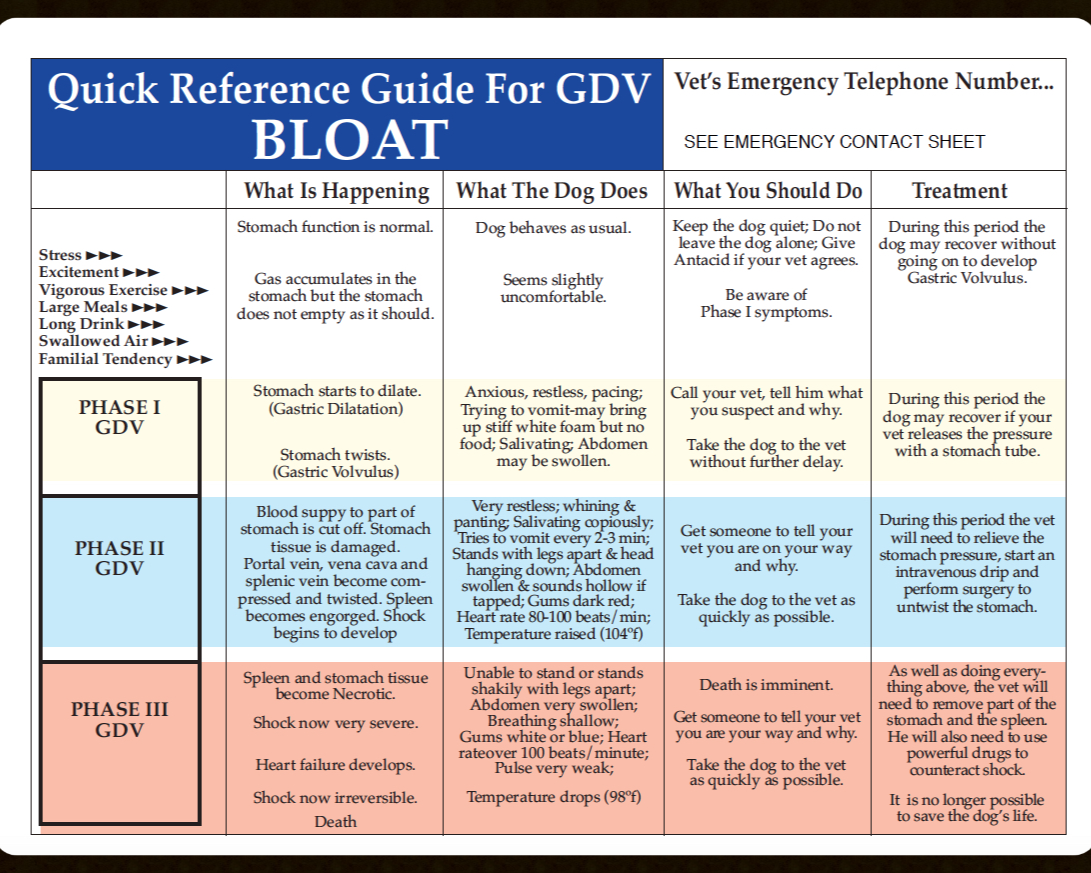
GDV is a condition where the dog's stomach dilates and twists into abnormal positions. This disease affects nearly all giants, such as Irish Wolfhounds, Great Danes, Giant Schnauzers, but also large breeds, for example, Bernese Mountain Dogs, Greyhounds, Standard Poodles, and Doberman Pinchers, etc. It is a life-threatening medical emergency that can kill a dog within several hours and is excruciatingly painful. Prognosis — at least 30% will die from this horrific event if it is not caught in the early phase(s) of progression. In recent years, however, this percentage appears to be understated, as I know of many Irish Wolfhounds who have died from the illness.
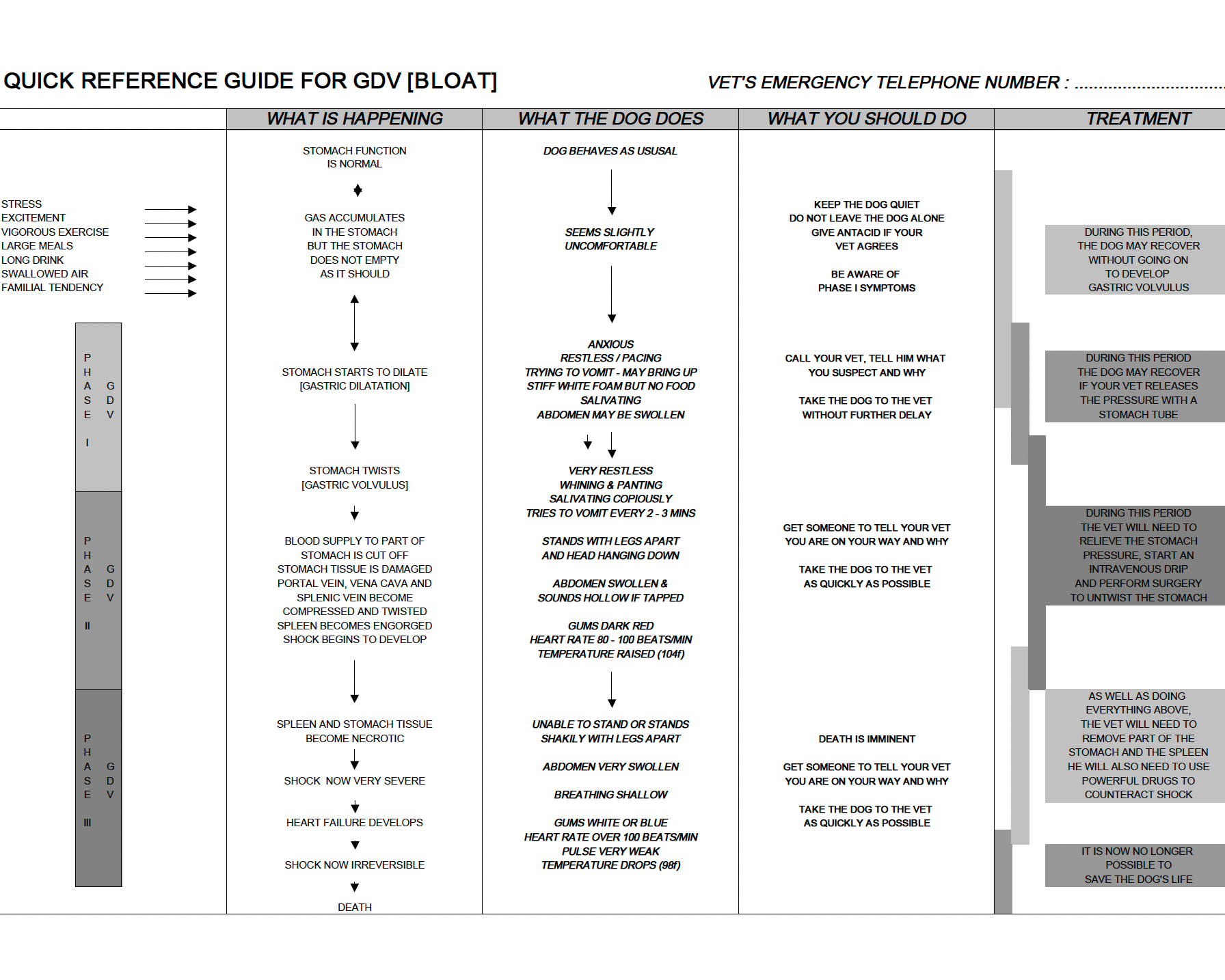
I found this Bernese Mountain Dog Bloat Chart some time ago, and it is important that every giant and large breed dog owner post this in a conspicuous area for quick reference! My Dog Caretaker must review, and it is strongly recommended that any pet sitter be instructed in this disease and emergency plans while you are traveling away from home.
If you review my Nutrition page found on "Facts & Info", I summarily discuss my position on this dreaded, frightening, life and death emergency and my steps to preventing it. I believe wholeheartedly that nutrition, pH Balance, and stress are contributing factors. Notably, in rare cases, unusual abdominal cancers are linked or highly suspected of causing GDV. Importantly, torsion can involve the spleen as well as the stomach or, in other cases, just the spleen.
My approach to combat this torturous and often deadly health emergency is prevention. Heeding the adage, particularly in Irish Wolfhounds, "an ounce of prevention is worth a pound of cure," is imperative. Moreover, it may indeed determine life or death. Here are a few of my policies.
Natural Rearing
Over the 40-plus years I have been immersed in Irish Wolfhounds, of those I have fed a natural diet with fresh food -- no commercial dog food for 30 years. Please navigate to my Nutrition web page to review my Natural Rearing program, where I provide feeding advice and have made my feeding videos available. I feed twice daily, NOT once daily. This applies to yearlings, adults well into their prime, and our Veterans, as well as to puppies who are fed up to 6 times per day. The purpose is to minimize the amount of food the hound ingests at every meal, reducing the possibility of overburdening and taxing their stomach.
I firmly believe that a combination of factors, quality nutrition, pH balance, and stress are related to GDV. Often, the lack of one, several, or all of these determinants can result in Bloat.
pH balance is essential to a healthy gut and is achieved through quality human-grade foodstuffs, digestive enzymes, and probiotics. More importantly, probiotics, which are specific to canines, such as Jarrow Formula’s Pet Dophilus Powder, contain Enterococcus faecium, a strain that is native to dogs and which some nutrition experts consider essential to canine health. If a Wolfhound owner does not feed natural diets, I will implore them, at the very least, to supplement with this probiotic and digestive enzymes. Enzymes are killed in the heating process of commercial dog food, if any existed in the first place, and, therefore, need to be added back into commercial food after processing, examples are Prozyme and NZymes. I also strongly suggest that systemic oral enzymes, such as Wobenzym or FlavenZym, be given to the commercially fed wolfhound, especially veteran age dogs. Here at Ballyhara, all our Irish Wolfhounds, as well as our Australian Terriers, are fed Probiotics in their food, as well as Systemic Enzymes, which are believed to have a significant impact on internal inflammation, as well as joint protection. Think about it; almost all of the diseases, such as cancer and arthritis, inflict harm through inflammation. Despite that, I Naturally Rear all my dogs, I provide systemic enzymes to them as well as myself, as Wobenzyme is a human-grade product.
We feed our Irish Wolfhounds on elevated feeding stands, which I have provided a photo of above. Our feeding stands are custom-built to my specifications out of solid hardwood, and most importantly, to fit our 5-quart stainless steel bowls. The measurements are 17 inches high, 29 inches long (left to right), and 15 inches wide or deep. Our bowls are 11 inches in diameter and a minimum of 4 inches deep. I feel that feeding a wolfhound on the ground is like watching a giraffe eat from the ground. Both have to spread their front legs wide apart to reach their food, creating a very uncomfortable stance.
If you are unable to have a custom stand built, then another good option, but not ideal, is Weather Tech, as it is only 14 inches high.
Avoid Stress as it can and will kill an Irish Wolfhound
Stress is a major factor in GDV. Highly stressed Wolfhounds are at high risk for bloat. We minimize stress as much as possible, especially before and after feeding times. DO NOT feed an overly excited or hot wolfhound! Hounds need to rest for half an hour before eating a large meal, preferably in a quiet setting, and they need to rest for approximately an hour after eating. Travel can be a trigger for Bloat as well; be aware. One of the times that I had an IW bloat was returning home from an annual Cardiac appointment with two Veteran IWs. I was nearly in a terrible car accident, and it was very sudden and stressful. We came out of it unscathed but very shaken. When I finally arrived home, I saw that the 8-year-old female was very stressed and upset, completely unlike her. She then began to torsion, and I was able to save her with emergency surgery.