
DOG BLOG
Musings
Candid Photographs
Some candid photos from recent Specialties on just a few Ballyhara Hounds.


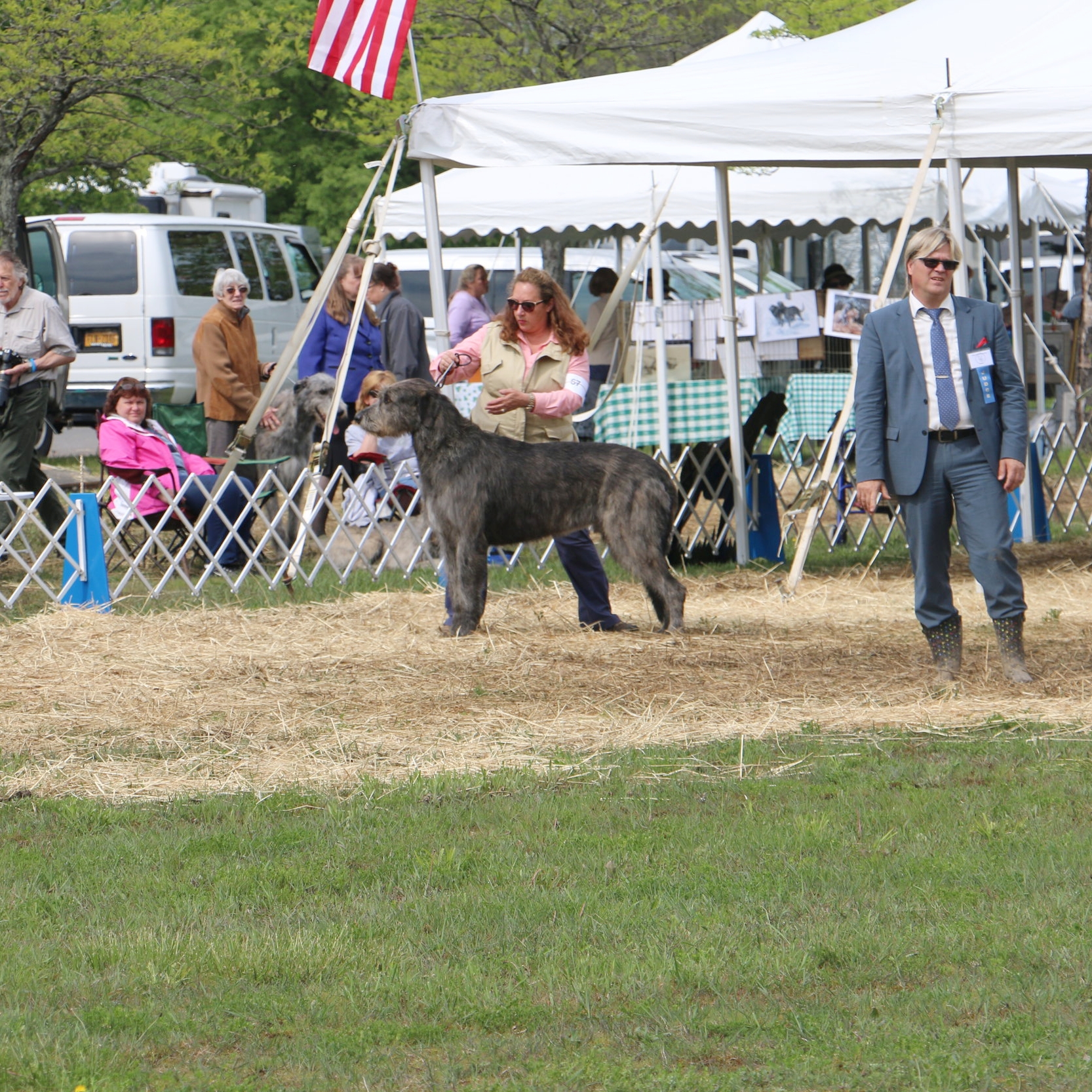


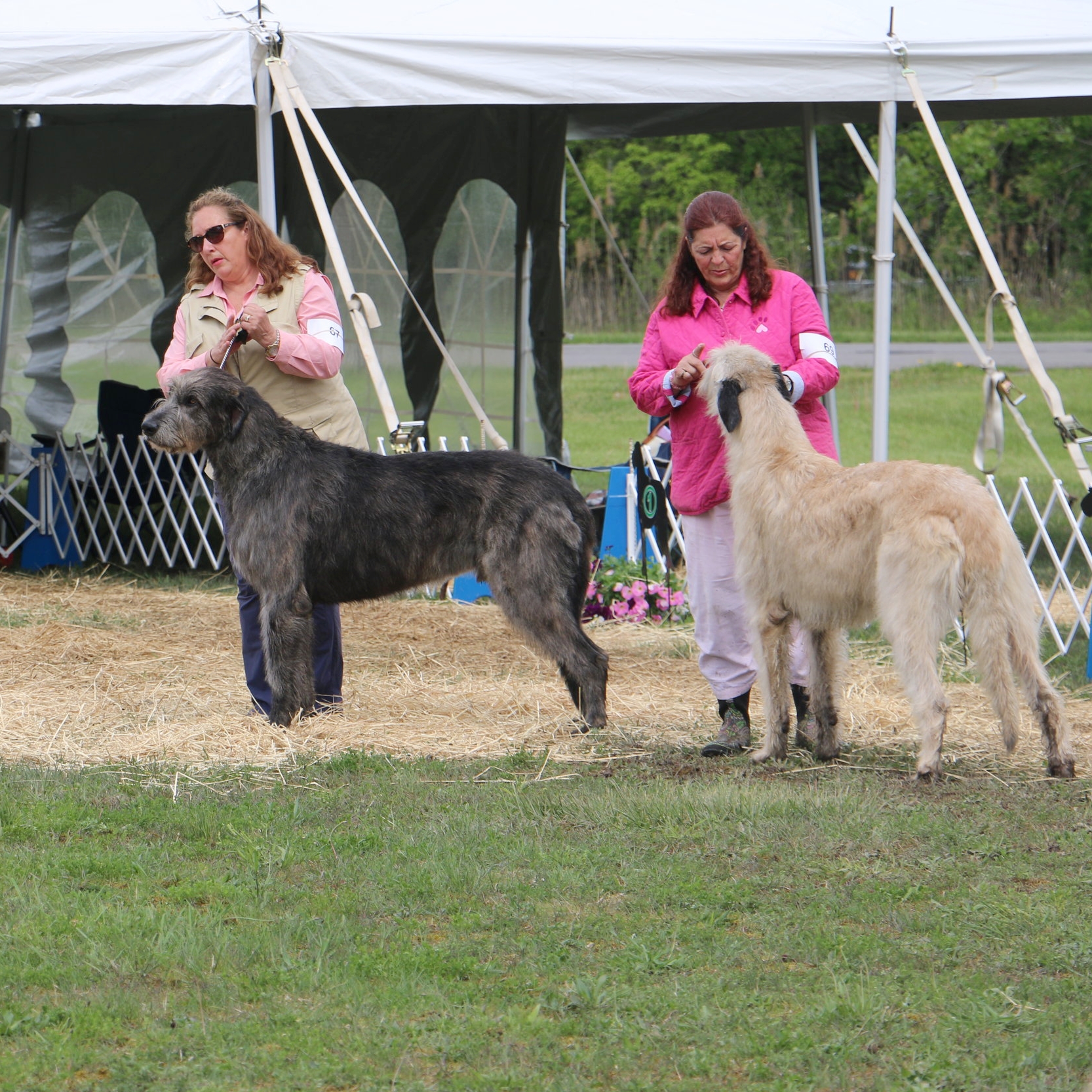


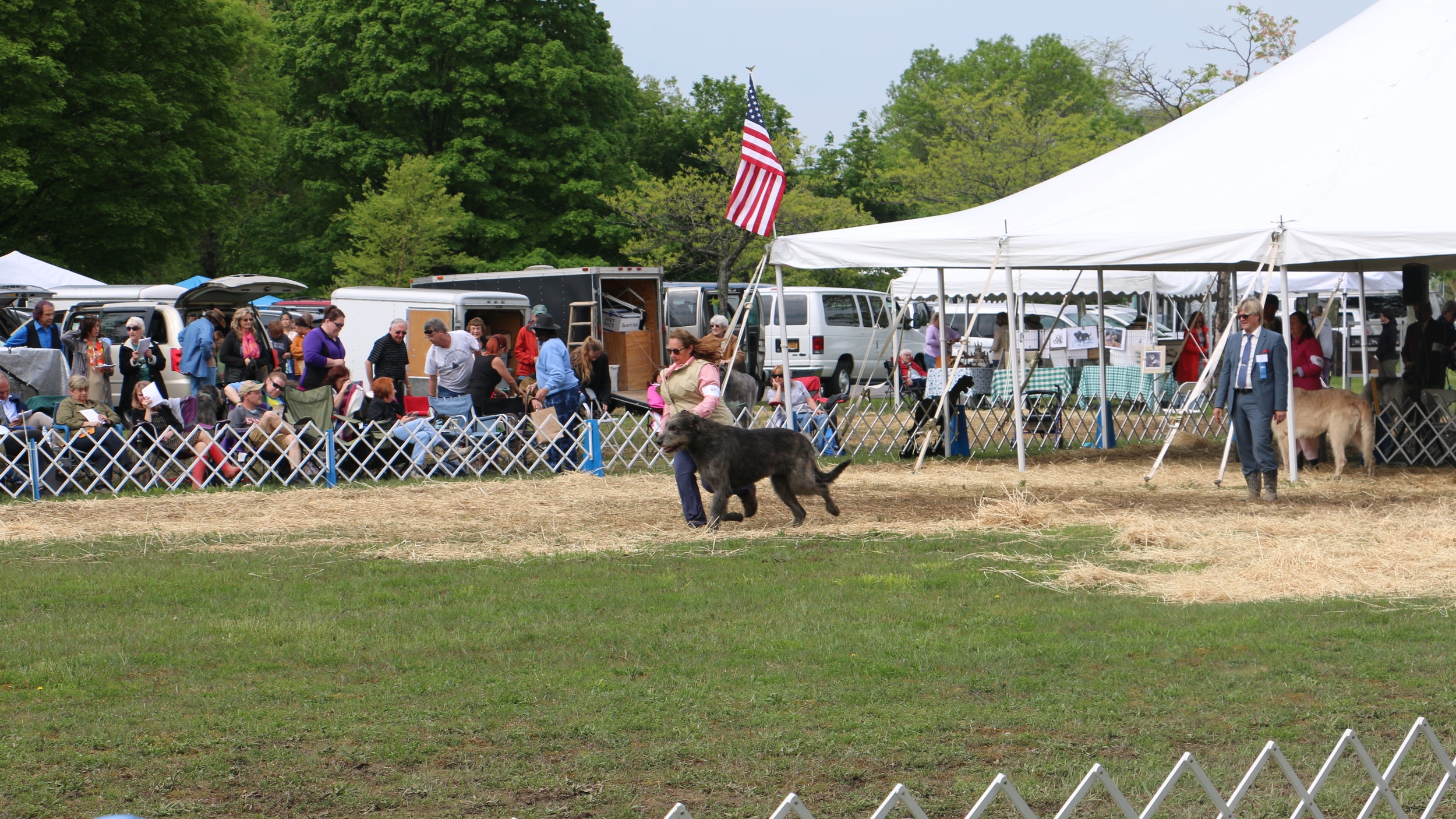


Several of these photographs at the end were taken by Lauren Swick. Our appreciation to Laura for sharing these as I had a knee injury and my husband Bobby had to gait the hounds so we could not take photos ourselves.
Canine Spinal Injury Update
In my earlier post from June 24, 2016, I described the injury my 8-year veteran male wolfhound sustained while roughhousing with his littermate. In my efforts to provide what may be valuable feedback on our experience, I will continue to update the therapy, instead of surgery, that our male, Danny, has and will be undertaking.
He had his first chiropractic consultation and treatment last week. He is a patient at The North Country Veterinary Referral Center located in Glens Falls, New York. Some may ask what is certified veterinary chiropractic care? The chiropractor is certified with either the American Veterinary Medical Association (AVMA) or the International Veterinary Chiropractic Association (IVCA). Both institutions are nearly interchangeable regarding their requirements for certification. More information about these programs is found on their appropriate links. It is important to find the services of a certified practitioner, and for giant breed owners, especially a doctor who works on horses. It goes without saying that doctor's who have worked with equines in chiropractic care state early in their diagnosis and examination of an Irish Wolfhound, "Well, it is like working on a horse." Those were the first words my veterinarian chiropractor stated as she pulled, massaged and worked my 183-pound male wolfhound, who by the way, has lost at least 5 pounds since his injury due to muscle loss.
It is important to note that the geographical location in the mountain resort in which we live dictates the ease of which I can access Certified Chiropractic care for my wolfhound. The care is available but at some distance being nearly one hour and forty minutes each way, albeit closer though than my other Board Certified Specialists who are 2 hours distant. As such, I cannot commit to two weekly sessions per week but only one. Danny's first session involved a thorough gait analysis and treatment in which the chiropractor manipulated his cervical muscles which were inflamed and a lengthening process of his spinal column. Due to the ataxia (incoordination) in his hindquarters as a result of the injury, she strongly recommends hydrotherapy in the form of rehabilitation of the muscles on an underwater treadmill. This physical rehabilitation center is located at the same facility, and she suggests two sessions per week, however, one visit each week for 6-12 weeks could be beneficial. I have agreed to this arrangement and will combine both the chiropractic therapy session and the underwater treadmill rehab on the same day with back-to-back appointments.
After Danny's first chiropractic session I noticed a moderate improvement in his forequarters and movement of his neck. His rear remains weak and uncoordinated but, we can hope that in time during his hydrotherapy, this too may improve. On a side note: he is not incontinent. Importantly, we have decided to try chiropractic care first along with the hydrotherapy before adding the methylprednisone (a potent anti-inflammatory steroid) protocol. Time will tell if this will work but for those who may find themselves in similar positions, my updates and reports should be beneficial.
Some may be wondering what the costs are related to these therapeutic treatments, apparently not inexpensive but at this point, a fraction of the costs associated with surgery and hospitalization. The chiropractic care for the initial appointment was $215 with subsequent weekly treatments at $115 each for a minimum of 4 weeks. The physical rehab package of 12 visits is $750.00.
The next or second therapy appointment is in two days, so I will post an update then.
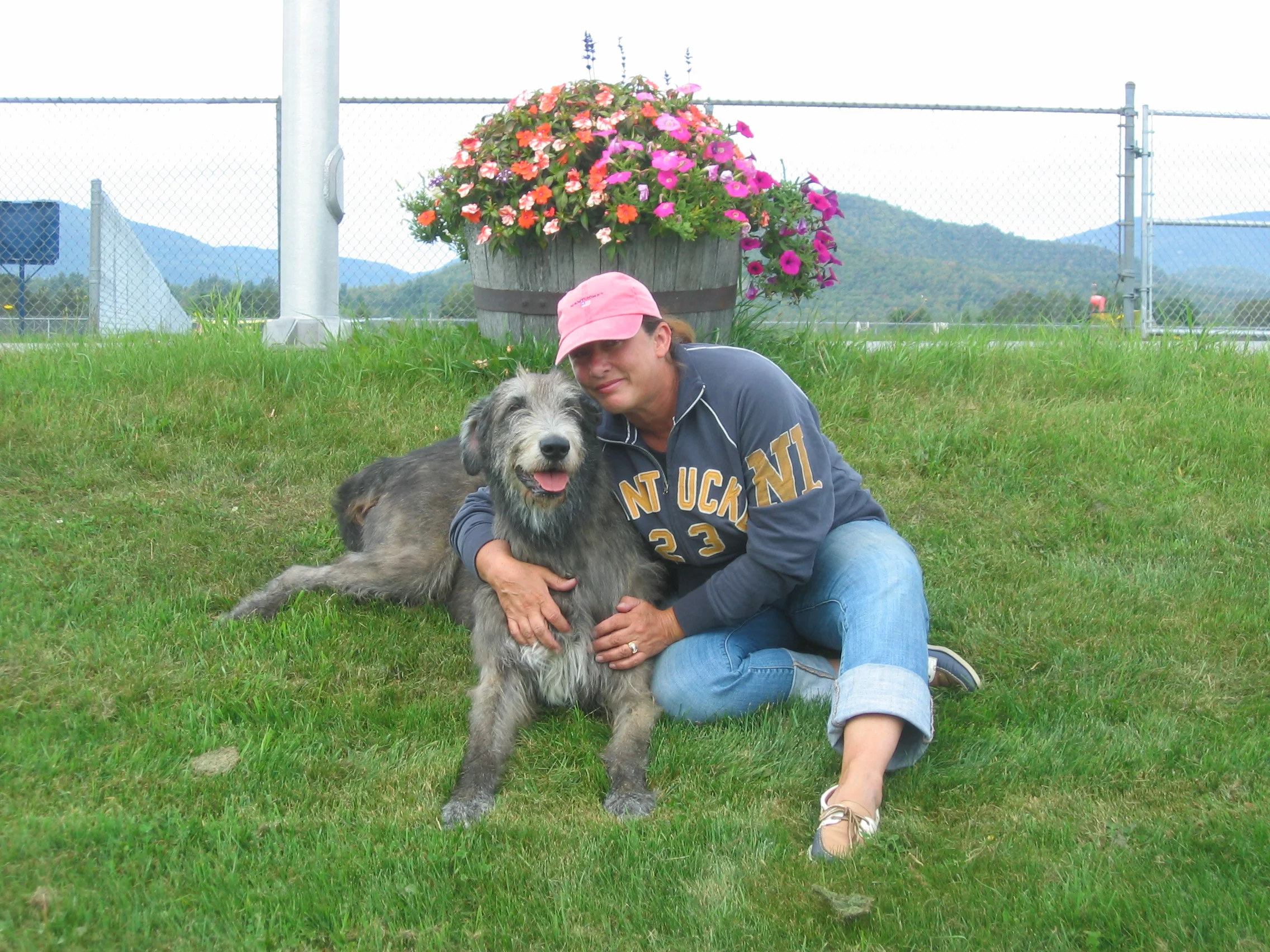
Ch. Ballyhara Danny, 3 years
Re-posting my blog post "Happy Holidays & Westminster Musings"
For me, it is disappointing that another year has rolled past without what I feel are necessary changes to the membership roles of the Westminster Kennel Club.
If you are unaware, this venerable club is Men Only -- NO WOMEN ALLOWED AS MEMBERS.
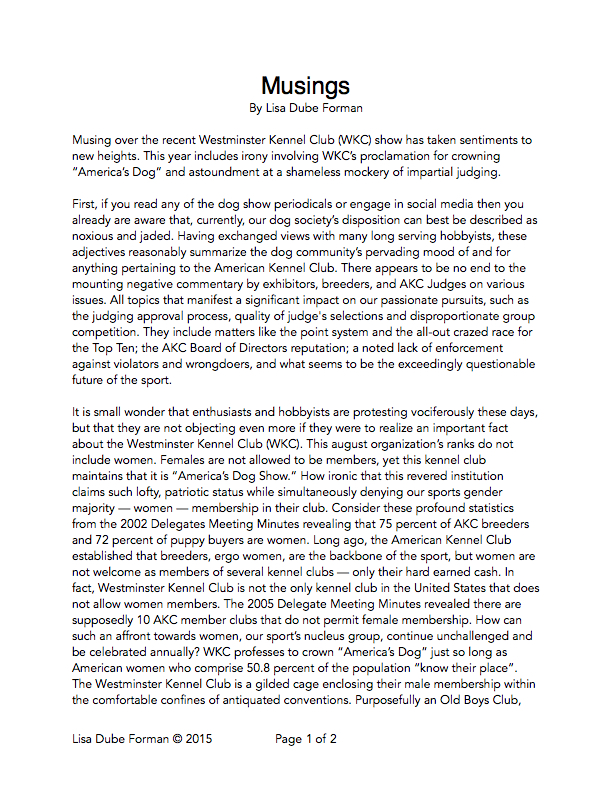
As I was performing chores this morning my thoughts turned to the upcoming Westminster Kennel Club dog show on February 15-16, 2016. For me, it is disappointing that another year has rolled past without what I feel are necessary changes to the membership roles of the Westminster Kennel Club. If you are unaware, this venerable club is Men Only -- NO WOMEN ALLOWED AS MEMBERS. Yes, you read that correctly. This dog club is not the only holdover in the United States, but certainly is one of the most prestigious. Here is an excerpt from my article I penned in March 2015, titled "Musings".
This august organization’s ranks do not include women. Females are not allowed to be members, yet this kennel club maintains that it is “America’s Dog Show.” How ironic that this revered institution claims such lofty, patriotic status while simultaneously denying our sports gender majority — women — membership in their club. Consider these profound statistics from the 2002 Delegates Meeting Minutes revealing that 75 percent of AKC breeders and 72 percent of puppy buyers are women. Long ago, the American Kennel Club established that breeders, ergo women, are the backbone of the sport, but women are not welcome as members of several kennel clubs — only their hard earned cash...
That the majority of AKC dog show participants are of the female gender and are, still, taking a backseat role in the governance of this sport in the year 2016 should be alarming. That in the year of 2016, while humanity is pursuing deep space exploration and a colonization of Mars in the advent of a successful, historic landing of reusable rockets back on Earth, the Westminster Kennel Club still clings to its antediluvian traditions of banning women from membership.
How can such an affront towards women, our sport’s nucleus group, continue unchallenged and be celebrated annually? WKC professes to crown “America’s Dog” just so long as women who comprise 50.8 percent of the American population “know their place”. The Westminster Kennel Club is a gilded cage enclosing their male membership within the comfortable confines of antiquated conventions. Purposefully an Old Boys Club, they celebrate and preserve their gender bias practices. Insofar as women, well, women are only necessary and welcome when the club needs exhibitor participation.
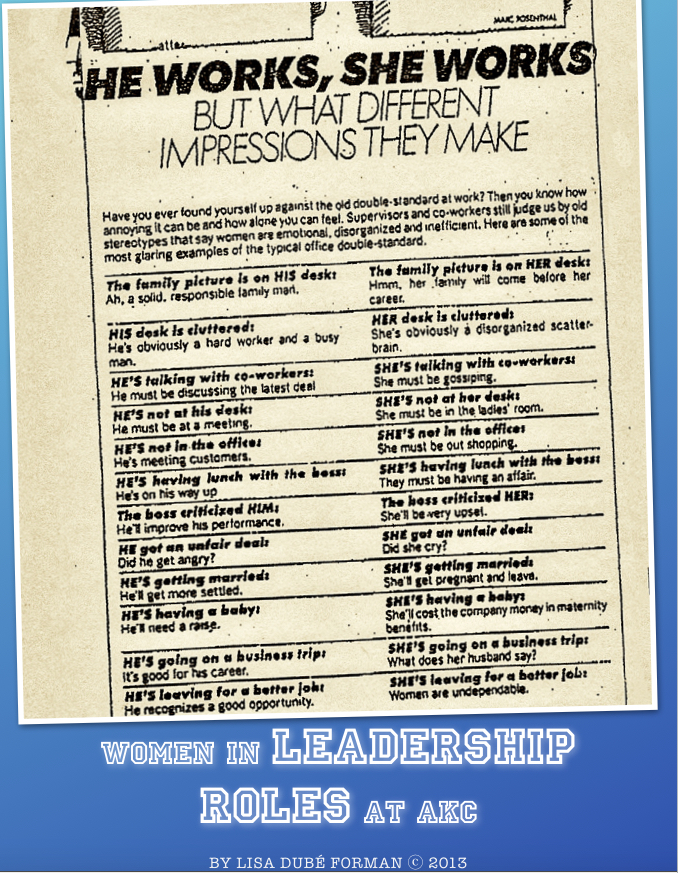
While we celebrate the holidays and give thanks for all that we have in our lives -- ponder on this contradiction and dismissal of women's equality and our rights. Consider that if women took a stand against such blatant gender discrimination, we can make an enormous difference. We did so with the women's suffrage movement resulting in the 19th Amendment to the US Constitution ratification in 1920 guaranteeing all American women the right to vote. In the sport of purebred dogs, it is unjust that women have been continuously denied administerial duties of the American Kennel Club Board of Directors. An excerpt from my investigative article "Women in Leadership Roles at the AKC" follows:
Let us consider first the little known historic, consequential and stunning fact that AKC did not admit women to serve in the Delegate body until the 1970s. On March 12, 1974, a motion to allow women to serve as delegates was seconded and carried by a vote of 180 to 7.
Furthermore, that the administrative part of the AKC has just one female President over its entire lifespan since its formation in 1884, and to date, there has never been a female Chairwoman of the Board of Directors is simply a travesty of equality.
Before I sign off from this post, I also would like to remind people of what had transpired during the 2015 WKC dog show. Another excerpt from my "Musings" article.
Yet, unfairness or bias was not limited to the organization’s constituency roll. A particular incident took place during breed judging that reinforces the dog show community’s prevailing, cynical state of mind. No wonder fanciers are disgusted, throwing their hands up in exasperation. Actions that did not merely give an impression of but created a dense cloud of impropriety.
The ethical transgression transpired when a Judge presided over a Best of Breed assignment which included a dog this judge very recently used at stud. The litter sired by this entry reportedly was whelped already. Destroying any sense of impartiality, the judge proceeded to award this stud dog Best of Breed over the competition and also awarded Select Dog to yet another dog they previously used at stud as well! The basis of sportsmanlike competition is to adjudicate with neutrality, imputing ethics, honesty, and common sense. Instead, this incident exposes a lack of common decency and an illiteracy for the Rules, Policies and Guidelines for dog show judges.
This is an unambiguous example of Conflict of Interest. AKC dog show judges are responsible for situations such as this that require the judge to excuse an exhibitor for causes even known only to them and they were obligated to recognize that a conflict of interest existed. As for the exhibitor(s) who intentionally exhibited their stud dog under this particular judge? The responsibility for entering dogs that are ineligible or create a conflict of interest lies with the exhibitors, so says the AKC Rules & Policies Handbook for Conformation Judges. In fact, the Handbook states that awards won may be canceled, and exhibitors with repeat violations may receive reprimands or fines. Further exacerbating the situation, this competition was video streamed live throughout the world! A great many breed fanciers watched in disgust as the judging unraveled. It most likely has not nor perhaps ever will dawn on the judge that they would have gained a great deal of respect, if, in fact, they had exercised their right and performed their duty by excusing the violating exhibitors from the show ring. However, it is too late as now their repute is justifiably and seriously challenged.
As for the other exhibitor(s) competing in the show ring, in my opinion, they should have filed a complaint without delay with the AKC Executive Field Representative who was visibly in attendance. Until our sport participants slip their binds of submissiveness and possess the courage of one's convictions, violator's such as these described will continue to bully, unhindered. Here are links to both of my articles discussed above.
The Eyes Have It!
Eye color. Much is made of it, but a majority of fanciers have no idea why their breed’s eye color is defined in the breed standard. Other than the cosmetics being the dark eye is considered by most as attractive, many breeders just “do as they are told.”
Eye color. Much is made of it, but a majority of fanciers have no idea why their breed’s eye color is defined in the breed standard. Other than the cosmetics being the dark eye is considered by most as attractive, many breeders just “do as they are told.”
The majority of breed standards demand dark eyes. In truth, for the greater number of our working, hunting breeds, this dark eye color is at odds with nature. There is no greater cultivator, progenitor than Mother Nature. Repeatedly throughout her creations, we find wild animals with light color eyes, predator, and prey alike. Why then do we humans selectively breed and require dark eyes for the better part of our dogs? For basic aesthetic purposes as humans selected for the more pleasant dark eye than the ‘bird of prey’ color, this being amber to yellow. Such light iris color most likely was unattractive but unsettling to our breed forebears, as it was reminiscent of a predator instead of a companion.
Some claim that dark irises permit our dogs to function more efficiently than light, yellow or amber. This is incompatible with Mother Nature. Consider the Lion, an unrivaled predator whose environment is Sub-Saharan Africa, with its savannas and grasslands. This predator’s eye color is golden or amber whose vision is comparable to a human during the daylight hours but has exceptional night-vision. Both the Cheetah and the Tiger irises are golden or yellow with the Cheetah having poor night vision and the Tiger’s approximately six times better than humans. Note that the development level of night-vision depends on the number of the photoreceptor (rod cells) the animal has and has nothing to do with the color of the iris. Further, wildlife biologists state that fur markings under these predators’ eyes aid their hunting vision, indicating whether they are nocturnal, crepuscular or daylight hunters. What of the Wolf, the only ancestor of the canine species whose eye color is typically gold, some amber or light brown and is often seen in hues of yellow, even gray? Even the Eagle, a bird of prey has a pale yellow iris. All these examples have not been disadvantaged with light eyes while performing their function in order to survive.
Ballyhara Kate, 9 months
Selective breeding and aesthetics have had a great influence on the modern breeds. The long-standing preference for dark eyes may already have had lasting repercussions. Such breeding may cause severe selective pressure -- selecting for dark eyes may carry a recessive mutant gene from the trait, along with a dominant normal gene that masked its effects. Such heterozygous dogs would be hidden carriers, unaffected by the mutation themselves but capable of passing it on to later generations. This should be especially concerning amongst breeds with limited genetic diversity.
Insofar as eye setting, frequently referred to as eye shape, incorrect settings can have injurious implications for many breeds. For example, the ideal Rhodesian Ridgeback eye is round, however never protruding as this can be damaging to the hound in his place of origin. The African Bush consists of Buffalo Thorn, Sickle Bush, and other sharp, thorny fauna which could injure and blind a dog whose eyes are bulging. The English Setter eye set specifies that the eye is neither deep set or protruding with the lids tightly fitted so as not to expose the haw. The Golden Retriever eye shape is to be medium-large with close-fitting rims as well and imparts a kind and pleasant demeanor. On the latter, slanting, narrow, triangular, squinty eyes detract from, moreover modify this expression causing the dog to appear mean. As in the Ridgeback, a prominent eye in both English Setters and Golden Retrievers can easily be injured by the brush and picker bush terrain in which these dogs hunt. Particularly at risk are exposed haws that catch debris causing eye infections or more serious, long-term damage.
Eye setting or shape is necessary for the majority of our working dogs. Regarding iris color, Mother Nature knows best, and we should recognize that tinkering with her work has consequences. We must face facts; the eyes have it.
This article was first published on the Canine Chronicle website.Short URL: http://caninechronicle.com/?p=36254
His Neck is on the Line
"His neck is on the line." This idiom is appropriate when conversing about show dogs but also specialized breeds. Yes, the neck is more than just another part of the canine skeletal structure that connects the trunk and the head. In truth, it seems to have fluctuating levels of importance depending on the breed.
"His neck is on the line." This idiom is appropriate when conversing about show dogs but also specialized breeds. Yes, the neck is more than just another part of the canine skeletal structure that connects the trunk and the head. In truth, it seems to have fluctuating levels of importance depending on the breed.
In conformation events, the neck can be a showpiece as handlers or exhibitors accentuate or occasionally overemphasize it as exceptional while presenting the dog for examination. It is a familiar sight to watch a handler jerk the dog’s collar up behind the ears while the other hand is stroking downwards on the neck to attract a judge’s eye to both the upper and underlines, subliminally boasting on its length and crest. The Cocker Spaniel or Whippet breed rings are good examples of this as the handler removes the show lead from the dog conferring great flourish on this one aspect of the anatomy. In some cases, such embellishment may be warranted because, in truth, it may be the best part of the dog!
Before I get ahead of myself, a quick anatomy lesson is appropriate. Every dog has seven neck vertebrae, no matter the breed. Attaching the neck and skull are the Axis and the Atlas vertebrae (C1) which allow for head movement. The nape is the skull and neck junction while ‘the blending’ refers to the neck and shoulder junction. Many are unfamiliar with the word 'nape' and the related term ‘crest,’ yet both factor into a number of breeds. Various breeds' fanciers prize a crest; that is a shapely neck whose upper line curves or arches over the Atlas vertebra. Two excellent breed examples are the Scottish Deerhound and the Akita. The Deerhound possesses a prominent nape adding to the beauty of his sighthound curves, and the Akita has an emphasized crest, which blends in with the base of the head, and is reasonably characteristic of the breed.
On the other hand, the neck is a lot more than a showpiece. For some hunting breeds, the neck is instrumental in performance and outcome, as well as safety. The Scottish Deerhounds neck is essential to his function, which is to hold a Stag. His neck is to be powerful and strong, not short and stumpy, but not as long as the greyhound. The greyhound, who has a long, smooth, muscular neck, uses it to stoop while dispatching hare. An Irish Wolfhound will dispatch game by breaking the back of the neck. In order to do this, he must himself have an extremely powerful, hard muscled, long neck, without which, he could become the victim. I included Figure One of an Irish Wolfhound, who illustrates a beautiful, powerful neck whose underline and upper line epitomizes ideal ‘blending.’ The form of this exemplary neck portrays strength and depth — the latter being the distance between the upper line and the underline. The neck is not overly long, weak and
spindly or stuffy, coarse and bunchy. The observer’s eye follows the flow of the neck which enhances the fine topline.
Cudama Santa of Ballyhara
The neck has central muscles coursing from the skull to the shoulder girdle, sternum and rib cage. The Splenius and Sternocephalicus muscles allow side to side motion, extension and lift of the neck. Other muscles lift and move the dog’s limbs, in particular, the Brachiocephalicus, Rhomboideus and Omotransversarius muscles. They work by stretching and contracting, allowing for circumduction of the scapula, shoulder, and upper arm. These are just a few of the vital neck mechanisms that permit the functional dog to perform and excel at his work.
There are approximately fourteen or so descriptions contemplating the varying shapes of the neck that we apply to the many breeds. A few common labels are the bull, ewe, goose, stuffy, 'reachy', and upright neck. Two others specify skin involvement, such as wet and dry necks. A wet neck’s skin is loose, showing wrinkles, throaty with excess dewlap. A dry or clean neck has tight fitting skin without wrinkles and dewlap. A few shapes, which fanciers should be very familiar with, describe either a virtue or a fault. Several are only the opposite of one another such as a reachy neck describes a neck that is of a good length, well-muscled, refined or elegant. This is radically different from a short, stuffy, bunchy, muscled neck. Fanciers tend to confuse ewe and goose neck descriptions, so an explanation is appropriate. The underline of an ewe neck has a slight convex shape (curving outwards) rather than a natural, concave appearance (curving inwards). A goose neck is elongated, round and tubular lacking depth and power. Both of these anatomically defective types have a circumference around the neck and shoulder base similar to that of the skull and neck junction.
In conclusion, breeders perceiving the neck as a mere ornamentation of the skeletal anatomy put their dogs' functional necks on the line.
This article was first published on the Canine Chronicle website,
Short URL: https://caninechronicle.com/?p=40257