
DOG BLOG
Musings
Candid Photographs
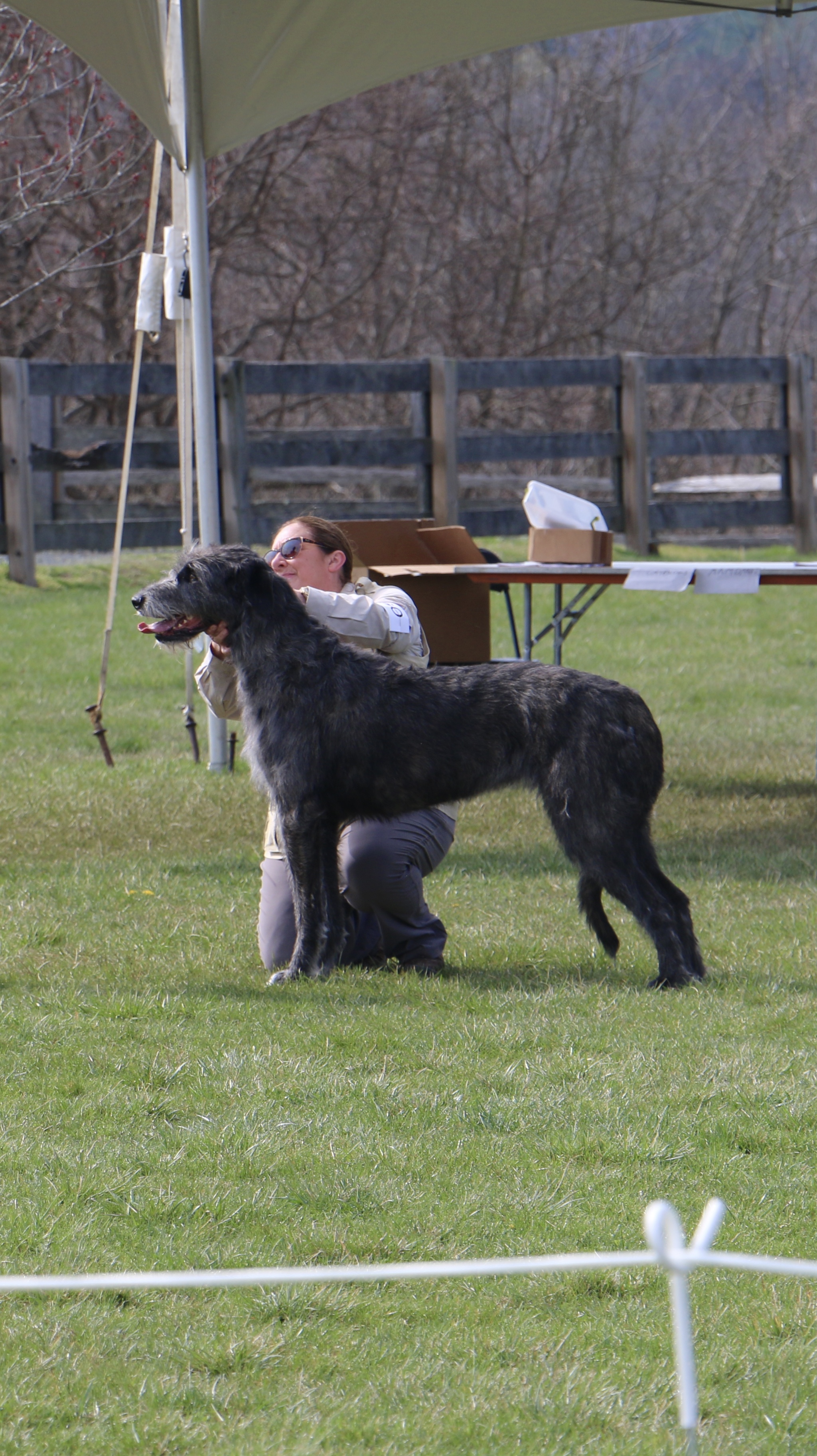
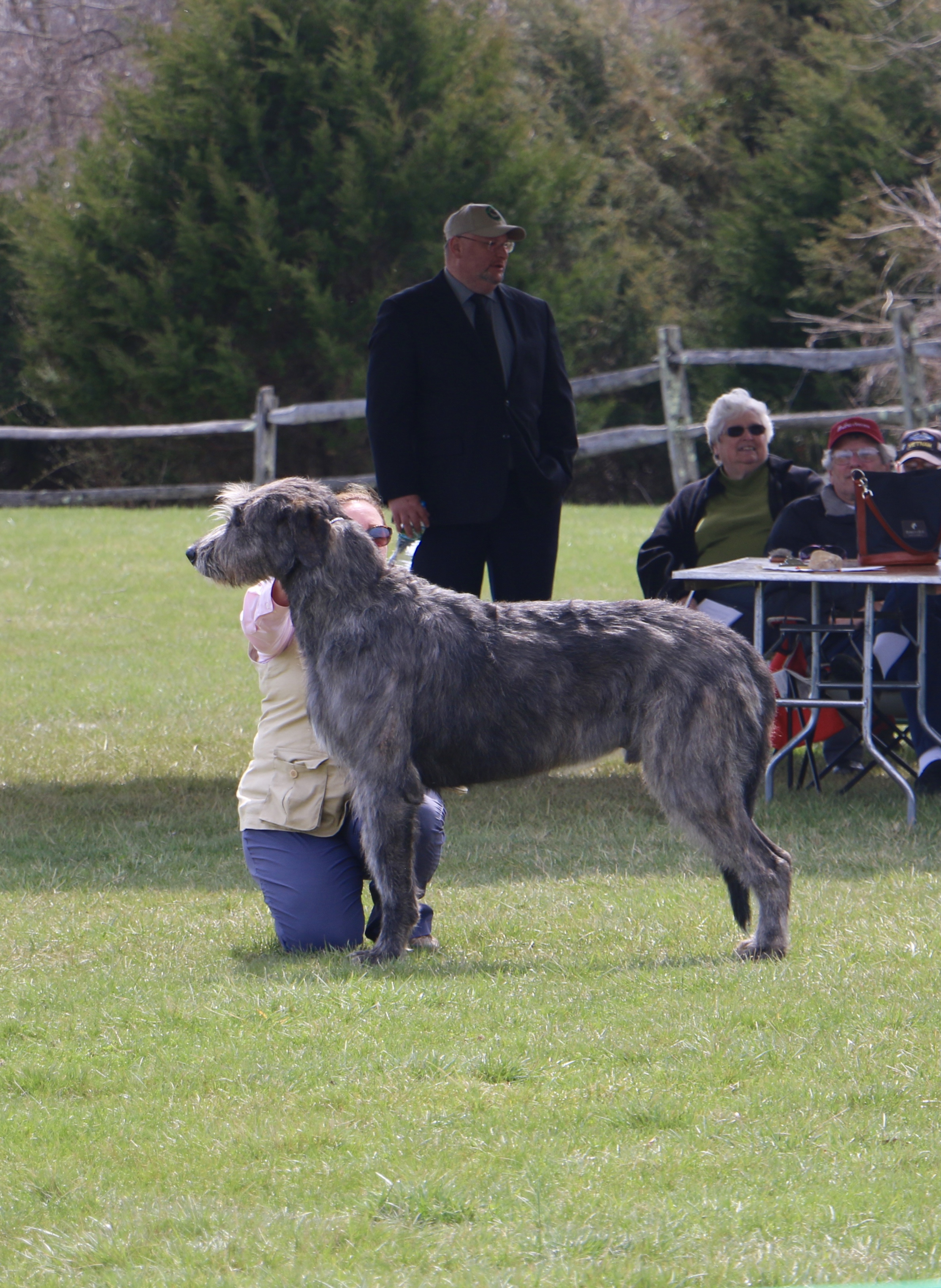
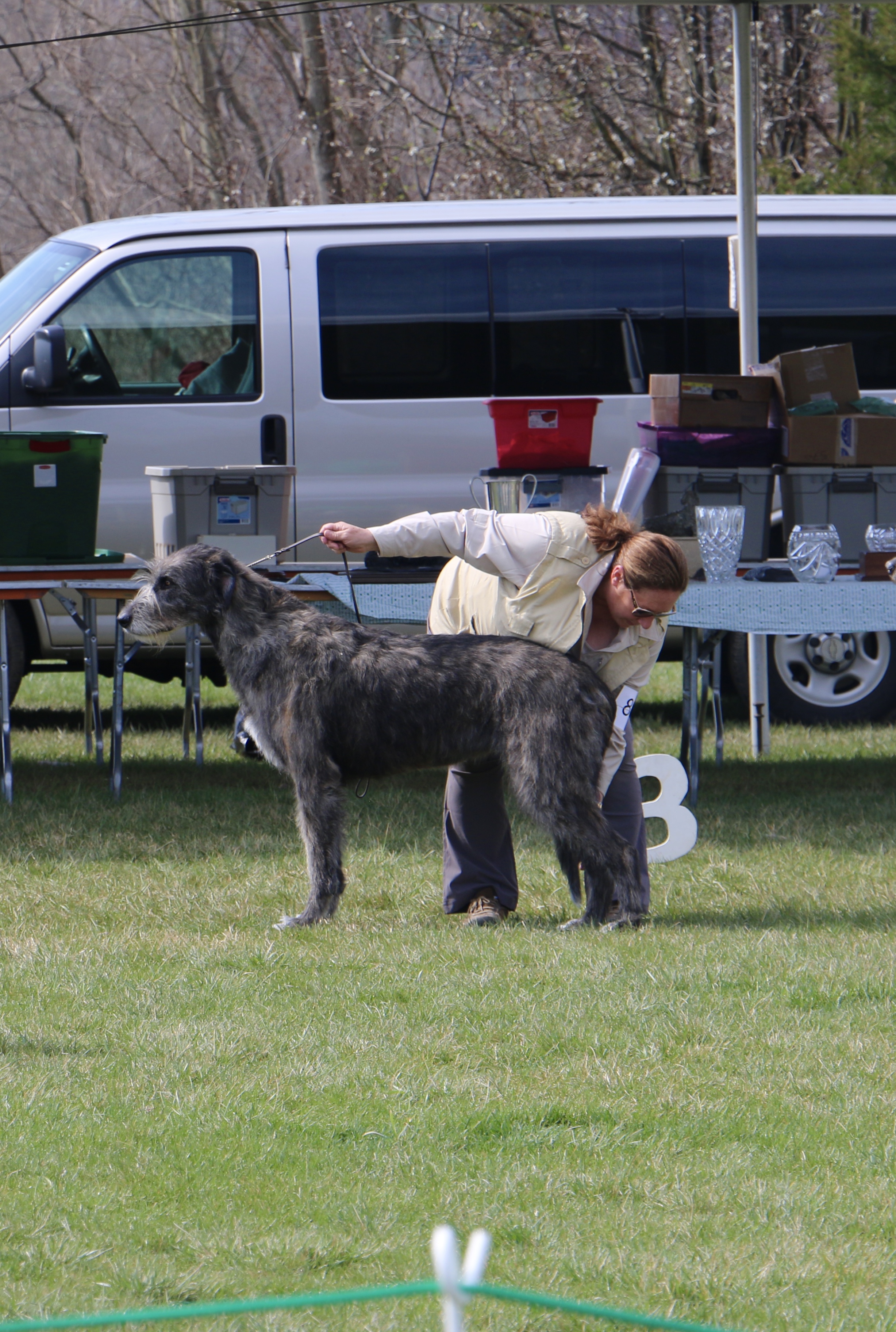
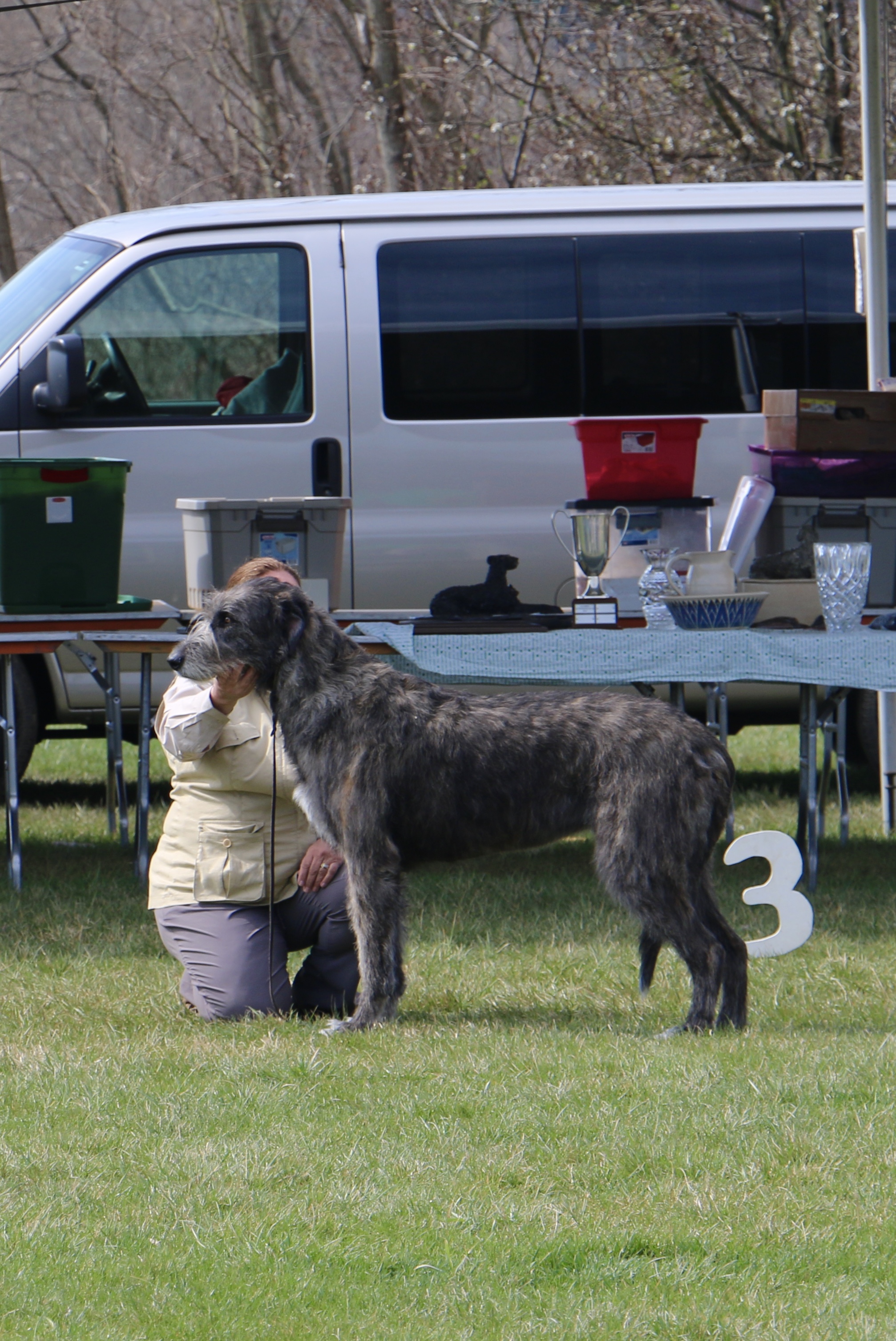
Some candid photos from recent Specialties on just a few Ballyhara Hounds.


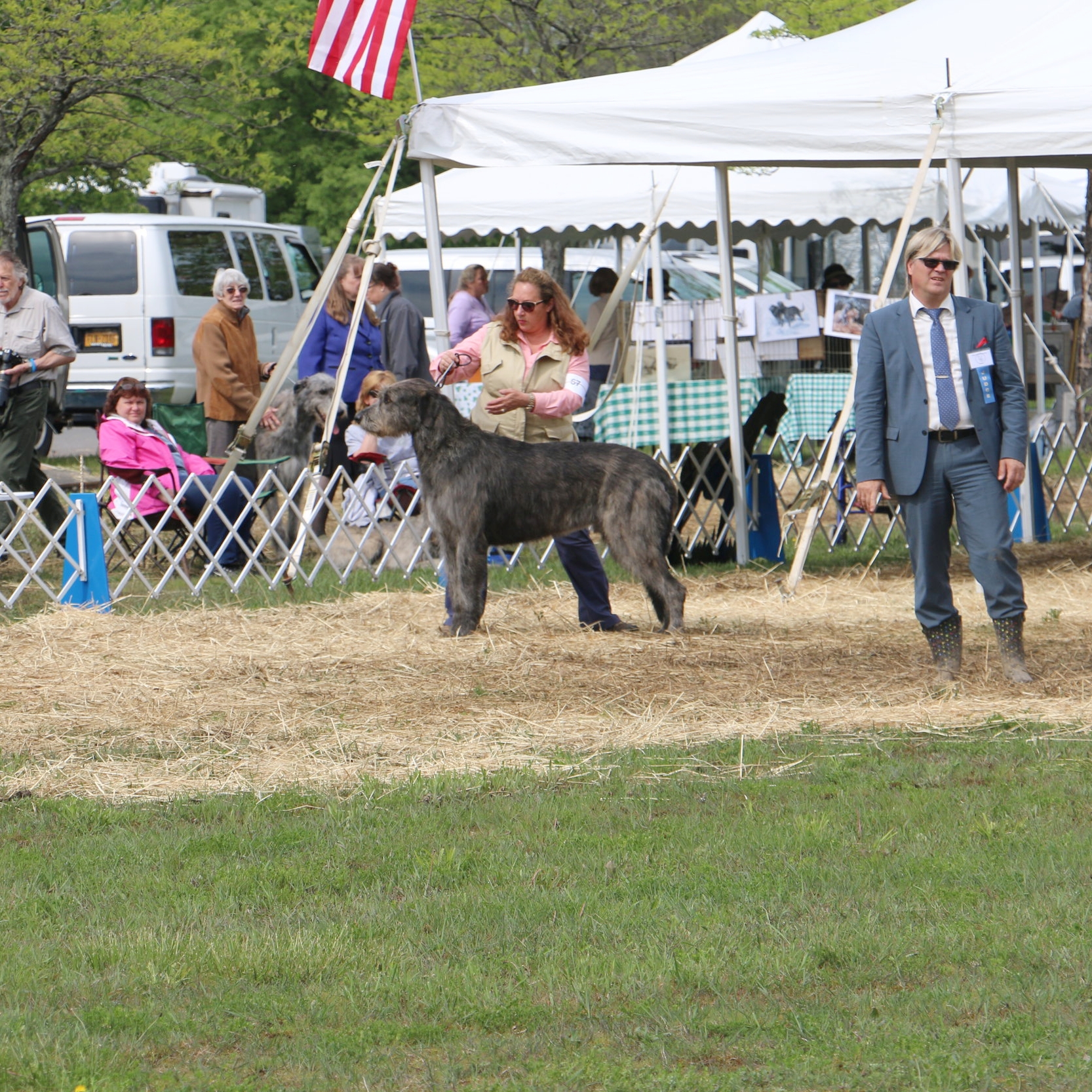


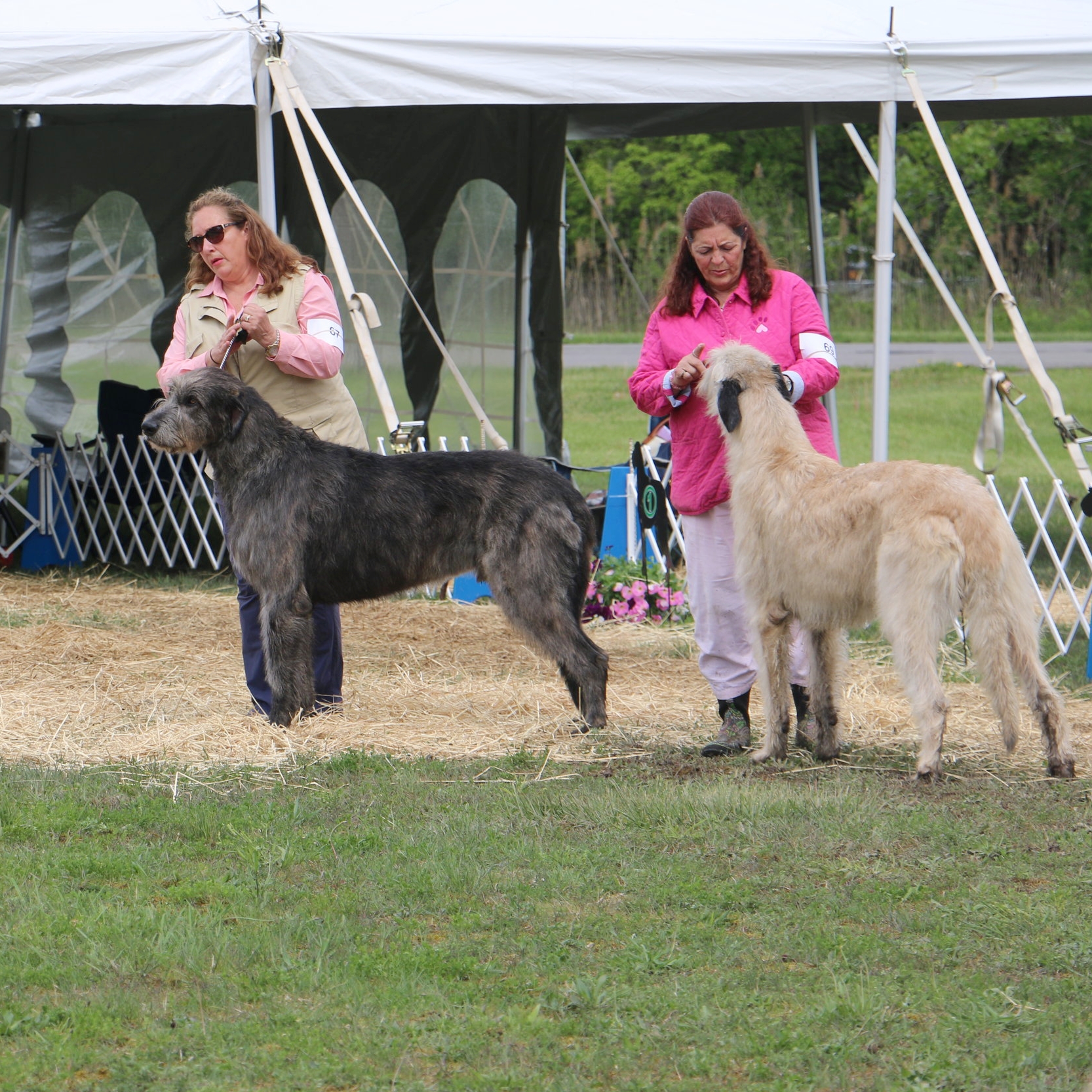


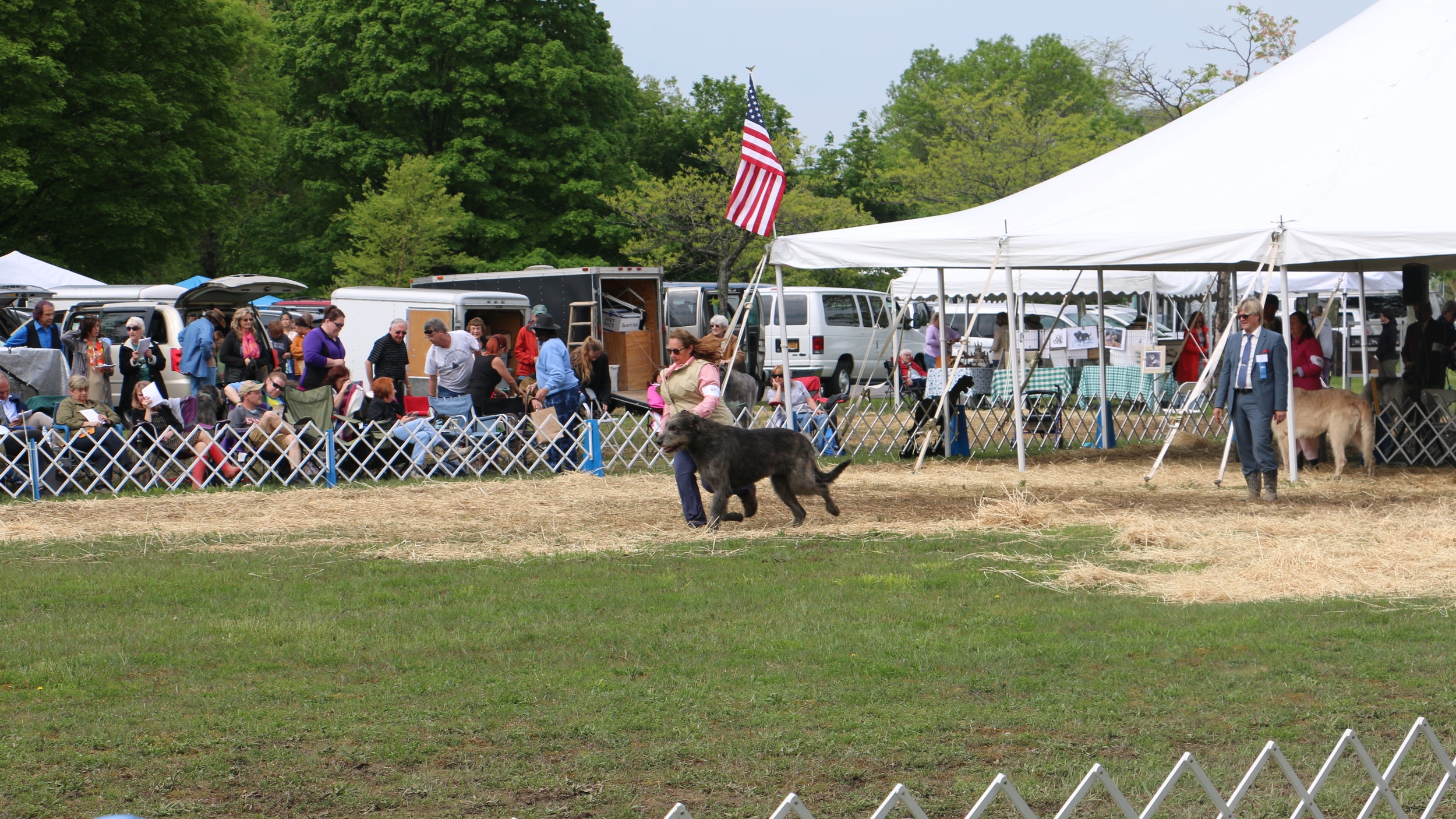


Several of these photographs at the end were taken by Lauren Swick. Our appreciation to Laura for sharing these as I had a knee injury and my husband Bobby had to gait the hounds so we could not take photos ourselves.
2017 Irish Wolfhound Quebec Regional Specialty & Underage Puppies
Saturday, June 10, 2017, was another lovely day for a Specialty in Quebec, Canada. This year, however, there was a sad sight to behold. More to the point, we were very upset as we saw a small waif of a puppy trying to walk on a lead with his owners.
Saturday, June 10, 2017, was another lovely day for the IWCC Regional Quebec Specialty in Canada. Herr Jurgen Rosner was adjudicating, and it was a pleasure seeing him again, especially since the last time I saw him was 21 years earlier when he judged the 1996 Irish Wolfhound Association of Delaware Valley Specialty! Remarkably, he has aged gracefully and has changed very little.
Ballyhara Kellyanne IWCC Quebec Regional Specilaty 2017
This Quebec Specialty is comfortable and pleasant though exhibitors experienced an issue with parking as a huge sports tournament was being held simultaneously on the military grounds. The Quebec club graciously provides a delicious homemade smorgasbord with soda, wine, and water which is so refreshing to see in this day and age. An overall, friendly atmosphere that keeps exhibitors and spectators coming back.
This year, however, there was a sad sight to behold. More to the point, we were very upset as we saw a small waif of a puppy trying to walk on a lead with his owners. Shocked, we inquired as to the age of the wolfhound pup, and were informed he was nine weeks of age! Upsetting, to say the least, and our disapproval was shared by several people sitting close-by who noticed him as well. The male pup was so small that my husband was convinced he was seven rather than nine weeks old.
Regrettably, the alarming trend of placing puppies at FAR TOO EARLY AN AGE is not new. I addressed this very concerning problem in my December 2015, "Caveat Emptor" Blog Post. It is unethical to sell or place a wolfhound puppy at the age of eight or nine weeks, especially because this is a giant sighthound who is underdeveloped — both mentally and physically -- at such an immature stage. It is paramount that Irish Wolfhound puppies are well socialized and spend quality and quantity of time with their Dam and siblings.
Mentally, the Irish Wolfhound breed is a slowly maturing hound. His overall weight and height at three months can be deceiving. You cannot compare him to other breeds at the same age. I have always informed students that this sighthound breed is unlike popular breeds such as Poodles, Golden Retrievers, Labradors or Shepherds. During growth stages, in a mental maturity comparison, for instance, a six-month-old wolfhound is comparable to a three-month-old Labrador. Even a yearling -- a phrase attributed to a wolfhound aged 12-24 months -- is still more immature than a similarly aged dog of another breed. The contrast has nothing to do with intelligence as an Irish Wolfhound is a clever breed which is always sensitive to his surroundings. Wolfhound puppies should be confident, poised, comfortable, and friendly. Traits that develop from various stimulations deriving from social interactions in the company of his littermates with the dam teaching them acceptable behavior during their twelve weeks of growth and companionship. There is no justifiable excuse for placing any puppy at less than 10-12 weeks of age, and this practice has to stop.
What has become of our wolfhound society if breeders feel justified and are emboldened to sell wolfhound puppies at 8 or 9 weeks of age? This puppy was not obtained from a commercial puppy farm in the American Midwest but from a person who was attending the Quebec specialty! For the record, my policy is that no puppy leaves before a minimum of 12 weeks and frankly, many times not until 16 weeks. Releasing underage wolfhound puppies is motivated by financial and opportunistic purposes. Commonly, this individual needs to move the pups out as quickly as possible because caring for them requires food, money, and work. Sometimes, they need to make room for a new litter, or frankly, they are too lazy and indifferent to support the young hounds adequately. Other times, many of these people are living hand to mouth and have no business raising expensive Irish Wolfhounds. What will be next -- placing them at seven weeks? Who is going to stop them then? My recommendation to these guilty people is to find another giant breed. Get out of Wolfhounds.
Reputable breed fanciers need to stop "tsk, tsking," while wringing their hands. We as a whole are obliged to speak up and express our concerns to these individuals. Many of these people are only masquerading as "breeders;" when they are only mating dogs. What do they know of genetic modes of inheritance? What do they know about anatomy and muscling physiology? What do they know of the breed founders and the Coefficient of Relationship of ancestry? What do they know of genetic diversity?
It is our obligation to explain their wrongdoings and the harm to both the puppy and the breed, especially if they are members of our breed associations. Our actions are not meddlesome -- we are NOT interfering in someone else's affair. On the contrary, it is our duty to moralize, as honorable, caring, responsible breed guardians. Placing underage puppies is NOT someone else's personal business -- it most certainly is not their prerogative to do so because it is harmful to the breed. These animals cannot speak for themselves, and as such, we are their custodians.
Bear in mind; amoral people prosper because their actions are unfettered. Your silence condones their behavior.
They know not of the commitment, the shared obligation we have as conservators for what was once a highly revered ancient sighthound. Their imprudent deeds are an offense, and we all need to unify against this growing malignancy. Ask yourself is this the standard of behavior that we foresee embodying the principles of our breed society?
Nostaglia for the Good Old Days
We often hear people say how different life or events were in yesteryear. Often we reflect on things or people that we miss, our nostalgic memories vivid as if it were just yesterday. I frequently find myself doing so as I reminisce about how our breed society once was and the stark contrast to what it is today. The consequences of such disparities are substantial being that today we now have the lowest standards of acceptability and accountability within our organization and society. The 2017 IWCA National Specialty recently provided several instances that aroused my sentimentalism........
We often hear people say how different life or events were in yesteryear. Often we reflect on things or people that we miss, our nostalgic memories vivid as if it were just yesterday. I frequently find myself doing so as I reminisce about how our breed society once was and the stark contrast to what it is today. The consequences of such disparities are substantial being that today we now have the lowest standards of acceptability and accountability within our organization and society. The 2017 IWCA National Specialty recently provided several instances that aroused my sentimentalism.
My husband and I very much looked forward to the National held in Geneva, New York. Despite my having attended many, many Nationals over these 33 years, I have only been able to attend, due to their location, just five in recent times. However, this relative absence provided a unique perspective on the changes that have occurred within the Club, in the hounds, as well as the personal character of some fanciers. Allow me to first preface my thoughts by extending my appreciation and respect for the effort, toil, and convictions of Show Chairpersons. I know first-hand the work involved as I have chaired a double-header in 1997 and 1998. Chairpersons do the absolute best to make certain that the event runs as if it were a well-oiled machine. However, mere mortals cannot control the weather which, once again, was uncooperative at this Specialty location with copious rain showers on the first day that sabatoged the grounds for the remainder of the four-day show. The Grounds Chairman, David Milne, was faced with a mud bog and attempted to find solutions. The show ring and surrounding grounds were mostly ruined requiring scores of hay bales spread everywhere for navigability, though cedar shavings would have been a better resolution. Unfortunately, the hay did very little as our shoes sunk in 3-inches of mud and worse, while gaiting, in many areas it was thick enough to suck the shoes off the back of your heel.
This experience leads me to a story, told by a good friend, who had learned of the conditions at this show and felt compelled to describe a similar incident that occurred decades past at a previous IWCA National. The year was 1978, and Miss Noreen Twyman was adjudicating. The weather was terribly uncooperative, with significant rain creating mud bogs in the show ring. As was told to me, Miss Twyman decided not to gait her entries in the show ring but rather to move them under the tent. She explained later at an informal "get-together" that running hounds in such treacherous conditions could injure the hound's tendons and or ligaments. Similar to post holing, if one is an experienced hiker.
Oh, how I miss those good old days where we had knowledgeable, wisened advisors such as Miss Twyman, who was not only a breed authority but a skilled large and small animal veterinarian. Genuine sportspeople who were experts in animal husbandry who could quickly size up a situation and determine the best course of action for the Hounds.
Even more significant and disturbing divergences from years gone by were observed at this past IWCA National Specialty. I witnessed a female wolfhound wearing a Prong obedience/training collar! Wolfhounds should not wear prong obedience/training collars. Period -- no ifs, ands or buts about it. These are not Doberman Pinchers, Rottweilers or Staffordshire Terriers. The woman was not disabled nor handicapped; she was not elderly, small or frail. The Wolfhound was not hard to handle, spooky or skittish. In fact, the Wolfhound appeared well-mannered as she was being towed along by this woman. I immediately and quickly sought out and spoke with a show official about the fact that a prong collar was being used on the show grounds, and even though they commiserated with me as to the unacceptability of the collar -- to my knowledge, nothing was done about it.
Oh, if this were the only disturbing incident, but alas, it was not. My husband and I were walking our hounds through the headquarters hotel parking lot when we walked past the open rear doors of a large utility trailer/hauler hitched to a pick-up truck. Much to our dismay, there were Wolfhounds bedded in hay within the hauler. How shocking but unsurprising all at the same time leaving the both of us with a bad taste in our mouths.
Regrettably, the reality is that, more than ever, the moral reasoning and development of character is stymied within many of today's breed fanciers. In years past, neither one of these offenses would have been tolerated at a National or Regional Specialty. As a matter of fact, at the 1990 Columbia, South Carolina IWCA National Specialty, a breeder/exhibitor had arrived with his wolfhounds in a trailer. I still remember to this day that one or more IWCA representatives took the gentleman aside and declared that Irish Wolfhounds were not livestock and therefore, using that form of transportation was completely unacceptable and would not be tolerated on the official show grounds. The matter was handled with grace and civility but make no mistake; the issue was addressed. At the same time, having known many of these old-standing fanciers, I am confident that the mere sight of a prong obedience collar on a Wolfhound would never have been overlooked or condoned.
Presently, it appears that the IWCA and regional club memberships are considered open season for enrollment. Memberships are wide open to highly reprehensible individuals whose primary motivation is profit and focus only on meeting supply and demand. Why are these people members at all? The IWCA, as well as one or more Regional Specialty clubs, chose to accept these highly controversial applicants. They did so despite having performed background checks with local, conscientious breeders as to the morality, ethics, and operations of the candidates. They did so notwithstanding the established Standards of Ethical Conduct for Members of the IWCA, and the Standard of Behavior for Breeders of the IWCA that requires these new members adherence. Let us be clear, according to the United States District Court Minnesota Sixth Division, in Avenson v. Zegart 1984; a puppy mill was defined as a "dog breeding operation in which the health of the dogs is disregarded in order to maintain a low overhead and maximize profits." So, are we being led to believe that these individuals are going to modify their business plans abruptly because they are now members of the IWCA? Of course not!
What is the reason for permitting membership to substandard amateur breeders and commercial puppy farms? As was explained to me -- one of the motives for allowing these dog brokers membership was to educate them. This explanation is outrageous as these hateful, inhumane persons seek only to gain credibility through our association so they can increase the sales price of their merchandise and expand their market. Now they have the ideal vehicle to do so with the backing of the IWCA and regional clubs.
It is so pitiful that the once revered guidelines, the merits, the excellence of our once upstanding association have plunged to such abject levels. Take for example new puppy owners attending a specialty with a 9-week old puppy in tow. Setting aside the offense of placing a wolfhound puppy at 8-9 weeks of age; let us add insult to injury by adding that this poor waif did not resemble any nine-week-old puppy on the Ambleside or Alfred de Quoy Growth Charts with minimum and maximum weights of 23 to 37 pounds. No, this 9-week old pup could not possibly top the scales at 20 pounds -- if that. To my eye, he looked to weigh 15 pounds. Oh yes, long gone are the ole days of principled fanciers. Read more on the placement of underage puppies in my earlier Blog Post titled, "Caveat Emptor."
Permit me to share one more memory that is in direct contrast with today's reality. I recall a time when the IWCA National Specialty Auction dinner event was a suit & tie or at least sports coat affair. Many of us remember the numerous items of excellent quality with unique and incomparable goods, such as an original bronze statue donated by the luminary artist, Dan Ostermiller fetching, if my memory serves me correctly, $1,000.00 or more. Gone now are those uncommon goods and extensive selections which once filled every nook and cranny of the room or outdoor tents such as in Newport and Lake Placid. Long ago, our society affairs were gracious, festive, and very well-attended held with and in stylish decorum. While attending this recent Auction Dinner, I was dismayed and saddened at the unconcerned casualness, humbleness, and smallness of what was once a celebrated affair.
Times have indeed changed. As it concerns our passion and hobby, the resulting developments are extraordinarily worrisome. It is a mystery as to how much of our breed society, as well as our parent organization, have debased themselves while setting new lows. Are we even capable of restoring the previous state of moralistic and respectable community that once was? Pitifully no, not if we were to consider current and continuous actions to form a conclusion. Look at the breeding model that has been followed around the globe resulting in the nearly complete loss of genetic diversity in our breed. According to the data contained on Dr. Silvan Urfer's website, 93% of the wolfhounds, worldwide, are affected by the current Population Bottleneck.
As for we bellwethers, we are blithely ignored.
Conformation Judges Oral Examinations
AKC strongly advises that all judges should ask the exhibitor to show the bite/open the mouth when conducting oral exams.
It is a shame that our international wolfhound judges having an extreme obsession with dentition are not versed in or with AKC's The Rules, Policies, and Guidelines for Conformation Dog Show Judges. The handbook states, "Study of the approved breed standard will define the proper oral exam for that breed." Note that the current IWCA Breed standard does not denote bite......
As an AKC Judge, I recently received this reminder:
“AKC Judging Operations Department strongly advises that all judges should ask the exhibitor to show the bite/open the mouth when conducting oral exams.
This is being sent to you for the safety and welfare of our dogs in consideration of the fact that reports of cases of Canine Influenza have resurfaced in recent weeks. This recommendation is consistent with information included in The Rules, Policies and Guidelines for Conformation Dog Show Judges under Evaluating a Dog’s Mouth (page 14), “Many exhibitors prefer to open their dog’s mouth themselves for examination. It is recommended that all judges ask the exhibitor to display the bite/teeth/open the mouth as appropriate for that breed. However, you have the authority to personally open the dog’s mouth.”
Example of a lovely underjaw: Ballyhara Dior
It is a shame that international judges who demonstrate an obsession with dentition and who insist on scrutinizing canines, incisors, and molars are not versed in or with AKC's "Rules, Policies, and Guidelines for Conformation Dog Show Judges." If they did they would find that the AKC handbook states, "Study of the approved breed standard will define the proper oral exam for that breed. A necessary component of completing a breed specific examination is to conduct the appropriate oral exam when evaluating the dog’s mouth." Those familiar with the IWCA Breed standard know that it does not denote bite.
Having just attended the IWCA National, yet again, we experienced, first-hand, another international judge who demonstrated a difference of opinion from the IWCA approved breed standard but as well, a streak of independence from the American Kennel Club's strongly worded advisement that all judges should ask the exhibitor to show the bite/open the mouth when conducting oral exams.
This particular judge did sanitize his hands though not routinely. I say this because, despite his having practiced judging methods, judges can miss a step. To illustrate, in Veteran Bitch class I observed the same judge examine one or more veteran females where he did not inspect bites. However, when I presented my nine-year-old, he thoroughly examined her bite. Moreover, over the course of the show I presented two other entries in which the judge did not return to his sanitizer before proceeding with an oral exam. Out of respect as an AKC Judge, I courteously did not point out this inconsistency, but nonetheless, it did occur. It takes just one mistake of not spreading the sanitizer thoroughly or simply forgetting to disinfect one time to spread canine diseases and from this point forward; I will request that I show the bite.
As a disclaimer, my hounds have excellent dentition with strong, squared underjaws, save for just an old veteran whose one canine is awry.
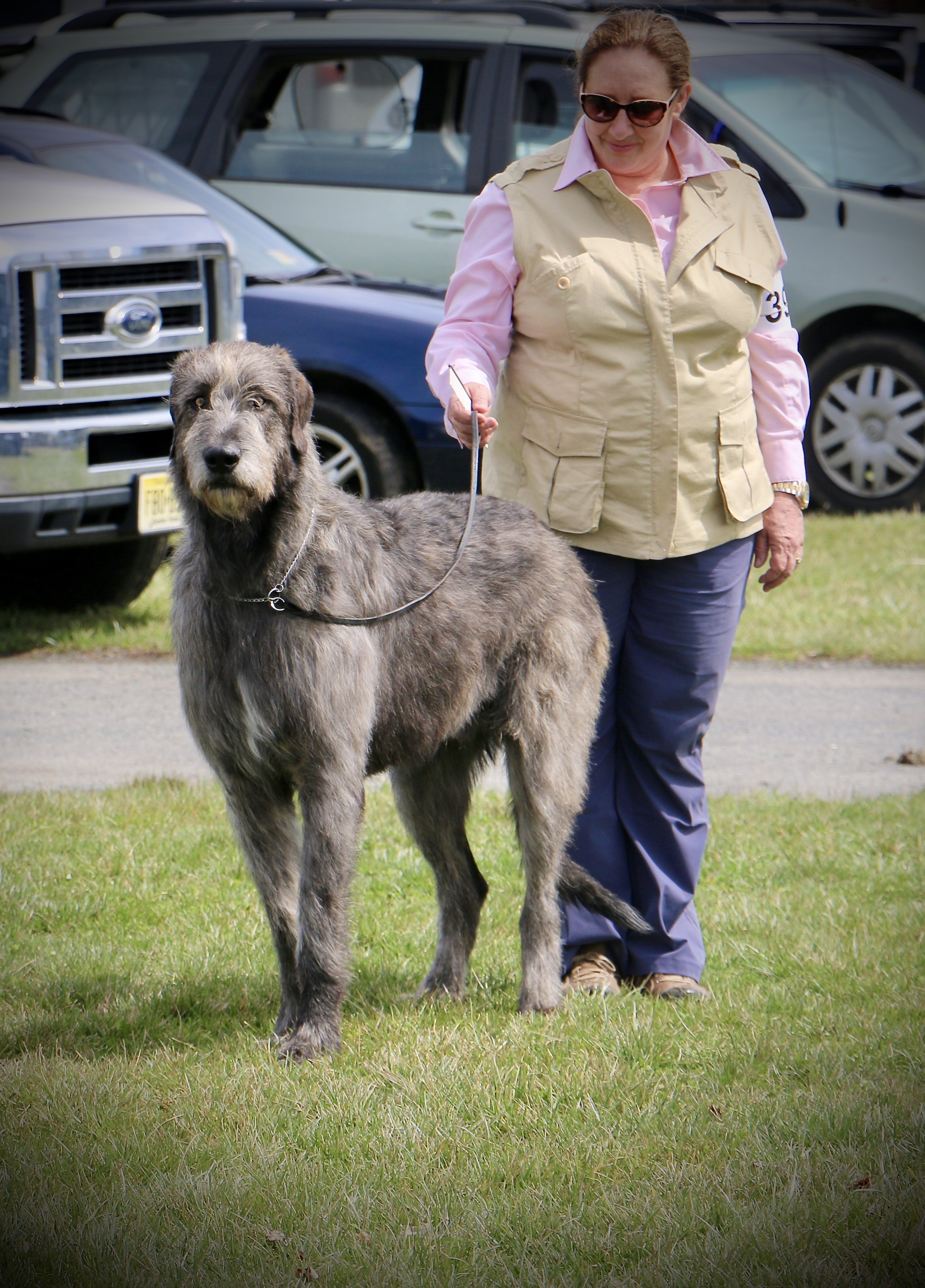
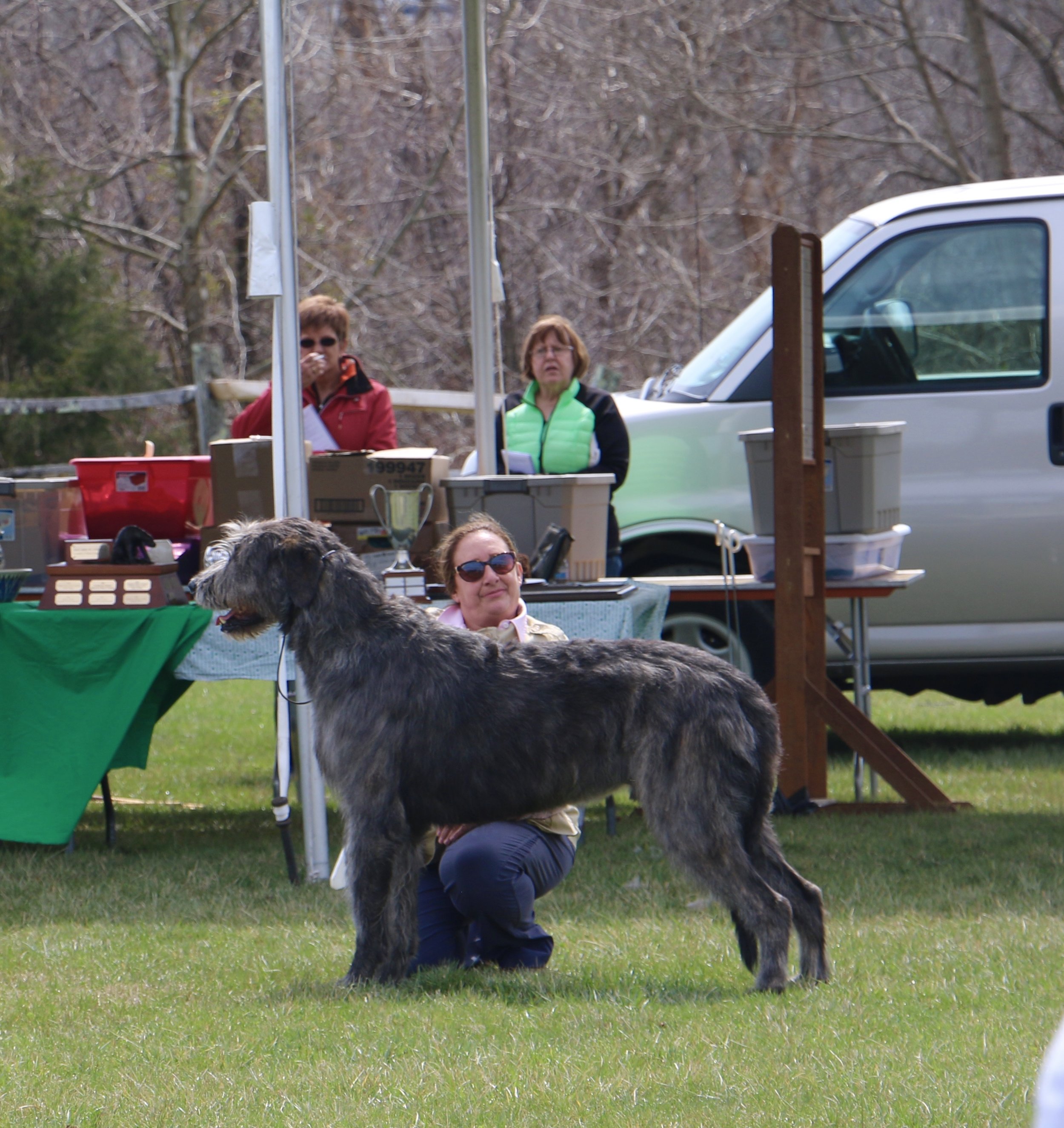
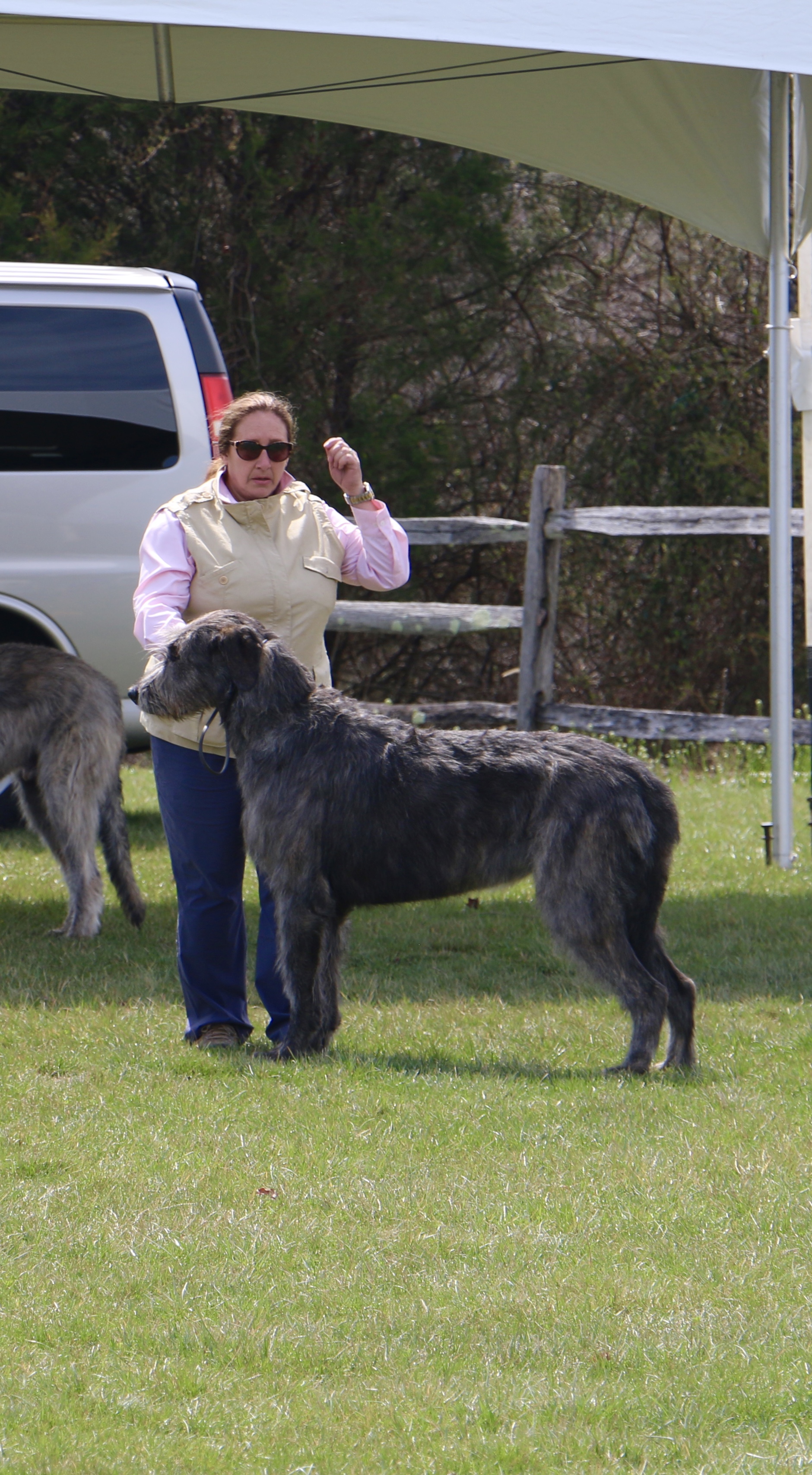
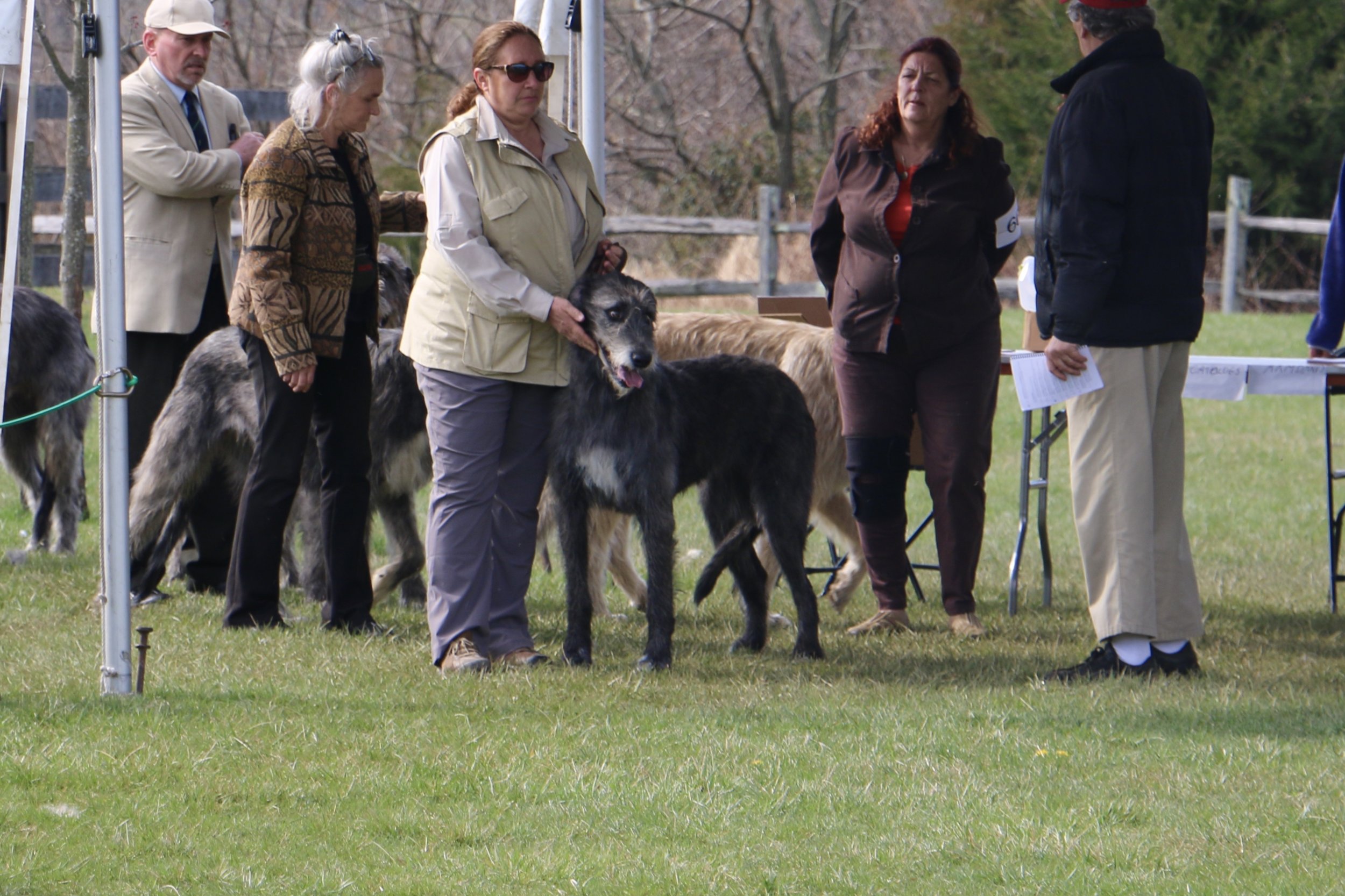
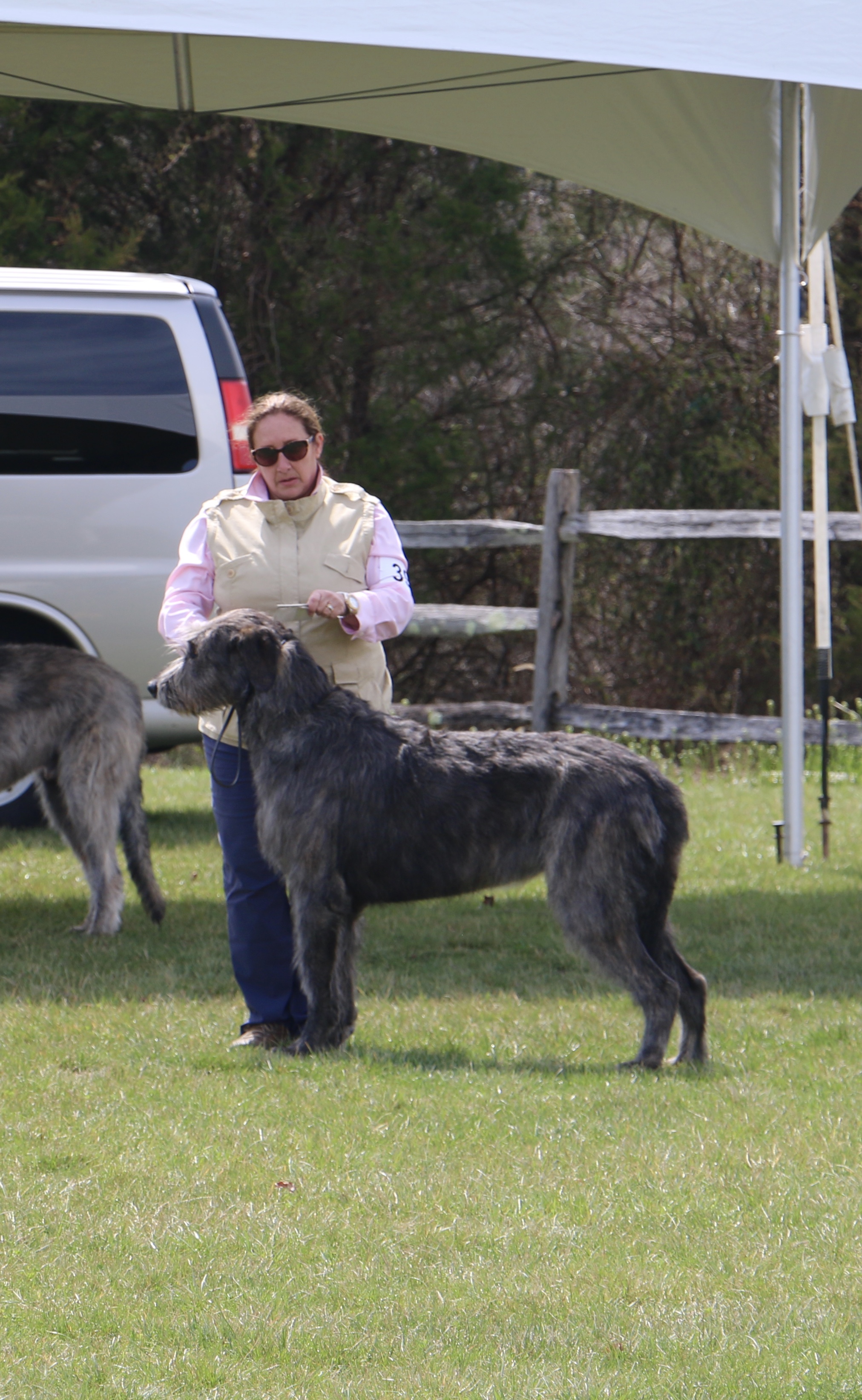
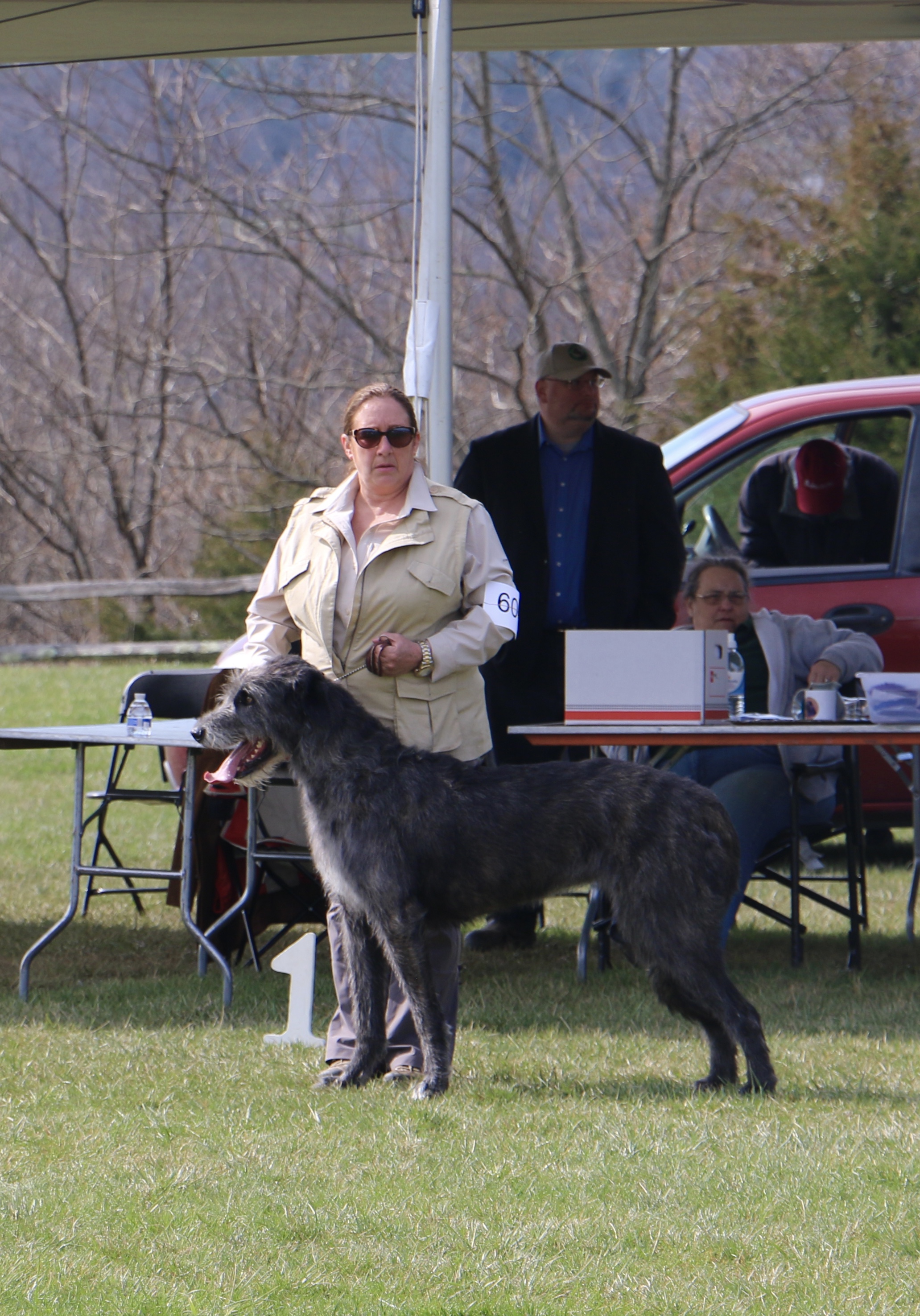
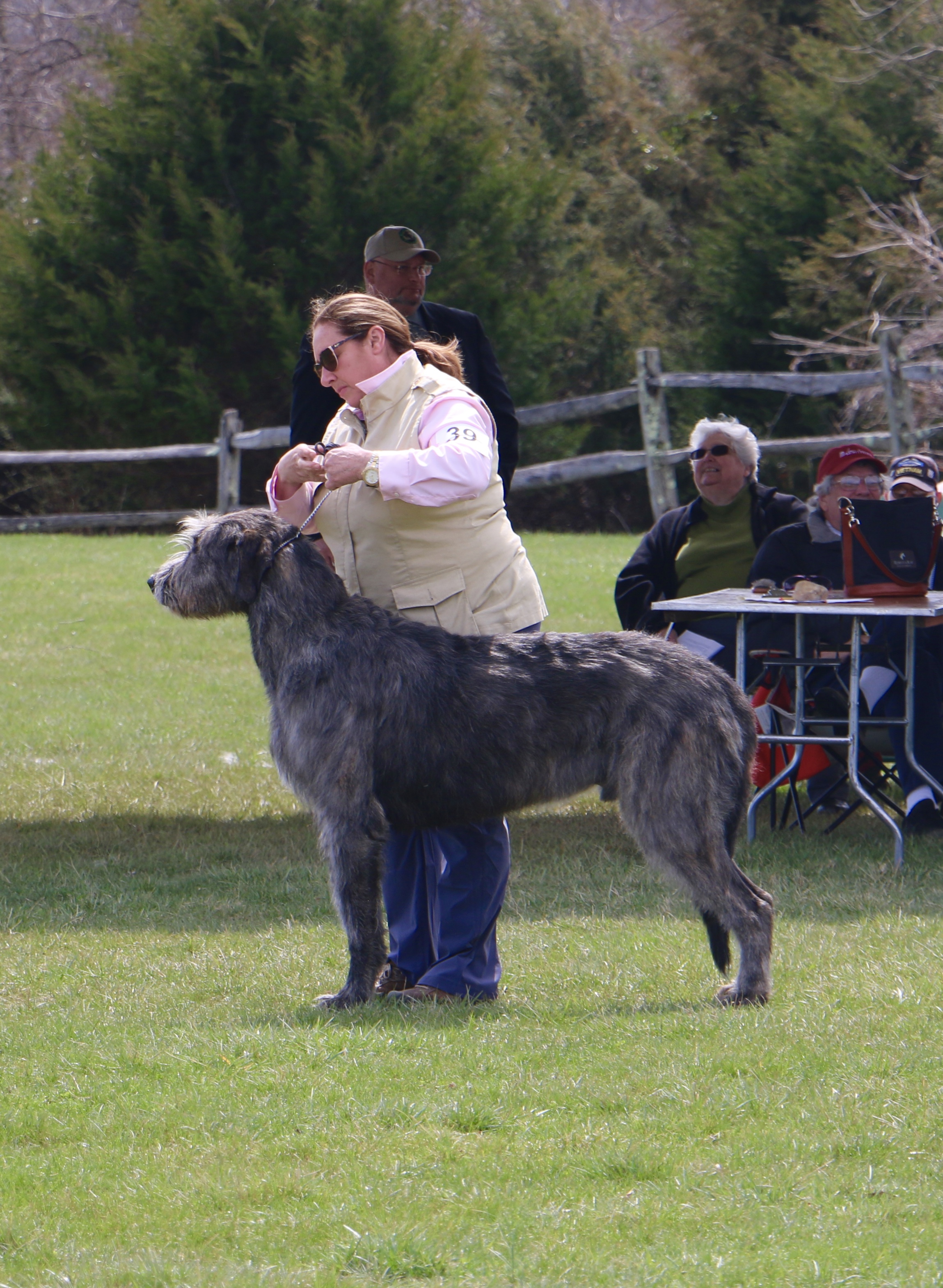
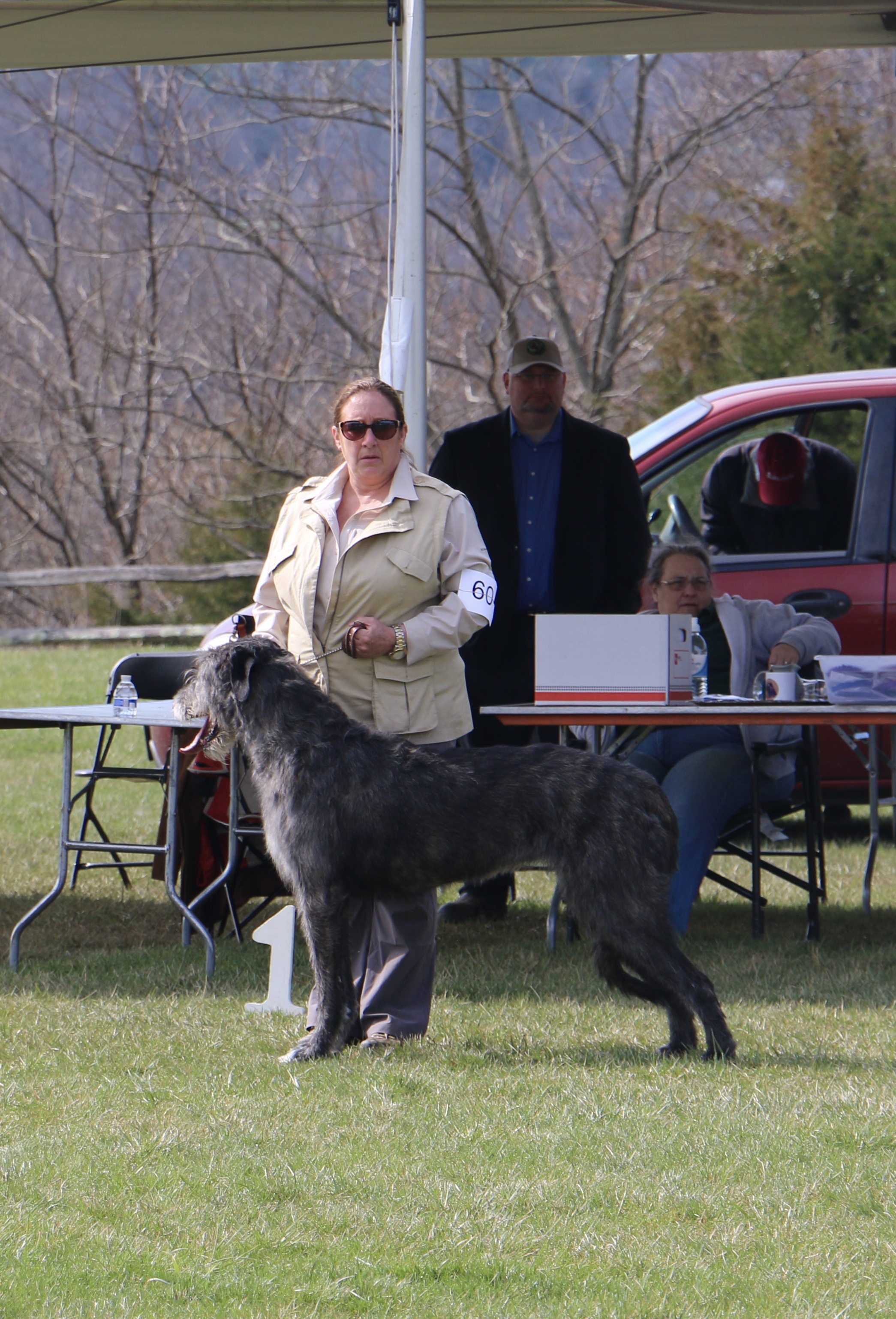
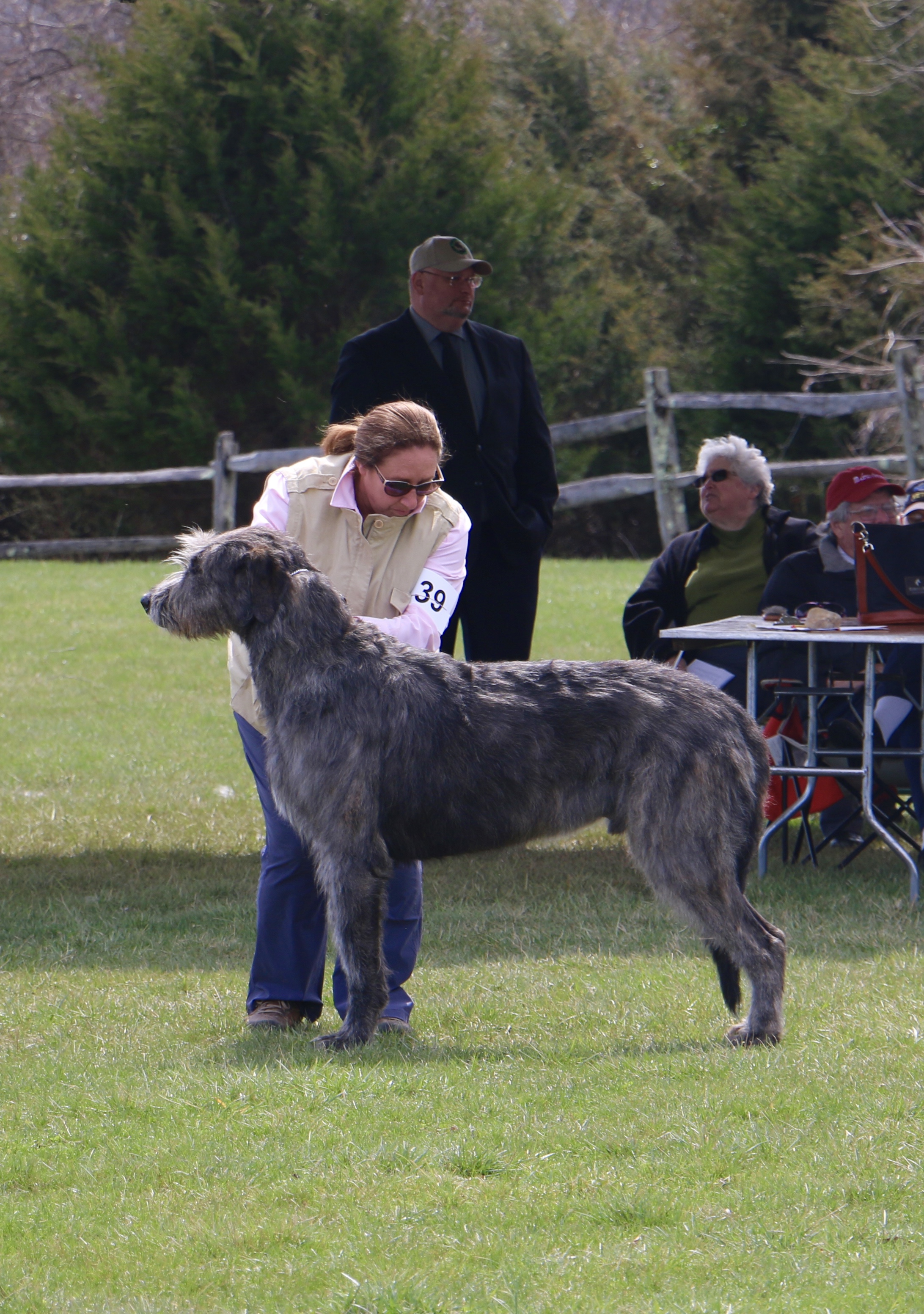
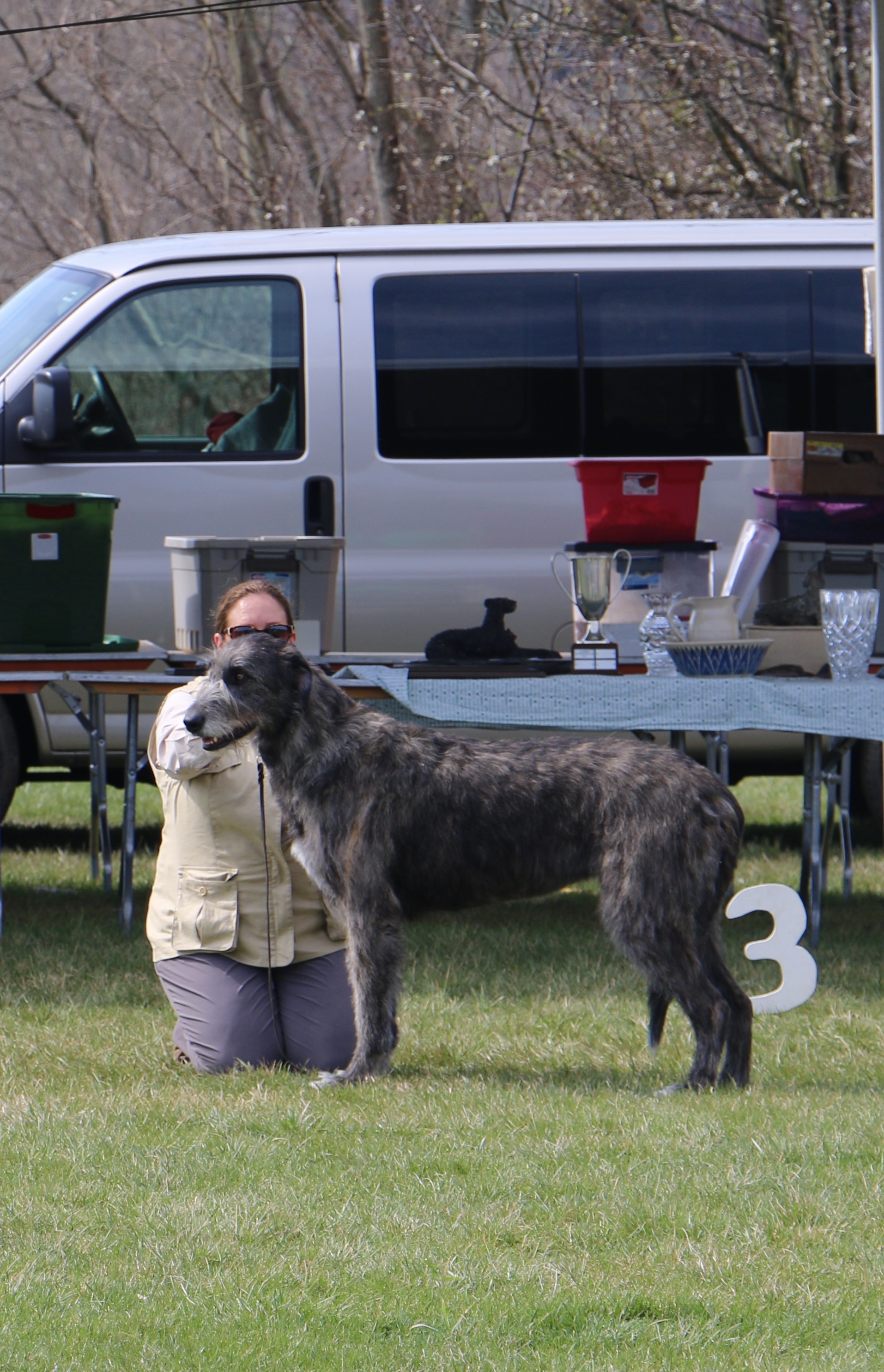
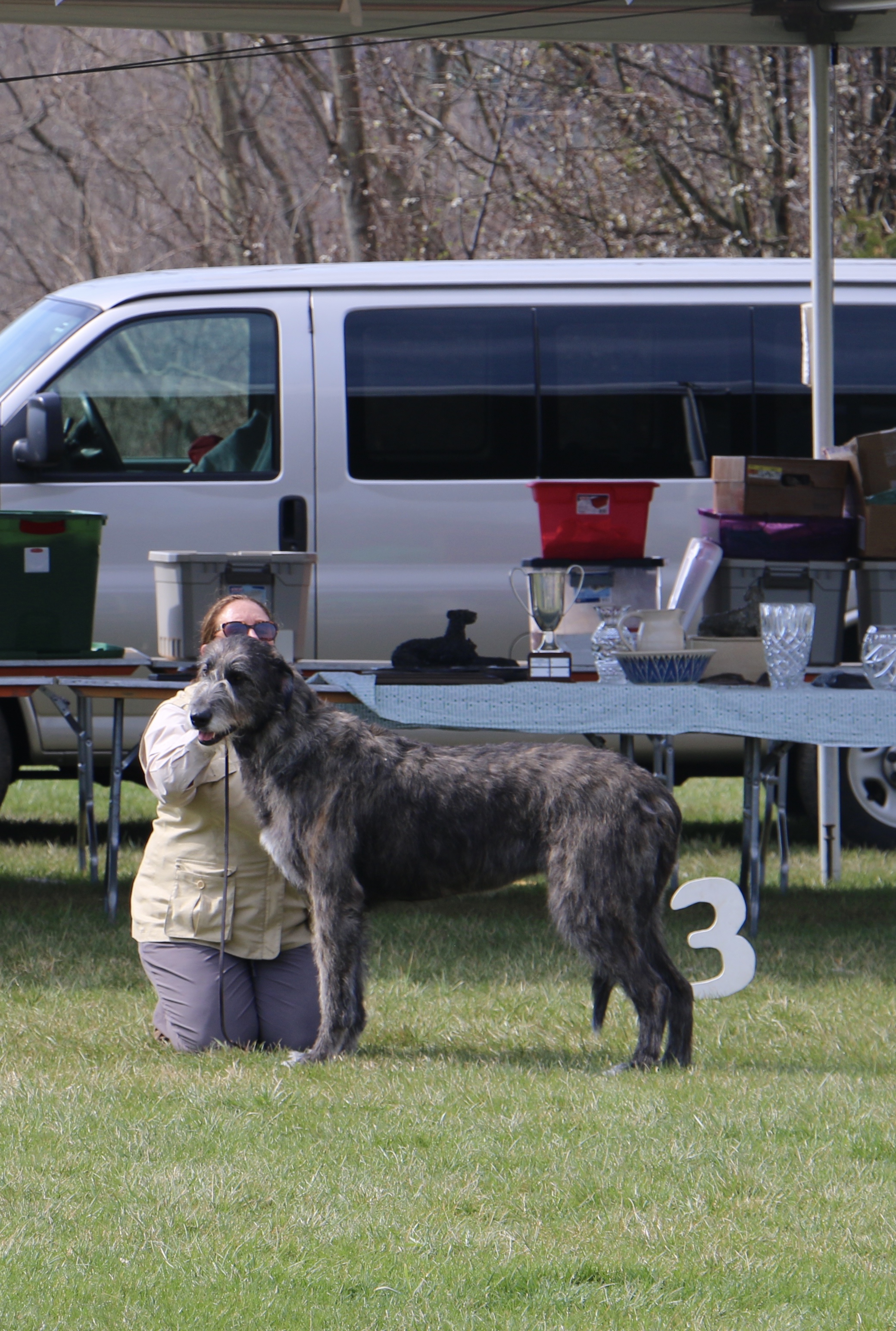
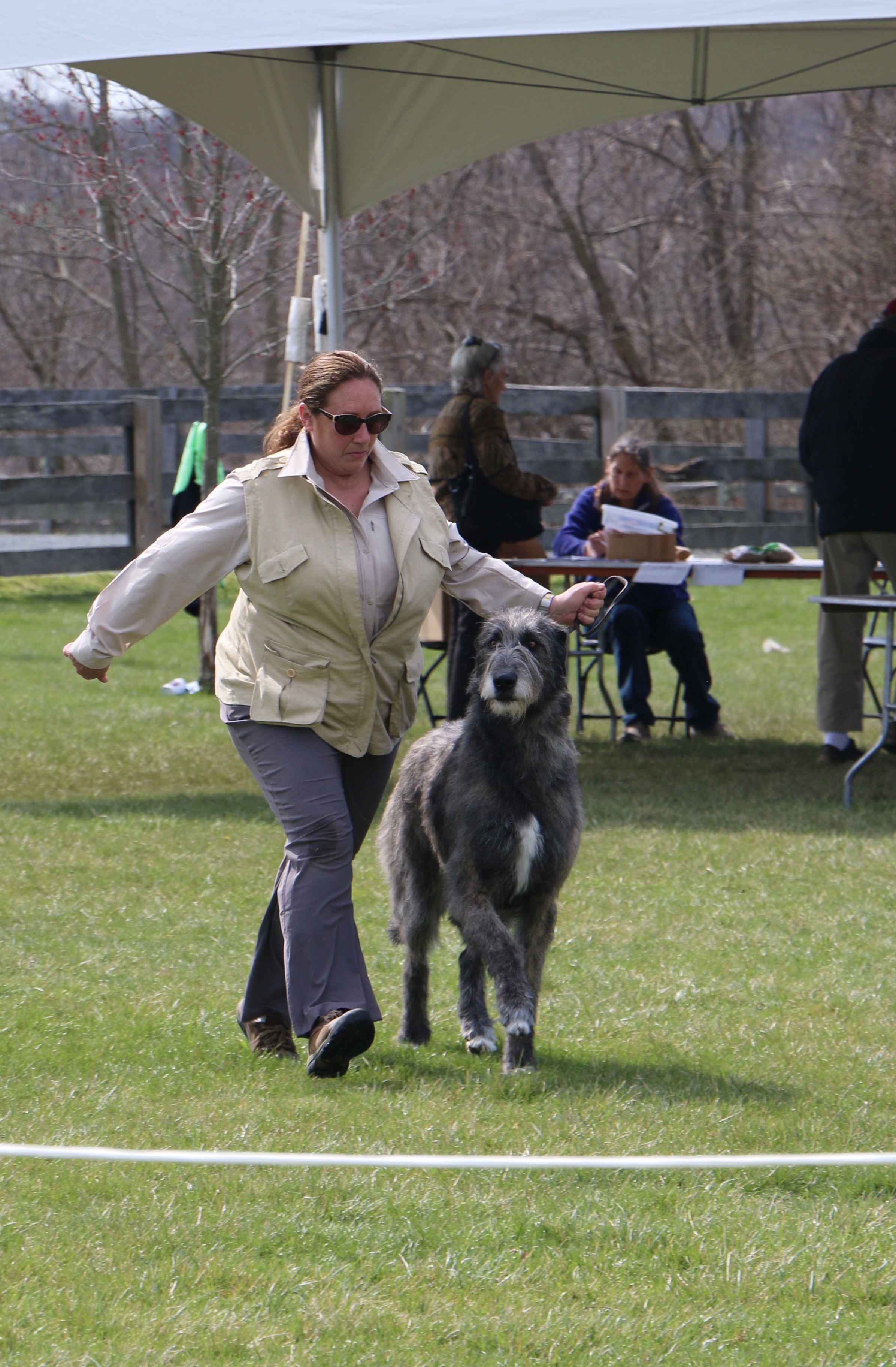
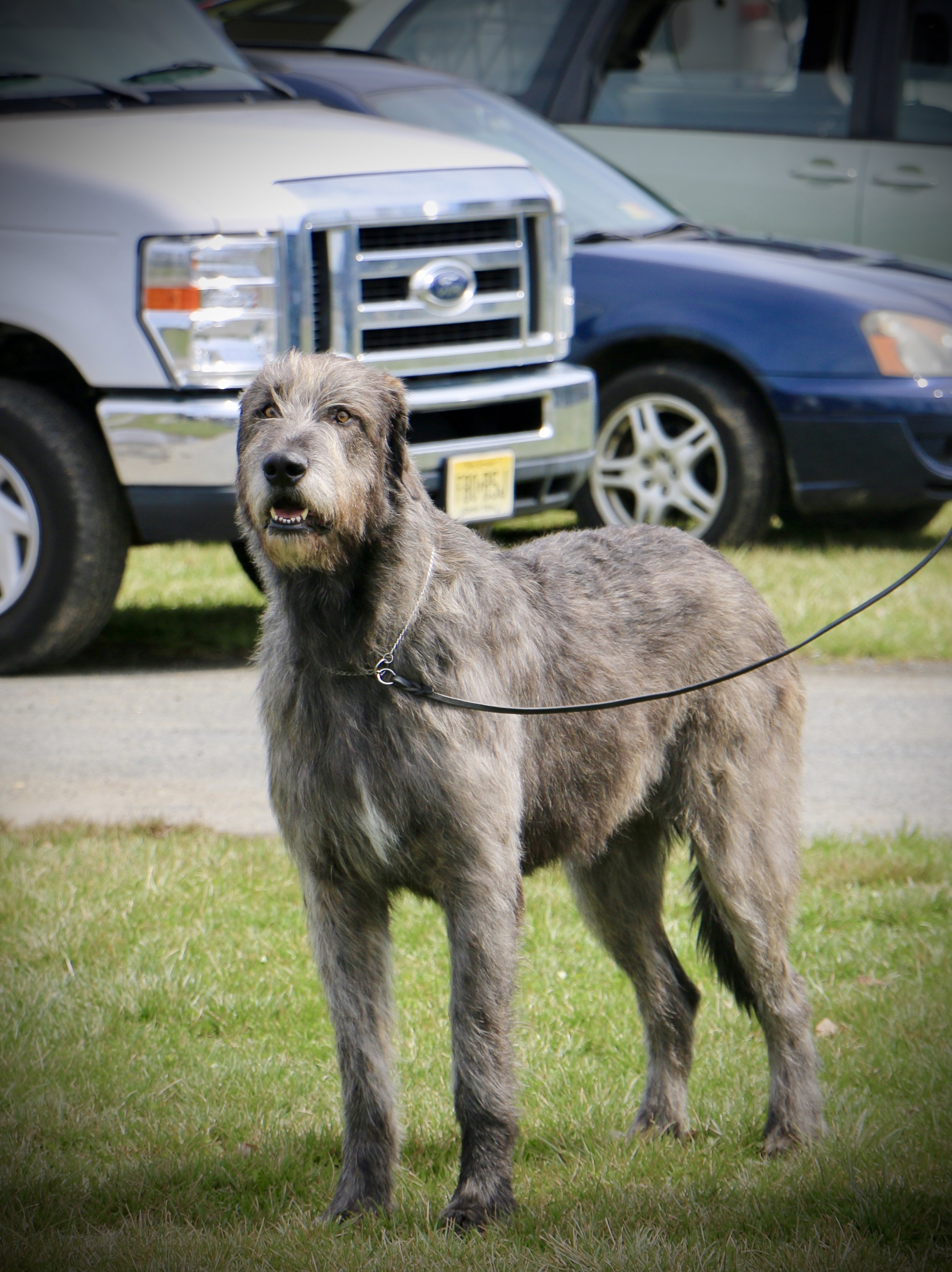
Ballyhara Candid photos from recent Potomac Specialty Show
Here are a few candid photos of my Irish Wolfhounds from a recent specialty show.
Irish Wolfhound Club of Canada Quebec Branch Specialty
Though this post is geared mostly to Irish Wolfhound fanciers, particularly in the Northeast, I think others may find it interesting. Though we have attended this specialty twice before, last weekend was the first time since I began writing my "Musings Dog Blog" and so this is my first opportunity to comment on this club and the show......
Though this post is geared mostly to Irish Wolfhound fanciers, particularly in the Northeast, I think others may find it interesting. Though we have attended this specialty twice before, our attending last weekend's specialty was the first time since I began writing my "Musings Dog Blog" and so this is my first opportunity to comment on this club and the show.
What I feel is the most memorable and enjoyable aspect of this Quebec Irish Wolfhound specialty club are its members and their hospitality towards guests. To illustrate, the members sponsor a luncheon buffet that is delicious and enormous. Homemade food set out as a huge spread under the tent incorporating fresh salads, hot foods, wraps, fresh turkey and roasted hams, desserts, water & soda and the like. A little something for everyone but the club asks only for a token donation.
We do not frequently see such hospitality in the dog clubs any longer. Friendly, welcoming and generous, these members are proud of their show from beginning to end. They host it on a military college campus in St.Jean-sur-Richelieu, Quebec along the Richelieu River at the northern end of Lake Champlain. The show site itself is alongside a sports gymnasium on a large, level, grassy area with giant shade trees adjacent to one side of the ring. Parking is limited near the show ring, though, and because it is held on a military campus, the security guards patrolling are usually quite stern if one is parked irregularly. The show officials, especially the show steward, were wonderfully patient and entertaining, organized and quite efficient. It is a small show offering down-home Quebec hospitality and Wolfhound enthusiasts should mark it on their calendar for the future. Keep in mind that they do have an official limit on the number of entries being 175, but this is a smaller specialty in which these figures most likely would not be met. Intriguingly, this club, for several years now, has sponsored an international judge to adjudicate and to be honest, I am amazed as to how they can afford to do so!
My only qualm involving our lovely experience this past weekend is an issue in which I have written about several times previously, and that is the level of unpreparedness of some foreign dog show judges for North American dog show assignments. Meaning, they are not knowledgeable in the American, rather, in this case, the Canadian Kennel Club judging procedures. Officiating was an international judge, Mrs. Csilla Juhash, of Glor Na Gael Kennels in Hungary, who has a lovely personality and was very polite and organized. Moreover, she possessed confident mannerisms throughout her adjudication process. However, we exhibitors and spectators became quite confused during the Best of Breed competition, although; it was clear that the judge most certainly was not. She proceeded confidently in what we assumed was according to the Federal Cynologique Internationale (FCI) judging system, instead of the CKC judging process.
As is typical, the Champion Dog entries, Winners Dog, and Veteran Dog were judged separately from the females. She finished examining all the Champion males but did not re-examine Winner's Dog or Veteran Male, which was her prerogative though she did re-gait them. However, it was here that our puzzlement began. The judge declared her top three best males from the entire line-up announcing them as first, second and third. First place was awarded to a Champion as Best Male; the "second best male" was given to Winners Dog and third place to another Champion dog.
Next, she judged all the Champion Bitches, along with Winners and Veteran Bitch, in the same manner as the dogs and selected, as I recall, two females, the first place being Winners Bitch. Now, all the top five re-entered the ring together where she awarded Winners Bitch as her Best of Breed, which by default was then also Best of Winners. After presenting the ribbon, she then awarded her Best of Opposite of Sex to her previously named Best Male. Next, she gave an Award of Merit to her "second best male" who was also Winners Dog. She then awarded Select Dog to the previously named "third best male" and then awarded Select Bitch to the remaining champion female from the top five. So, she apparently was very comfortable and confident in her procedure, demonstrating that she clearly knew what she was doing. However, for those of us who have never shown in Europe, we were bewildered. It would be entertaining to listen to the replay of the gallery of onlookers and the puzzled pleas and questions as to what was going on, if I only had the foresight to record it on my iPhone.
It think it would be particularly useful if the AKC and CKC provided a simplified handbook for the international judges to study before arriving to complete an assignment in our countries. Though the CKC has a "Handbook-for-Conformation-Judges," as well as AKC has their "Rules, Policies, and Guidelines for Conformation Dog Show Judges," neither are streamlined for the foreign judge, though they both do, in fact, require that judges proceed and award in a specific order. But, neither pointedly detail in one small, quick handbook our judging process from beginning to end.
Though certainly not relevant to this specialty show, the foregoing and current guidelines do not discuss frequently seen errors that repeatedly occur at other specialty shows, such as foreign judges asking exhibitors the age of a dog, or bestowing the Select Award on a class dog. Quite often, many international judges are unaware that Select awards will be disallowed if conferred on a class dog/female who is not a champion of record, to include Veterans class winners. Although, in fact, many foreign judges do not know that a Veteran class winner is indeed eligible for the Select Award. Allowable because some, but not all, Veteran class winners are champions of record. Still, most foreign judges are not aware that they are not permitted to ask if a Veteran is a champion. How's that for a vicious cycle?
Other details that would be very helpful to an unfamiliar judge include suggestions useful in judging large classes. For instance, it is not recommended to make a cut leaving only five dogs, for obvious reasons, and that six or more is appropriate. One of the most common mistakes I witness foreign judges make in our breed, Irish Wolfhounds, is during Best of Breed competition. The judge makes a cut and dismisses one of their Winners and or one or both of their Veteran winners. They should know that it is proper protocol to keep both Winners and, if weather permitting, the pair of Veterans for consideration until the conclusion of their awards. Perhaps I might create a helpful, simplified handbook that clubs can provide to their foreign judges before their assignments to facilitate theirs and the exhibitors experience.
One last note, for Americans traveling to Canada, a solution for the passport quandary is simple. Instead of having to retrieve one's passport from your safety deposit box to cross the border, I suggest that fanciers obtain a Passport Card. The passport card is valid for travel between the United States, Canada, Mexico, the Caribbean and Bermuda and can be used at land border crossings or sea ports-of-entry, but not international travel by air. It is much more convenient and less expensive than a passport book. The size of a drivers license, the passport card can be kept continuously in your wallet in its protective sleeve with your driver's license and is obtained from the U.S. Passports and International Travel agency.
Hopefully, we will see you next year in Quebec as I am sure you will enjoy yourself!