
DOG BLOG
Musings
Emergency Mobility For Giant Breeds
Preparation is critical, and we all have our moments of oversight. Even I, being detail-orientated and organized, have been caught off guard. Doing so is particularly crucial while owning giant breeds, as their sheer mass and size can pose significant challenges in times of crisis.
Preparation is critical, and we all have our moments of oversight. Even I, being detail-orientated and organized, have been caught off guard. Doing so is particularly crucial while owning giant breeds, as their sheer mass and size can pose significant challenges in times of crisis.
The loss of a giant breed dog is a profoundly emotional experience, as we recently lost our beloved Wolfhound, Kellyanne, several weeks ago at 10 years of age. Then, unexpectedly, we lost her brother, our dearest stallion wolfhound, SBIS Ballyhara Ki, two weeks later. A towering male, standing approximately 36 inches at the shoulder and during the prime of his life, was 175 lbs.
How do you solve the dilemma of moving an injured, sick, or dying giant breed dog when you are alone? There are various animal stretchers and options on the Internet and Amazon. But most are well-suited for average-sized dogs and not giants. I researched as many options as possible and settled on a particular stretcher I could use by myself.
Some giant breeder owners use the black two-wheel animal stretcher from Amazon, which is 45 inches long and great for medium to large breeds. I decided against this option as a long-backed giant breed is much more elongated than 45 inches, and you must lift the stretcher up only on one end to haul the dog. I was concerned about stuffing an injured or sick IW into this small space and then having them slide down, despite the webbed restraints, and bumping or dragging along the ground when hauling this stretcher. In my experience, the mesh barrier could not possibly hold the weight of a wolfhound whose body is sliding from gravity as the stretcher is tipped up to move.

I chose a medical stretcher, which is an excellent alternative. Pricer than the typical animal stretcher, this is a human-size stretcher. The criteria were simple. I needed a long stretcher that my Wolfhounds could lie on (this one is 72 inches long) that was low to the ground so that I alone would be able to drag a massive wolfhound onto it one section at a time, such as the hindquarters then the front-end and head and so forth. The other criteria were that it had 4 wheels for motion and a handle and would be narrow enough to fit through a typical doorway. The dimensions of this medical stretcher are 72.8 inches long, 19.6 inches wide, and 7.8 inches high. It has thickened Oxford cloth that can carry up to 350 pounds, has two web belt restraints, and is foldable.
As seen here, the Amazon animal stretcher is 45" long by 22 inches wide and 6 inches high. It has only 2 wheels, and the animal must be tipped up to move it. A model made with 4 wheels was previously available. Still, it has been out of stock, and there have not been any updates on when it will be available again.

Unfortunately, and heartbreakingly, we had to use our new stretcher shortly after receiving it. As I mentioned, we lost our beautiful hound and had to transport Ki from the backyard to the vehicle. Though my husband was here to assist, after using the medical stretcher, I was comfortable knowing that I would have the ability to at least move my injured, sick, or dying hound by myself to get them to the Emergency Clinic. Getting them to the vehicle safely without causing further harm to them is paramount.
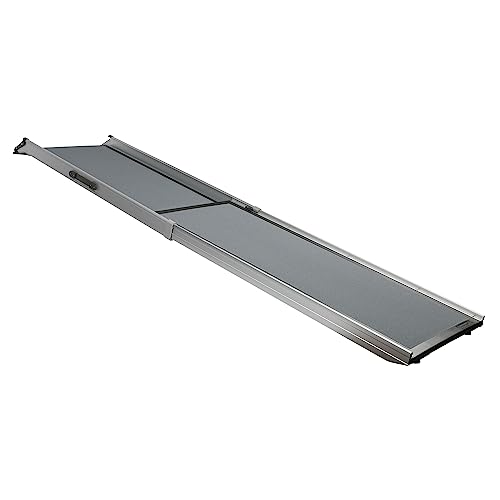
Getting them into our van is another issue. We have always used a telescoping dog ramp with side rails for the hounds' access to our vehicles. Our new stretcher can fit on our wide dog ramp, but it is a tight fit, as the dog ramp is 20 inches wide with side rails. Our ramp telescopes up to 82 inches and can hold 300 pounds. Still, I would move the van so its rear access doors are adjacent to higher ground to minimize the slope to a comfortable 25 to 30-degree incline and then haul the stretcher up the dog ramp. Even better, in the future, after we get done with our construction here, as we are going to be building a new house and dog lounge, I will construct a permanent, gradually sloped earthen ramp for such emergencies where I find myself alone having to move an injured or very ill wolfhound.
If you need to purchase a dog ramp, the one below is an acceptable choice. I'm glad to share my experience with everyone.
Truth and Consequences
The truth is that most companion owners who are not well versed in sighthounds do not understand, appreciate nor have deference for their sighthound’s instinctual prey drive. However, there can be consequences for their ignorance.
Scene One:
The proud, new owners of an Irish Wolfhound puppy visit their local dog park to socialize and exercise their newest family member. Over time, the pup is trained to the basic commands of sit, stay, down and recall. Ideally, these novice owners were also properly educated on and appreciate what we veterans recognize as the typical "I'll think about it" hound response to training. That is to say the momentary, delayed reaction to almost all commands as the hound deliberates before fulfilling any instructions given to them. Incidentally, I believe that our hounds eventually do as we ask not to please but because they merely tolerate our requests.
Scene Two:
Fast forward in time and the much-loved wolfhound, no longer a puppy, is very familiar with the dog park, having enjoyed the recreation and fraternizing for quite a while. Ultimately, some time ago, the owners believed they could trust their wolfhound, especially since the hound had not demonstrated worrisome disobedience nor an intense interest in chasing other dogs. As a result of his continuing good behavior, the gentle giant engages in off-lead play time, happily galloping and casting around for new scents.
Scene Three:
Today, a new dog comes to the park. Although there is a segregated area for small dogs, this leashed newcomer accompanied by his elderly owner, cheerfully trots into the big dog park through the double gated chain-link entrance. In the distance, our wolfhound previously occupied with a Golden Retriever buddy has now become keenly aware of the new presence. The wolfhound's owners who are yards away may notice, but are unknowing of sighthound body language. Veterans know the warning signs and understand what I gently coined ‘intense interest’ as actually ‘the look of death.’ A marked attentiveness usually, but not always, accompanied by rigidity of carriage, and lowering of the neck and head while the limbs crouch ever so slightly before launching into action.
Scene Four:
The wolfhound's owners react too late and are yelling their recalls that quickly turn into panic as they watch their hound, disregarding their commands, bear down on the small dog. Realistically, though just about any person’s reaction, unless one is nearby and can dive through the air and onto the Hound, will be too late for a swift gazehound. Meanwhile, the elderly woman is frozen with fear as the strange, giant hound gallops full speed towards her little dog. She does not turn and flee back through the gate in time.
Final Scene:
Amid all the tremendous sobbing and shouting, the elderly woman looks on as her dog lay lifeless. She too possibly has fallen after being hip checked by a 150-pound flying wolfhound body. The police are called, and animal control arrives to seize the giant sighthound whose only crime was having an innate response to stimuli. That being a strange little dog that appeared to the wolfhound as being a lot like prey. What fate lies in store for this poor sighthound depends on municipality ordinances, regional social attitudes, and the sympathy, if any, of the court. Certainly this hound is not to blame because his instinctual drive overrode any supposed clicker training, and sadly, he could pay the ultimate price— with his life.
Truth: The above scenario is certainly not preposterous nor unimaginable. I know first-hand that such a plot can happen, but my ending was significantly more fortunate. Though the setting was different, a long time ago I had a wolfhound run down two small dogs, harming one before I was able to intervene. My self-prescribed penance was the $700.00 in surgical costs as I was profoundly grateful that no lives were lost, as a result of the incident. Fundamentally, the essence of an instinct is any performed behavior that is not based on prior learning. Hard-wired prey drive is an inborn complex behavior and most sighthound breeds, many with origins dating one or more Millennium, once specialized in independent hunting and dispatching of Game. Indeed, this inherent ability is still well and strong today. In fact, this faculty has proven to be very surprising, though it should not have been, to breed fanciers and novice enthusiasts involved with the rehoming of wolfhounds. I am aware of a few rehomed Irish Wolfhounds who, allegedly, had not previously demonstrated any prey drive. Nonetheless, after the original owners placed their hounds for common excuses, such as finances, relocating, or divorce; these hounds' natural prey drive emerged, especially as they were highly stressed and they went on to dispatch neighboring dogs.
Consequences: There are possible aftermaths stemming from the above hypothetical dog park scenario. Court cases do exist involving dogs sentenced for euthanasia by the legal justice system for killing another domestic animal. One recent case involved two medium-sized dogs, who after having killed their neighbor’s cat, were both condemned by a Court Judge to be destroyed. Only after circulating a petition garnering over one hundred thousand signatures and the family retaining an attorney were the dogs granted a repeal, but the conditions required relocating them to another area.
The truth is that most companion owners who are not well versed in sighthounds do not understand, appreciate nor have deference for their sighthound’s instinctual prey drive. Many novices confuse this drive with the passive aggressive scent hunting attributes displayed by our other hound brethren, and mistakenly believe that prey drive can be trained away. Such as the prospective young admirer who recently contacted me for a wolfhound. Though an initiate in both breeds, she is an advocate of compliance training to resolve potentially high prey drive. Because she has insufficient acreage, she proposes exercising a wolfhound on another property. She writes, “I understand your concerns with the Wolfhound’s prey drive. Our Bloodhound has a very strong drive to run (because of that darn nose), but he was properly trained and knows better. However, with the right training and guidance, I feel we will have no problems. If I can unleash a bloodhound on a 60-acre farm and know that he will not go out of my sight because of our training — then I feel confident that we can do the same for a Wolfhound.”
Any seasoned sighthound fancier is aware that gazehounds have specialized attributes. Galloping hounds live to run and when they are in flight mode, both their speed and focus are simply amazing to observe; so long as their pursuit is performed in a safe location. Rarely can you instantly call off sighthounds while they are chasing live game or prey. I explain to newcomers that the hound enters a different zone or realm. While he is fixated on the quest, neither recall commands, whistles, clickers or shouts will break him off from a hunt. That is until his concentration wanes or is broken, especially if chasing white-tailed deer. Often though and quite tragically, their focus is interrupted by other means such as an automobile and, by then, it is too late.
Prey drive must be respected at all times, and even the most experienced fanciers can make mistakes. I recall one such time when I sat down ringside next to a woman with a reclined, relatively relaxed greyhound. Accompanying me was my 17-pound Australian Terrier who jumped on my lap and within seconds, the greyhound shot up and snapped connecting with my terrier's muzzle. Given that this occurred while we were seated and not while on the ground where the greyhound could have broken the terrier's neck was extremely fortunate. The terrier being a terrier shook it off and, of course, the only one to blame was me for disrespecting the Greyhound's prey drive and momentarily letting my guard down.
Before I go on, I acknowledge that the degree of prey drive can vary in singular sighthounds of the same breed, just as individual people have varying measures of aggressiveness. In my experience, I have had littermates with fluctuating levels of prey interest. Several demonstrating a keen interest in cats and small dogs, and a few that could mingle safely with them. Interestingly, at one time or another, I even have had one or two wolfhounds that would not leave my side, no matter the inducement. However, in my experience, this is very, very rare. That is not to say that a giant or large sighthound cannot successfully co-exist with small dogs or cats. For the past nine years, an Australian Terrier matriarch has governed our home. She imprinted on and raised each wolfhound out of the whelping box. Nonetheless, we have management protocols in place to protect her and exercise strict precautions, largely during feeding or when the hounds are roughhousing. Despite the presence of this queen who commands respect, some of our hounds demonstrate an interest in other, off-site smaller dogs. As a result, we tread carefully, and our hounds are not off-lead in public areas.
We, breeders, receive numerous queries and more often than not these potential owners have ambitious plans to exercise their sighthounds on public lands, dog parks or trails. At the outset, this may sound well and good, but new owners become complacent not believing or knowing that sighthound behavior can change instantly. Misplaced trust in a sighthound can result in sad endings. I'll soon not forget an AKC Gazette breed column written years past by veteran Scottish Deerhound fancier, Joan Shagan. A story that always stuck with me, she recounted an incident involving her 8-year old Deerhound, who accompanied her on a trip. During their travels, they stopped off to overnight at a friend's home. Upon arriving, the Deerhound vacated his bladder and returned to her as usual. Later that dreary rainy evening, Joan lets her cherished Deerhound outside. As she waited and watched, he began trotting away down a path and soon was gone. Without even a backward glance, the old Deerhound disappeared from his beloved owner into the gloom and kept on going. In the wee hours of the morning, and only after a long, sleepless night for all, the Deerhound -- wet, cold and frightened -- was discovered several miles away by a stranger and was thankfully identified by his microchip.
It goes without saying that this story's ending could have been much different as even the author expected to find her Deerhound collapsed, trapped, dead or dying. Mysterious behavior is not unheard of as those who are long versed in sighthounds know that these breeds can behave eerily. I once had a wolfhound slip out a gate and started trotting away down the road. She paused at my recalls, looking over her shoulder at me with an odd expression -- as if she did not know me -- and then continued away. We were able to secure her safely, but it was a look I had seen before throughout the decades in other Wolfhounds who have gotten loose at specialty shows. Unhappily, at one point in time or another old hand breeders, such as myself, have participated in search parties at specialty or all-breed shows to look for a spooked sighthound that has run off. We know full-well the resulting sorrow it can bring. I have endeavored to describe this meaningful glance to newcomers, but the majority of people do not get it.
I recall a particularly memorable and tragic tale that continues to haunt me in spirit, involving a hound that I knew very well. After having returned from a dog show, a wolfhound bitch ran away from a Handler and through a driveway gate that was not secured. Despite searches, even the use of a psychic, she was not recovered. The bitch's owners also retained the services of a bloodhound trained in trailing lost dogs who allegedly followed the wolfhound back to her home's open driveway gates. She had found her way back home, seemingly close enough to view and hear all her kennel mates who also may have seen or smelled her and who would have most likely been calling to her. However eerily, she turned and ran off, disappearing forever and reportedly, without any further sightings. Why this Wolfhound found her way back home but mysteriously left, we will never understand.
Suffice to say, if events such as these can befall hardened hound enthusiasts, it certainly can happen to novice owners. I believe it is important to educate new owners to sighthound flight tendencies and their typical reaction when spooked. Sighthound personalities can change if they are experiencing an immediate and continuous state of fright. For example, a frightened Irish Wolfhound runs away from and not towards humans as this is a natural reflex because the hound remains highly stressed and panicked. In contrast, a lost Labrador Retriever having a different temperament will approach strangers — friends or foe.
When introducing the subject to prospective sighthound owners, it is important to emphasize that if a sighthound is loose, frightened or lost it may be difficult to entice, lure or capture them again. In some cases, it has taken several weeks despite search parties, countless flyers, social media alerts, and radio announcements. In short, they can transform into flight hounds. One often overlooked consideration is the sighthounds impressive size and the subsequent reaction to such. Although those familiar with these breeds understand they are gentle towards people, the majority of the public may be shocked, frightened or just plain nasty and unkind. Some may even call the police who might shoot the strange, huge dog. When encountering a large loose sighthound, people might respond by shouting, gesturing angrily at them, or possibly throw objects which further terrorizes the hound. I recall a sad incident several years ago while attending the Rhodesian Ridgeback National Specialty. After a Rhodesian Ridgeback puppy had become startled, he escaped from his owner and ran off. At one point, he reportedly was seen at the back of the hotel, near the rear kitchen and garbage areas but was waved and scared off by an employee. Though there was a collective search, he was not found alive after apparently being struck by a vehicle.
I am quite accustomed to the commotion a giant breed creates as I have lived in a year-round resort for over 33 years where we regularly socialize our leashed Irish Wolfhounds around the village tourist areas. The reception they experience ranges from people exclaiming their beauty and wanting to touch them, to a few screaming in fear. The latter has surely happened on occasions and from time to time children recoil or run at the sight of them.
As I write this article, I received a phone inquiry for a wolfhound from a family whose one and half-year-old wolfhound is dead. After recently moving to a new home that was not yet fenced, the wolfhound, while unleashed outside with the grandchildren ran out and was hit by a car. Several weeks later and still deeply upset, these strangers contacted me to inquire about a puppy, even then though they had no definitive plans in place for installation of proper fencing. It goes without saying that I would not place any hound with such irresponsible and reckless people. Yet, how very sad and wasteful that such a special breed is bordering on expendable and plainly seen as replaceable. As breeders, we cannot control every aspect of our hounds future life with a loving family. However, it is my policy to counsel owners on the 'what if' scenarios, such as moving to a new home, and every necessary precaution that must be made beforehand and during these stressful times. All to ensure the safety and well-being of the hound, leaving nothing to chance.
Though the above casualty did not involve my breeding, I too once had a novice owner with one of my hounds relocate with terrible consequences. The people transferred to another state and purchased a sizable farm. They did not safeguard their hound by erecting fencing before moving into their new home, and shortly afterward, their beloved wolfhound was killed. However, his demise differed from the above incident — it came at the end of a rifle. The wolfhound was shot and killed while wandering on his new farm. You see, the new neighbors did not care if the hound was friendly or not. Though his death was both violent and indefensible, in some states there are statutes allowing farmers to shoot a dog while he is roaming unattended if there is a claim the dog was attacking livestock. In some states, ordinances permit a farmer to pursue a dog away from the livestock and then shoot him. Short of having an eyewitness to defend the dog, there is no way of disproving a neighbor or farmer's allegations, except if the dog were slain in a secure, appropriately fenced area.
Subsequently, there may be no legal implications for the assailant such as animal cruelty charges. Even if there is a conviction, it is a small measure of comfort, and it will not bring your devoted friend back. What a pathetic and appalling way to perish for such a beautiful animal.
Sighthound Necessities
The Importance of Free Exercise for Large Sighthounds
Sighthounds love to gallop, to chase and stretch out. They experience unmistakable, sheer glee as they are bending, folding and leaping. You can see it in their expression. So, why is it that so many of these admirable Sighthounds are found living in unsuitable homes, having little or no fenced, secured acreage?
The Importance of Free Exercise for Large Sighthounds
Sighthounds love to gallop, to chase and stretch out. They experience unmistakable, sheer glee as they are bending, folding and leaping. You can see it in their expression. So, why is it that so many of these admirable Sighthounds are found living in unsuitable homes, having little or no fenced, secured acreage? As responsible fanciers and hobbyists, fulfilling their needs should be a primary concern when we place our hounds in their new, permanent homes. Our stewardship of these unique breeds obliges us to proceed with utmost care and concern while considering a new home.
I am not an elitist who snubs a potential puppy owner, turning up my nose at those whose accommodations are not ideal for our Sighthounds. On the contrary, I encourage them to contact me so that I may educate them about the exceptional needs and characteristics of our breeds. More importantly, though, I am aware that urban population growth has changed significantly over the past 60 years in our nation. We all live in an evolving landscape. "Metropolitan areas are now fueling virtually all of America's population growth," as reported in the Washington Post by Emily Badger. In an interesting article, unwittingly she corroborates what many conscientious breeders have realized, that ideal Sighthound companion homes are harder and harder to find. Small population centers with less than 50,000 people have had infinitesimal growth changes. Rural populations have dwindled. Today, one in three Americans lives within the metro areas of 10 cities — or just a few spots on the nation's map. The relevancy of the census data must not be under-appreciated, as this means that, slowly but surely, there are fewer opportunities for us to find homes for our galloping hounds.
The reality I face is that significantly more inquiries than in the past hail from people with no land. From the 36 puppy requests I have received in the past six months alone, 32 (90%) were from persons who did not have what I consider sufficient area to accommodate a Sighthound. Furthermore, this percentage includes some individuals who either currently have or previously owned a Sighthound — from another breeder — in their home.
I readily anticipate the question "How much land does she require?" Ideally, a home for a large breed Sighthound should have at least one acre of property secured with breed-appropriate fencing, but from my experience of three-plus decades in dogs, this often seems like an unrealistic requirement. A bare minimum of half an acre of open land, again properly fenced, not including the house, is my condition. I have received some requests from potential puppy buyers who own half an acre of land that included the home as well as an accessory building; one memorable inquiry offered half an acre of land that included the house, an in-ground swimming pool with a cabana and what appeared to be a Bocce ball court. All that was left was a postage-sized space for the hound to defecate in, without any area to run and play.
I politely refuse to place my large Sighthound puppies in these environments, notwithstanding the usual promises of the on-lead daily exercise that the hound would receive. You must be familiar with this type of dialog. A potential owner asserts that, although there is no acreage for free running, they regularly walk so-and-so many miles and they also live near a park where the hound can be off-lead. Almost all of us understand that Sighthounds are not candidates for off-lead running on public grounds. Simply, this is a hazardous situation due to their prey drive — a good subject for another article I plan on writing.
As for good intentions and best-laid plans, how many times has life thrown us curve balls? Life has a habit of bringing unexpected, unwanted changes or accidents. If a hound’s principal caregiver is injured or becomes ill, ultimately the hound is handicapped as well. The Sighthound will no longer have lengthy walking excursions to release energy and obtain needed exercise. Likewise, if an owner’s work responsibilities increase, this almost invariably impacts the time spent with the hound on a leash. Regrettably, because the properly fenced acreage was initially sacrificed, the hound does not have an area for self-exercise and running. So, ultimately, he suffers.
Self-exercise for a Sighthound is not only the freedom to stretch out his legs, to leap, twist and turn, all of which releases energy. It also is key to a Sighthound's development, both physical and mental. Strong, hard muscles are vital to proper maturation and longevity, as well as to protecting the body from unwarranted injuries. Secured exercise provides valuable mental stimulation: simply, it is good for a Sighthound's psyche or soul, mind, and spirit. His personality and character can develop to their full potential, which is especially crucial in the powerful, giant Sighthound breeds where it is especially important that they must be even-tempered and well adjusted.
Some may feel that placing companion-quality Sighthounds in a loving home where they receive individualized attention is far better than allowing these hounds to languish in a kennel environment. To a great extent, I agree, but the compromises that some breeders make are worrisome. The trade-offs are unfair and incompatible for galloping hunters bred for running, especially when we hear that Wolfhound puppies are placed in townhomes, not as temporary but as permanent quarters. Where is the line drawn for responsible breeders to reject a potential home?
Others may belittle this discussion by stating that one cannot keep every puppy, and who am I to decide what is enough space for a Sighthound to live on comfortably? Some may claim that leashed exercise is sufficient for our hounds and that many of the hounds exercised only on leash are in better physical condition than a hound with acreage. Now and again, this statement could prove true. Having been a longtime Wolfhound fancier, I know from first-hand experience that, on occasion, some Wolfhounds will not use the available space for running but just sit at the gate. Despite having one hundred fenced acres, there they were, lying on the opposite side of the fence gate waiting for me. On the other hand, Sighthounds living on considerably less acreage may happily explore and bound about their areas.
Today's average homeowner does not have acres of property, in fact, much, much less. For those fortunate to have some but still acceptable amount of property, it can be transformed to accommodate a galloping hound, as long as the homeowner is willing to do so. Indeed, the initial fencing investment is costly, but our sighthound breeds can be expensive. Expenses are a certainty all prospective puppy owners must be prepared for, though, in the end; these hounds are well worth the investment.
Returning to the subject of alternative leashed exercise, I frequently pose this logical question. Which athlete would have the better overall cardiovascular condition? A person who runs or walks daily? Granted, walking is far superior to no workout and also offers benefits. I always recommend puppy owners frequently walk with and socialize their hounds, regardless if they have one or ten acres of fenced land. However, what about the muscle-toning obtained while the Sighthound enjoys fenced but free exercise that is not achieved by just leash-walking? While placing a Sighthound, maybe future fitness is not a priority for some breeders, despite the health benefits. If care, love, and clean accommodations are all that a breeder requires from their puppy owners, they are, in my opinion, doing a disservice to our Sighthounds.
If we cannot respect these breed's noble heritage, why then do we bother having them? There is a myriad of other Group breeds who require only small areas and some exercise who are entirely satisfied residing on the couch. In fact, AKC generates several suggested dog breed lists that correspond to homeowners lifestyles. You can see the links to these from my website page, Irish Wolfhound Breed Character. Several times in these past years, after I called attention to inadequate property conditions and discussed such concerns with a few rational, prospective owners who had fallen in love with the Irish Wolfhound breed, they did, in fact, resist the urge of instant gratification. These people understood my objections; they respected my advice and my decision, recognizing that it would be simply unfair for them to have a giant, galloping hound. As a long-standing breed custodian, a rational resignation like this is one of the best things that I could wish for my wonderful sighthound breed, the Irish Wolfhound.
Amicar and Post-Operative Bleeding in Irish Wolfhounds
Irish Wolfhounds bleeding-out after surgery and untimely deaths. Amicar is a drug that is strongly recommended for ALL Gazehounds for use immediately following surgery!
Within the Ballyharaiws.com website, I have an entire section dedicated to Irish Wolfhound Health Concerns along with Spay Neuter Concerns, in which both contain essential recommendations and precautions all Wolfhound owners should take BEFORE any elective surgery on their Sighthounds. You will find reports about the Greyhound and Scottish Deerhound authored by John Dillberger, DVM on the dangers of Post-Operative bleeding in Sighthounds and the drug that should be administered immediately following any surgery.
In the late 2000s, disproportionate cases of postoperative bleeding were taking place in Greyhounds one or two days after surgery in which affected dogs formed normal blood clots but then dissolved too quickly resulting in early deaths. Foremost, in the Greyhound studies, Blood Clotting Function was tested before surgery, and results were normal as were their Serum Chemistry Profiles and Complete Blood Cell Counts.
Aminocaproic Acid (Amicar) is a drug vital to Sighthounds most often when you least expect it such as after routine spay neuter surgery or more complicated operations in areas prone to more profuse bleeding. The drug prevents or treats delayed postoperative bleeding usually given every 8 hours for five days. Without having taken Amicar, I know of at least two Wolfhounds who, after surgery, one or two-days later "bled out" and died and their blood clotting tests, CBC, etc. were also normal.
According to the report, Gazehounds with high-performance circulatory systems have thick blood moving at high speed and under high pressure. Consequently, they have more frequent blood vessel damage and micro-clot formation. As a consequence these Gazehounds almost certainly have fibrinolysis systems that are hyperactive, putting them at risk for delayed
postoperative bleeding. The clots form but begin to dissolve far too early leaving the hound in jeopardy. Typically, the hound goes home with the owner, but complications begin approximately 24-36 hours later, and hounds have been found dead having bled-out.
The Board Certified veterinarian I spoke with explained that they believe it is a recessive genetic mutation which you CANNOT possibly know exists, regardless if "You have never had it before." Remember, each of your hounds do not inherit the same genes as the other another from each Parent. It is possible that one littermate may inherit such mutation associated with high-performance circulatory systems and another does not but one thing is certain, you can never be sure. Do not risk not using Amicar, otherwise, you could wake up one day to find your beloved companion has died.
Keep foremost in mind that Amicar is a SPECIALTY drug that most veterinary practices do not usually have in stock unless they are a specialty clinic. As such, Amicar MUST be ordered in advance and kept on hand at your local facility in case of an emergency such as Bloat surgery, and it is 3:00 in the morning.
ShowSight Presents The Irish Wolfhound
If you missed the ShowSight March 2018 "The Irish Wolfhound" Breed Issue then, fret not as I am including both the ShowSight Breed feature link, https://www.showsightmagazine.com/breed-magazines but also my specific article I wrote for the feature.

A Picture is Worth a Thousand Words
We all are familiar with the above aphorism which I believe is perfectly suited for purebred dog conformation events and its show photography. However, I feel that people unknowingly pay lip service to this truism. Almost all our typical dog show photographers shoot only stacked, profile ‘win’ show photos. Preferably, they should be focusing on, and we should demand movement shots........
We all are familiar with the above aphorism which I believe is perfectly suited for purebred dog conformation events and its show photography. However, I feel that people unknowingly pay lip service to this truism. Almost all our typical dog show photographers shoot only stacked, profile ‘win’ show photos. Preferably, they should be focusing on, and we should demand movement shots. Why? Well, what does that profile photograph tell you? How many times have you observed a dog about to be photographed at a show and instantly appear a flock of people fussing, brushing, whistling, straightening, readjusting, throwing toys to arouse the dog or to lift its head? When you see the photo, you can assess breed type, and you may be able to assess forequarter and hindquarter assembly, depending on the breed. In a few cases, seasoned fanciers can predict how that dog will move out around the ring based on its static profile. However, having been in sighthounds for 32 years, I can confidently say that the still-life is not always accurate. Mostly, inaccurate nowadays because that little army of hairdressers and assistants are styling that dog just like a film star has to go to makeup before appearing in a scene. Even further, some photographers will take ¾ shots to shorten up the dogs’ body length.
Gaiting photographs are worth a thousand words. Knowledgeable breeder/exhibitor/handlers relish locomotive shots in succession because movement is a critical aspect in almost all breeds. Seeing our dogs digitally, frame by frame, speak volumes on anatomy and muscling physiology. The experienced observer and breeder can see what is wrong and what is right, and these photos illustrate what is needed to improve upon the dog. Show win photos do not fulfill this function.
Ballyhara Darley gaiting photo by Andra O'Connell
Movement shots are vital learning tools to assist all of us in improving our breeding programs and the welfare of our dogs. Why welfare? With all other things being equal, e.g. genetic good health, a sound, properly constructed, proportionate, and well-muscled dog will have a greater life expectancy than a dog that is unsound and improperly built who will require chemical supplementation to relieve arthritis and strained muscles. Why the need for drugs such as Rimadyl and the host of other anti-inflammatory and steroidal medications? Incorrect angulation and poor assembly cause additional stress to tendons predisposing dogs to bone injury. Inferior muscling or unbalanced muscling increases susceptibility to injury as well. As a result, in many of these cases, these medical issues necessitate a need for pain relievers and anti-inflammatory medications (chemicals) to comfort the dog over the course of his lifespan.
In conclusion, the advancement of the sport of purebred dogs and its reputation is heavily dependent on the dog’s ability for locomotion. The origin of purebred dog shows was not established on nor did they award the dog who stood still the longest. Lastly, consider that companion dog owners do not buy dogs who cannot move. It would defeat the purpose of having a dog.
This edited article first appeared on the Canine Chronicle digital website. Short URL: http://caninechronicle.com/?p=7711
Truth and Consequences
The truth is that most companion owners who are not well versed in sighthounds do not understand, appreciate nor have deference for their sighthound’s instinctual prey drive. However, there can be consequences for their ignorance.
Scene One:
The proud, new owners of an Irish Wolfhound puppy visit their local dog park to socialize and exercise their newest family member. Over time, the pup is trained to the basic commands of sit, stay, down and recall. Ideally, these novice owners were also properly educated on and appreciate what we veterans recognize as the typical "I'll think about it" hound response to training. That is to say the momentary, delayed reaction to almost all commands as the hound deliberates before fulfilling any instructions given to them. Incidentally, I believe that our hounds eventually do as we ask not to please but because they merely tolerate our requests.
Scene Two:
Fast forward in time and the much-loved wolfhound, no longer a puppy, is very familiar with the dog park, having enjoyed the recreation and fraternizing for quite a while. Ultimately, some time ago, the owners believed they could trust their wolfhound, especially since the hound had not demonstrated worrisome disobedience nor an intense interest in chasing other dogs. As a result of his continuing good behavior, the gentle giant engages in off-lead play time, happily galloping and casting around for new scents.
Scene Three:
Today, a new dog comes to the park. Although there is a segregated area for small dogs, this leashed newcomer accompanied by his elderly owner, cheerfully trots into the big dog park through the double gated chain-link entrance. In the distance, our wolfhound previously occupied with a Golden Retriever buddy has now become keenly aware of the new presence. The wolfhound's owners who are yards away may notice, but are unknowing of sighthound body language. Veterans know the warning signs and understand what I gently coined ‘intense interest’ as actually ‘the look of death.’ A marked attentiveness usually, but not always, accompanied by rigidity of carriage, and lowering of the neck and head while the limbs crouch ever so slightly before launching into action.
Scene Four:
The wolfhound's owners react too late and are yelling their recalls that quickly turn into panic as they watch their hound, disregarding their commands, bear down on the small dog. Realistically, though just about any person’s reaction, unless one is nearby and can dive through the air and onto the Hound, will be too late for a swift gazehound. Meanwhile, the elderly woman is frozen with fear as the strange, giant hound gallops full speed towards her little dog. She does not turn and flee back through the gate in time.
Final Scene:
Amid all the tremendous sobbing and shouting, the elderly woman looks on as her dog lay lifeless. She too possibly has fallen after being hip checked by a 150-pound flying wolfhound body. The police are called, and animal control arrives to seize the giant sighthound whose only crime was having an innate response to stimuli. That being a strange little dog that appeared to the wolfhound as being a lot like prey. What fate lies in store for this poor sighthound depends on municipality ordinances, regional social attitudes, and the sympathy, if any, of the court. Certainly this hound is not to blame because his instinctual drive overrode any supposed clicker training, and sadly, he could pay the ultimate price— with his life.
Truth: The above scenario is certainly not preposterous nor unimaginable. I know first-hand that such a plot can happen, but my ending was significantly more fortunate. Though the setting was different, a long time ago I had a wolfhound run down two small dogs, harming one before I was able to intervene. My self-prescribed penance was the $700.00 in surgical costs as I was profoundly grateful that no lives were lost, as a result of the incident. Fundamentally, the essence of an instinct is any performed behavior that is not based on prior learning. Hard-wired prey drive is an inborn complex behavior and most sighthound breeds, many with origins dating one or more Millennium, once specialized in independent hunting and dispatching of Game. Indeed, this inherent ability is still well and strong today. In fact, this faculty has proven to be very surprising, though it should not have been, to breed fanciers and novice enthusiasts involved with the rehoming of wolfhounds. I am aware of a few rehomed Irish Wolfhounds who, allegedly, had not previously demonstrated any prey drive. Nonetheless, after the original owners placed their hounds for common excuses, such as finances, relocating, or divorce; these hounds' natural prey drive emerged, especially as they were highly stressed and they went on to dispatch neighboring dogs.
Consequences: There are possible aftermaths stemming from the above hypothetical dog park scenario. Court cases do exist involving dogs sentenced for euthanasia by the legal justice system for killing another domestic animal. One recent case involved two medium-sized dogs, who after having killed their neighbor’s cat, were both condemned by a Court Judge to be destroyed. Only after circulating a petition garnering over one hundred thousand signatures and the family retaining an attorney were the dogs granted a repeal, but the conditions required relocating them to another area.
The truth is that most companion owners who are not well versed in sighthounds do not understand, appreciate nor have deference for their sighthound’s instinctual prey drive. Many novices confuse this drive with the passive aggressive scent hunting attributes displayed by our other hound brethren, and mistakenly believe that prey drive can be trained away. Such as the prospective young admirer who recently contacted me for a wolfhound. Though an initiate in both breeds, she is an advocate of compliance training to resolve potentially high prey drive. Because she has insufficient acreage, she proposes exercising a wolfhound on another property. She writes, “I understand your concerns with the Wolfhound’s prey drive. Our Bloodhound has a very strong drive to run (because of that darn nose), but he was properly trained and knows better. However, with the right training and guidance, I feel we will have no problems. If I can unleash a bloodhound on a 60-acre farm and know that he will not go out of my sight because of our training — then I feel confident that we can do the same for a Wolfhound.”
Any seasoned sighthound fancier is aware that gazehounds have specialized attributes. Galloping hounds live to run and when they are in flight mode, both their speed and focus are simply amazing to observe; so long as their pursuit is performed in a safe location. Rarely can you instantly call off sighthounds while they are chasing live game or prey. I explain to newcomers that the hound enters a different zone or realm. While he is fixated on the quest, neither recall commands, whistles, clickers or shouts will break him off from a hunt. That is until his concentration wanes or is broken, especially if chasing white-tailed deer. Often though and quite tragically, their focus is interrupted by other means such as an automobile and, by then, it is too late.
Prey drive must be respected at all times, and even the most experienced fanciers can make mistakes. I recall one such time when I sat down ringside next to a woman with a reclined, relatively relaxed greyhound. Accompanying me was my 17-pound Australian Terrier who jumped on my lap and within seconds, the greyhound shot up and snapped connecting with my terrier's muzzle. Given that this occurred while we were seated and not while on the ground where the greyhound could have broken the terrier's neck was extremely fortunate. The terrier being a terrier shook it off and, of course, the only one to blame was me for disrespecting the Greyhound's prey drive and momentarily letting my guard down.
Before I go on, I acknowledge that the degree of prey drive can vary in singular sighthounds of the same breed, just as individual people have varying measures of aggressiveness. In my experience, I have had littermates with fluctuating levels of prey interest. Several demonstrating a keen interest in cats and small dogs, and a few that could mingle safely with them. Interestingly, at one time or another, I even have had one or two wolfhounds that would not leave my side, no matter the inducement. However, in my experience, this is very, very rare. That is not to say that a giant or large sighthound cannot successfully co-exist with small dogs or cats. For the past nine years, an Australian Terrier matriarch has governed our home. She imprinted on and raised each wolfhound out of the whelping box. Nonetheless, we have management protocols in place to protect her and exercise strict precautions, largely during feeding or when the hounds are roughhousing. Despite the presence of this queen who commands respect, some of our hounds demonstrate an interest in other, off-site smaller dogs. As a result, we tread carefully, and our hounds are not off-lead in public areas.
We, breeders, receive numerous queries and more often than not these potential owners have ambitious plans to exercise their sighthounds on public lands, dog parks or trails. At the outset, this may sound well and good, but new owners become complacent not believing or knowing that sighthound behavior can change instantly. Misplaced trust in a sighthound can result in sad endings. I'll soon not forget an AKC Gazette breed column written years past by veteran Scottish Deerhound fancier, Joan Shagan. A story that always stuck with me, she recounted an incident involving her 8-year old Deerhound, who accompanied her on a trip. During their travels, they stopped off to overnight at a friend's home. Upon arriving, the Deerhound vacated his bladder and returned to her as usual. Later that dreary rainy evening, Joan lets her cherished Deerhound outside. As she waited and watched, he began trotting away down a path and soon was gone. Without even a backward glance, the old Deerhound disappeared from his beloved owner into the gloom and kept on going. In the wee hours of the morning, and only after a long, sleepless night for all, the Deerhound -- wet, cold and frightened -- was discovered several miles away by a stranger and was thankfully identified by his microchip.
It goes without saying that this story's ending could have been much different as even the author expected to find her Deerhound collapsed, trapped, dead or dying. Mysterious behavior is not unheard of as those who are long versed in sighthounds know that these breeds can behave eerily. I once had a wolfhound slip out a gate and started trotting away down the road. She paused at my recalls, looking over her shoulder at me with an odd expression -- as if she did not know me -- and then continued away. We were able to secure her safely, but it was a look I had seen before throughout the decades in other Wolfhounds who have gotten loose at specialty shows. Unhappily, at one point in time or another old hand breeders, such as myself, have participated in search parties at specialty or all-breed shows to look for a spooked sighthound that has run off. We know full-well the resulting sorrow it can bring. I have endeavored to describe this meaningful glance to newcomers, but the majority of people do not get it.
I recall a particularly memorable and tragic tale that continues to haunt me in spirit, involving a hound that I knew very well. After having returned from a dog show, a wolfhound bitch ran away from a Handler and through a driveway gate that was not secured. Despite searches, even the use of a psychic, she was not recovered. The bitch's owners also retained the services of a bloodhound trained in trailing lost dogs who allegedly followed the wolfhound back to her home's open driveway gates. She had found her way back home, seemingly close enough to view and hear all her kennel mates who also may have seen or smelled her and who would have most likely been calling to her. However eerily, she turned and ran off, disappearing forever and reportedly, without any further sightings. Why this Wolfhound found her way back home but mysteriously left, we will never understand.
Suffice to say, if events such as these can befall hardened hound enthusiasts, it certainly can happen to novice owners. I believe it is important to educate new owners to sighthound flight tendencies and their typical reaction when spooked. Sighthound personalities can change if they are experiencing an immediate and continuous state of fright. For example, a frightened Irish Wolfhound runs away from and not towards humans as this is a natural reflex because the hound remains highly stressed and panicked. In contrast, a lost Labrador Retriever having a different temperament will approach strangers — friends or foe.
When introducing the subject to prospective sighthound owners, it is important to emphasize that if a sighthound is loose, frightened or lost it may be difficult to entice, lure or capture them again. In some cases, it has taken several weeks despite search parties, countless flyers, social media alerts, and radio announcements. In short, they can transform into flight hounds. One often overlooked consideration is the sighthounds impressive size and the subsequent reaction to such. Although those familiar with these breeds understand they are gentle towards people, the majority of the public may be shocked, frightened or just plain nasty and unkind. Some may even call the police who might shoot the strange, huge dog. When encountering a large loose sighthound, people might respond by shouting, gesturing angrily at them, or possibly throw objects which further terrorizes the hound. I recall a sad incident several years ago while attending the Rhodesian Ridgeback National Specialty. After a Rhodesian Ridgeback puppy had become startled, he escaped from his owner and ran off. At one point, he reportedly was seen at the back of the hotel, near the rear kitchen and garbage areas but was waved and scared off by an employee. Though there was a collective search, he was not found alive after apparently being struck by a vehicle.
I am quite accustomed to the commotion a giant breed creates as I have lived in a year-round resort for over 33 years where we regularly socialize our leashed Irish Wolfhounds around the village tourist areas. The reception they experience ranges from people exclaiming their beauty and wanting to touch them, to a few screaming in fear. The latter has surely happened on occasions and from time to time children recoil or run at the sight of them.
As I write this article, I received a phone inquiry for a wolfhound from a family whose one and half-year-old wolfhound is dead. After recently moving to a new home that was not yet fenced, the wolfhound, while unleashed outside with the grandchildren ran out and was hit by a car. Several weeks later and still deeply upset, these strangers contacted me to inquire about a puppy, even then though they had no definitive plans in place for installation of proper fencing. It goes without saying that I would not place any hound with such irresponsible and reckless people. Yet, how very sad and wasteful that such a special breed is bordering on expendable and plainly seen as replaceable. As breeders, we cannot control every aspect of our hounds future life with a loving family. However, it is my policy to counsel owners on the 'what if' scenarios, such as moving to a new home, and every necessary precaution that must be made beforehand and during these stressful times. All to ensure the safety and well-being of the hound, leaving nothing to chance.
Though the above casualty did not involve my breeding, I too once had a novice owner with one of my hounds relocate with terrible consequences. The people transferred to another state and purchased a sizable farm. They did not safeguard their hound by erecting fencing before moving into their new home, and shortly afterward, their beloved wolfhound was killed. However, his demise differed from the above incident — it came at the end of a rifle. The wolfhound was shot and killed while wandering on his new farm. You see, the new neighbors did not care if the hound was friendly or not. Though his death was both violent and indefensible, in some states there are statutes allowing farmers to shoot a dog while he is roaming unattended if there is a claim the dog was attacking livestock. In some states, ordinances permit a farmer to pursue a dog away from the livestock and then shoot him. Short of having an eyewitness to defend the dog, there is no way of disproving a neighbor or farmer's allegations, except if the dog were slain in a secure, appropriately fenced area.
Subsequently, there may be no legal implications for the assailant such as animal cruelty charges. Even if there is a conviction, it is a small measure of comfort, and it will not bring your devoted friend back. What a pathetic and appalling way to perish for such a beautiful animal.
Sighthound Necessities
The Importance of Free Exercise for Large Sighthounds
Sighthounds love to gallop, to chase and stretch out. They experience unmistakable, sheer glee as they are bending, folding and leaping. You can see it in their expression. So, why is it that so many of these admirable Sighthounds are found living in unsuitable homes, having little or no fenced, secured acreage?
The Importance of Free Exercise for Large Sighthounds
Sighthounds love to gallop, to chase and stretch out. They experience unmistakable, sheer glee as they are bending, folding and leaping. You can see it in their expression. So, why is it that so many of these admirable Sighthounds are found living in unsuitable homes, having little or no fenced, secured acreage? As responsible fanciers and hobbyists, fulfilling their needs should be a primary concern when we place our hounds in their new, permanent homes. Our stewardship of these unique breeds obliges us to proceed with utmost care and concern while considering a new home.
I am not an elitist who snubs a potential puppy owner, turning up my nose at those whose accommodations are not ideal for our Sighthounds. On the contrary, I encourage them to contact me so that I may educate them about the exceptional needs and characteristics of our breeds. More importantly, though, I am aware that urban population growth has changed significantly over the past 60 years in our nation. We all live in an evolving landscape. "Metropolitan areas are now fueling virtually all of America's population growth," as reported in the Washington Post by Emily Badger. In an interesting article, unwittingly she corroborates what many conscientious breeders have realized, that ideal Sighthound companion homes are harder and harder to find. Small population centers with less than 50,000 people have had infinitesimal growth changes. Rural populations have dwindled. Today, one in three Americans lives within the metro areas of 10 cities — or just a few spots on the nation's map. The relevancy of the census data must not be under-appreciated, as this means that, slowly but surely, there are fewer opportunities for us to find homes for our galloping hounds.
The reality I face is that significantly more inquiries than in the past hail from people with no land. From the 36 puppy requests I have received in the past six months alone, 32 (90%) were from persons who did not have what I consider sufficient area to accommodate a Sighthound. Furthermore, this percentage includes some individuals who either currently have or previously owned a Sighthound — from another breeder — in their home.
I readily anticipate the question "How much land does she require?" Ideally, a home for a large breed Sighthound should have at least one acre of property secured with breed-appropriate fencing, but from my experience of three-plus decades in dogs, this often seems like an unrealistic requirement. A bare minimum of half an acre of open land, again properly fenced, not including the house, is my condition. I have received some requests from potential puppy buyers who own half an acre of land that included the home as well as an accessory building; one memorable inquiry offered half an acre of land that included the house, an in-ground swimming pool with a cabana and what appeared to be a Bocce ball court. All that was left was a postage-sized space for the hound to defecate in, without any area to run and play.
I politely refuse to place my large Sighthound puppies in these environments, notwithstanding the usual promises of the on-lead daily exercise that the hound would receive. You must be familiar with this type of dialog. A potential owner asserts that, although there is no acreage for free running, they regularly walk so-and-so many miles and they also live near a park where the hound can be off-lead. Almost all of us understand that Sighthounds are not candidates for off-lead running on public grounds. Simply, this is a hazardous situation due to their prey drive — a good subject for another article I plan on writing.
As for good intentions and best-laid plans, how many times has life thrown us curve balls? Life has a habit of bringing unexpected, unwanted changes or accidents. If a hound’s principal caregiver is injured or becomes ill, ultimately the hound is handicapped as well. The Sighthound will no longer have lengthy walking excursions to release energy and obtain needed exercise. Likewise, if an owner’s work responsibilities increase, this almost invariably impacts the time spent with the hound on a leash. Regrettably, because the properly fenced acreage was initially sacrificed, the hound does not have an area for self-exercise and running. So, ultimately, he suffers.
Self-exercise for a Sighthound is not only the freedom to stretch out his legs, to leap, twist and turn, all of which releases energy. It also is key to a Sighthound's development, both physical and mental. Strong, hard muscles are vital to proper maturation and longevity, as well as to protecting the body from unwarranted injuries. Secured exercise provides valuable mental stimulation: simply, it is good for a Sighthound's psyche or soul, mind, and spirit. His personality and character can develop to their full potential, which is especially crucial in the powerful, giant Sighthound breeds where it is especially important that they must be even-tempered and well adjusted.
Some may feel that placing companion-quality Sighthounds in a loving home where they receive individualized attention is far better than allowing these hounds to languish in a kennel environment. To a great extent, I agree, but the compromises that some breeders make are worrisome. The trade-offs are unfair and incompatible for galloping hunters bred for running, especially when we hear that Wolfhound puppies are placed in townhomes, not as temporary but as permanent quarters. Where is the line drawn for responsible breeders to reject a potential home?
Others may belittle this discussion by stating that one cannot keep every puppy, and who am I to decide what is enough space for a Sighthound to live on comfortably? Some may claim that leashed exercise is sufficient for our hounds and that many of the hounds exercised only on leash are in better physical condition than a hound with acreage. Now and again, this statement could prove true. Having been a longtime Wolfhound fancier, I know from first-hand experience that, on occasion, some Wolfhounds will not use the available space for running but just sit at the gate. Despite having one hundred fenced acres, there they were, lying on the opposite side of the fence gate waiting for me. On the other hand, Sighthounds living on considerably less acreage may happily explore and bound about their areas.
Today's average homeowner does not have acres of property, in fact, much, much less. For those fortunate to have some but still acceptable amount of property, it can be transformed to accommodate a galloping hound, as long as the homeowner is willing to do so. Indeed, the initial fencing investment is costly, but our sighthound breeds can be expensive. Expenses are a certainty all prospective puppy owners must be prepared for, though, in the end; these hounds are well worth the investment.
Returning to the subject of alternative leashed exercise, I frequently pose this logical question. Which athlete would have the better overall cardiovascular condition? A person who runs or walks daily? Granted, walking is far superior to no workout and also offers benefits. I always recommend puppy owners frequently walk with and socialize their hounds, regardless if they have one or ten acres of fenced land. However, what about the muscle-toning obtained while the Sighthound enjoys fenced but free exercise that is not achieved by just leash-walking? While placing a Sighthound, maybe future fitness is not a priority for some breeders, despite the health benefits. If care, love, and clean accommodations are all that a breeder requires from their puppy owners, they are, in my opinion, doing a disservice to our Sighthounds.
If we cannot respect these breed's noble heritage, why then do we bother having them? There is a myriad of other Group breeds who require only small areas and some exercise who are entirely satisfied residing on the couch. In fact, AKC generates several suggested dog breed lists that correspond to homeowners lifestyles. You can see the links to these from my website page, Irish Wolfhound Breed Character. Several times in these past years, after I called attention to inadequate property conditions and discussed such concerns with a few rational, prospective owners who had fallen in love with the Irish Wolfhound breed, they did, in fact, resist the urge of instant gratification. These people understood my objections; they respected my advice and my decision, recognizing that it would be simply unfair for them to have a giant, galloping hound. As a long-standing breed custodian, a rational resignation like this is one of the best things that I could wish for my wonderful sighthound breed, the Irish Wolfhound.