
DOG BLOG
Musings
Canine Heart Health and Genetic Testing
Canine genetic tests are important and must be interpreted together. Phenotype refers to a dog’s observable traits, whereas genotype refers to a dog’s genetic constitution. Phenotypic tests are typically performed by a veterinarian or board-certified cardiologist. DNA tests can be used to determine a dog’s genotype for specific genetic variants, but phenotype tests are required to obtain a diagnosis of heart disease.
The following article published by the AKC is the newest article on Heart Health and is essential for many purposes. Many companion owners need to be aware of the warnings and advice of a breed's Parent Club; in this case, it would be the Irish Wolfhound Club of America (IWCA.)
Unfortunately, the IWCA is noticeably absent from this article in providing valuable and critical guidance to Wolfhound owners, as cardiac disease is one of the leading causes of death in Wolfhounds. In my opinion, based on the number of emails and requests I receive, it is the leading cause of death as, sadly, countless breeders do not educate their IW owners about Atrial Fibrillation and Dilated Cardiomyopathy (DCM), as well, Ventricular Premature Complexes (VPC). Many wolfhounds die needless early deaths because they were not properly and annually tested.
My policy has always been to inform Wolfhound owners that heart testing is imperative and mandatory beginning at age two and annually after that. Any advanced cardiac testing MUST include Auscultation, EKG and Echocardiograms.
The IWCA website states: It is important to remember that testing is important for all Irish Wolfhounds, not just those who are used for breeding. Early detection of changes in health often leads to a better quality of life for your dog. All Irish Wolfhounds may benefit when your dog participates in a health study that increases our knowledge…Cardiac screening in IWs should always be performed by a Board-certified veterinary cardiologist.
Canine Heart Health and Genetic Testing
By Claire Wiley, VMD, DACVIM
Published: Feb 22, 2024
Canine genetic tests are important and must be interpreted together. Phenotype refers to a dog’s observable traits, whereas genotype refers to a dog’s genetic constitution. Phenotypic tests are typically performed by a veterinarian or board-certified cardiologist. DNA tests can be used to determine a dog’s genotype for specific genetic variants, but phenotype tests are required to obtain a diagnosis of heart disease.
The heart is a complex organ that can manifest disease in multiple ways. Some heart diseases are present at birth (congenital), whereas others develop as the dog ages. These conditions can lead to symptoms such as coughing, lethargy, exercise intolerance, fainting, and even sudden death if left untreated. Some common heart diseases seen in dogs include:
1. Degenerative Mitral Valve Disease (DMVD)
This middle to old age disease is the most common of all canine heart diseases. One of the heart valves, the mitral valve, becomes thickened and damaged as the dog ages. The valve can leak blood and cause heart enlargement that can progress to congestive heart failure (CHF). Although small breed dogs are more prone to developing this disease, any dog can be affected. At the time of writing this article, no genetic tests are available to help predict the occurrence of this disease.
2. Dilated Cardiomyopathy (DCM)
With DCM, the second most common form of heart disease in dogs, the heart chambers become enlarged (dilated) and the walls become thin. DCM can have multiple causes, including inherited and nutritional. Multiple genetic variants have been identified that are associated with DCM that are typically breed-specific tests. Although some of these variants are inherited in a simple Mendelian fashion, others are complex and represent risk factors. Age of onset can vary from breed to breed. For example, Portuguese Water Dogs can develop an inherited, juvenile form that typically manifests before 6 months of age, called Juvenile Dilated Cardiomyopathy.
Phenotypic tests are crucial for evaluating the current function of the heart. Some common tests include:
1. Auscultation: Auscultation involves listening to the heart sounds using a stethoscope. Abnormalities such as murmurs, irregular rhythms, or gallops can indicate underlying cardiac issues.
2. Echocardiography: Echocardiography, or cardiac ultrasound, provides detailed images of the heart’s structure and function. It helps assess chamber sizes, valve function, and overall cardiac performance.
3. Electrocardiography (ECG or EKG): ECG records the electrical activity of the heart, helping identify arrhythmias and conduction abnormalities.
4. Chest radiographs: Radiographs offer valuable insights into the size and shape of the heart, as well as detecting signs of congestive heart failure, such as pulmonary edema or pleural effusion.
5. Holter Monitoring: Holter monitoring involves continuous ECG recording over 24-48 hours, allowing for the detection of intermittent arrhythmias.
The American Boxer Club, Inc., for example, recommends routine Holter monitoring annually for breeding to help decrease the incidence of Boxer Cardiomyopathy.
Genetic testing related to canine cardiac health is most important for informing breeding practices when selecting breeding pairs. The AKC DNA Program is about to launch genetic testing in the coming months, and several genetic variants for heart health are included in this panel.
Parent Club Recommended DNA Cardiac Health Tests:
Dilated Cardiomyopathy (Schnauzer Type) This specific genetic variant investigates a deletion in the RBM20 gene.
Juvenile Dilated Cardiomyopathy in Portuguese Water Dogs (Available only through PennGen) This genetic variant investigates a locus on canine chromosome 8.
Other AKC DNA + Health Heart Tests:
Cardiomyopathy and Juvenile Mortality. This genetic variant is associated with severe heart disease that can cause death from heart failure by 8 weeks of age.
Dilated Cardiomyopathy (Doberman Pinscher Type Risk Factor, Variant 1)
This specific genetic variant investigates a deletion in the PDK4 gene and is associated with disease in Doberman Pinschers, and its association with DCM in other breeds is not clear. This genetic variant is inherited in an autosomal dominant manner with incomplete penetrance. In other words, not every dog with this genetic variant goes on to develop the disease DCM.
Dilated Cardiomyopathy (Doberman Pinscher Type Risk Factor, Variant 2)
This specific genetic variant investigates a single nucleotide polymorphism (SNP) in the TTN gene and is associated with disease in Doberman Pinschers.
Canine genetic testing for heart disease represents a valuable tool in the arsenal against decreasing the risk of producing cardiac conditions in dogs. By leveraging the power of genetics, veterinarians and dog owners can work together to identify at-risk individuals, implement preventive measures, and provide personalized care to improve the overall cardiac health and well-being of our beloved canine companions. Each known genetic variant for DCM will be discussed in more detail in the coming months. As research continues to advance, genetic testing holds the promise of further enhancing our understanding and management of canine heart disease.
Citations:
1. Werner P, Raducha MG, Prociuk U, Sleeper MM, Van Winkle TJ, Henthorn PS. A novel
locus for dilated cardiomyopathy maps to canine chromosome 8. Genomics. 2008
Jun;91(6):517-21.
1. Harmon MW, Leach SB, Lamb KE. Dilated Cardiomyopathy in Standard Schnauzers:
Retrospective Study of 15 Cases. J Am Anim Hosp Assoc. 2017 Jan/Feb;53(1):38-44.
3. Gurtner C, Hug P, Kleiter M, Köhler K, Dietschi E, Jagannathan V, Leeb
T. YARS2 Missense Variant in Belgian Shepherd Dogs with Cardiomyopathy and
Juvenile Mortality. Genes (Basel). 2020 Mar 14;11(3):313. PubMed: 32183361
4. Meurs KM, Lahmers S, Keene BW, White SN, Oyama MA, Mauceli E, Lindblad-Toh K. A
splice site mutation in a gene encoding for PDK4, a mitochondrial protein, is associated
with the development of dilated cardiomyopathy in the Doberman pinscher. Hum
Genet. 2012 Aug; 131(8):1319-25.
5. Owczarek-Lipska M, Mausberg TB, Stephenson H, Dukes-McEwan J, Wess G, Leeb T. A
16-bp deletion in the canine PDK4 gene is not associated with dilated cardiomyopathy
in a European cohort of Doberman Pinschers. Anim Genet. 2013 Apr;44(2):239.
6. Meurs KM, Friedenberg SG, Kolb J, Saripalli C, Tonino P, Woodruff K, Olby NJ, Keene
BW, Adin DB, Yost OL, DeFrancesco TC, Lahmers S, Tou S, Shelton GD, Granzier HG. A
missense variant in the titin gene in Doberman pinscher dogs with familial dilated
cardiomyopathy and sudden cardiac death. Hum Genet. 2019 May;138(5):515-524.
Kennel Emergency & Disaster Planning – Keeping Your Dogs & Facility Safe
Here is a good article from AKC “Kennel Emergency & Disaster Planning - Keeping Your Dogs & Facility Safe” on the basics behind prepping for emergencies and disasters. Perhaps you already have a plan in place but read on in case you may have missed something!
Here is a good article from AKC “Kennel Emergency & Disaster Planning - Keeping Your Dogs & Facility Safe” on the basics behind prepping for emergencies and disasters. Perhaps you already have a plan in place but read on in case you may have missed something!
By Stacy Mason
Once again, April showers have brought May and June flowers along with severe weather across the United States. All over the weather channels and news stations, I am seeing very vivid reminders of severe weather and natural disasters that have unfortunately damaged millions of dollars’ worth of property and taken far too many lives.
What defines an “emergency” or a “disaster?” Oxford dictionary says an “emergency” is a serious, unexpected, and often dangerous situation requiring immediate action. It continues by saying “Your quick response in an emergency could be a lifesaver.” Oxford also says a “disaster” is a sudden event, such as an accident or a natural catastrophe, that causes great damage or loss of life.
Both are particularly good definitions of an “emergency” and of a “disaster,” however, neither definition says it is exclusive to people. Have you ever thought about all the things that could be an “emergency” or a “disaster” around your home and/or kennel? These events don’t have to involve wind, rain, sleet, snow, or tornados.
In this article, lets focus on what could be an “emergency” or a “disaster” for you and/or your dog(s) or other animals. Most of my emergencies happen after business hours, in the evenings, on the weekends or over the holidays. This leads to my next questions, which hopefully will help you plan for when an emergency or disaster happens.
Question: Who is helping you or taking care of your dogs and animals if:
You go on vacation?
You become incapacitated and end up in the hospital?
You are unexpectedly detained, arrested, or unable to return to your home/kennel?
There is a train derailment or a traffic accident and you are evacuated or prohibitedfrom coming back to your home/kennel or neighborhood?
There is an explosion or gas leak which causes a hazardous or toxic waste spill or fumes near your home/kennel?
Your home/kennel has a fire?
You are killed in a traffic or other transportation incident?
You suddenly die of natural causes?
You have an animal disease outbreak?
An unknown person turns your dogs loose from the yard/kennel/primary enclosure/crates?
The 10 things listed above are much more likely to happen to you and your animals, than your home/kennel being struck by a natural disaster, like a hurricane, tornado, wildfire, or earthquake.
Create Plan of Action & Detailed Contact List: Do you have a written plan of action for your dog sitter should one of your dogs get hurt while you are away on vacation? What if a dog has a challenging time whelping in the middle of the night on a long holiday weekend? Do you have your first, second and third choice veterinarian telephone numbers posted in an obvious place?
What happens should the power or the air conditioning go out on a sizzling hot summer day? Do you have the telephone number posted for your electrician, plumber and heat and air repair persons? If you have a well, do not forget to list a contact number for that repair if needed!
Do you have a list of fellow dog friends and their telephone numbers posted to help you in an emergency or a disaster? Could your friends help you round up dogs if a “animal extremist” turned all your animals loose?
The greatest emergency or disaster risk any dog/kennel owner will face is the threat of a disease outbreak. This will be devastating to your animals, and you will have a loss of life, if not acted upon quickly, efficiently and with a plan of action before it happens. With the number of cases of Canine Influenza on the rise across the United States, you CANNOT wait to make a disaster preparedness plan for this scenario.
Think about the 10 items above. Chances are you will be able to think of more scenarios that may be a potential risk for an “emergency or a disaster” in your home. A disaster preparedness plan should be unique to you and your animals. There are no right or wrong answers. Just remember the most important rule is “Health and human safety first!” Call 9-1-1 if necessary, and then set your written plan into action. If you do not have a written plan that you have outlined and practiced, you will lose valuable time, time that can save lives. Make a difference in your dogs lives and the people’s lives they touch. Make your plan today!
For more information on developing an emergency/disaster plan go to: Developing an Emergency or Disaster Preparedness Plan
Stacy Mason is an AKC Senior Breeder Relations Field Representative.
Discoveries: Advances in Canine Bone Cancer Research
New treatments are needed for canine bone cancer. Current treatment options include surgical removal of the tumor and chemotherapy to treat metastatic disease (cancer spread to distant parts of the body). Unfortunately, surgery can have complications, not all dogs are good candidates for surgery due to other health problems, and many affected dogs develop metastatic disease and only survive for one year or less after diagnosis.
AKC Canine Health Foundation Discoveries
By Sharon Albright, DVM, CCRT
Manager of Communications & Veterinary Outreach, AKC Canine Health Foundation
New treatments are needed for canine bone cancer. Current treatment options include surgical removal of the tumor and chemotherapy to treat metastatic disease (cancer spread to distant parts of the body). Unfortunately, surgery can have complications, not all dogs are good candidates for surgery due to other health problems, and many affected dogs develop metastatic disease and only survive for one year or less after diagnosis.
Since 1995, the AKC Canine Health Foundation (CHF) and its donors have invested more than $3 million in 42 studies to improve outcomes for dogs with bone cancer. Since canine bone cancer is similar to human adolescent bone cancer, what we learn about dogs could also help children affected by this devastating disease. There is exciting progress toward that goal.
A recent study conducted by 2016 CHF Clinician-Scientist Fellow Dr. Shirley Chu found that genetic mutations in canine bone cancer cells were similar even in different locations within a patient. However, the mutations were unique to each individual dog studied. Additional research could explore if these mutation differences indicate subtypes of bone cancer that should be studied to offer more targeted and effective treatments and a more accurate prognosis for affected dogs.

Cudama Santa at Ballyhara
Another study showed that a unique form of bone cancer that strikes Irish Wolfhounds at a young age (less than 5 years old) is highly heritable with 65% of disease development attributed to genetic factors. Future studies will explore the specific genetic mutations that contribute to this form of cancer.
Investigators at Tufts University described the DNA of canine bone cancer cell cultures, confirming that these cultured cells adequately represent natural disease. This means that scientists can study these cell cultures to see which chemical pathways are disrupted by cancerous mutations and could be targeted by new treatments.
Finally, an exciting line of study at the Virginia-Maryland College of Veterinary Medicine is concentrating on a treatment protocol for canine bone cancer using the technology known as histotripsy. This focused ultrasound treatment mechanically disintegrates tumor tissue without affecting surrounding muscle or nerve cells. The treatment was first tested on bone cancer tissue samples removed from donor dogs. After this successful study, histotripsy was used to treat five client-owned dogs with suspected bone cancer. These clinical trial participants received standard limb amputation surgery 1-2 days after the histotripsy treatment. They showed no significant adverse effects from the treatment and microscopic examination showed that histotripsy effectively disintegrated the tumor tissue while sparing surrounding normal tissues.
Exploration of histotripsy as a new treatment for bone cancer continues, as CHF funding is helping scientists determine the best way to monitor response to treatment and how it impacts the immune system. Other newly awarded grants
will examine interactions between bone cancer and immune system cells – exploring how immune cells gain access to important regions within bone tumors and if and how they are manipulated to help the tumor grow. Study also continues on the genetic mutations found in bone cancer cells and how we can use them to develop better tests and treatments. And the exciting prospect of a blood test for early detection of canine bone cancer is under development at the University of Minnesota.
Canine bone cancer is a devastating diagnosis for dogs and their families. But thanks to the dedication of CHF’s donors and funded investigators, there is hope. Hope for better diagnostic tests. Hope for more successful and less invasive treatment options. And hope for longer, healthier lives for the dogs we love. Learn more about CHF-funded bone cancer research, including how you can help, at akcchf.org/osteosarcomaRPA.
Cardiovascular (Heart) Disease in the Irish Wolfhound
Most novice and current owners do not realize that advanced annual cardiac screenings, to include Electrocardiograms (ECG) AND Echocardiograms (Echos) are paramount in the care and maintenance of your Irish Wolfhound. Typically, these screenings are performed during the adult stages of growth (beginning at two years) and onward throughout their senior years…..
Cardiovascular (Heart) Disease
Notably, Dilated Cardiomyopathy (DCM), Atrial Fibrillation, and Ventricular Premature Complexes or Contractions (VPC).
Most novice and current owners do not realize that advanced annual cardiac screenings, to include Electrocardiograms (ECG) AND Echocardiograms (Echo) are paramount in the care and maintenance of your Irish Wolfhound. Typically, these screenings are performed during the adult stages of growth (beginning at two years) and onward throughout their senior years. However, regular electrocardiograms (ECG) are recommended earlier on to monitor any conditions that may develop. I implore all Irish Wolfhound owners to please read my DogMusings Blog Post title, "Irish Wolfhound Heart Health" for a brief but important explanation on necessary, annual, full-scale heart evaluations. Afterwards, please read the "Holter ECG Ambulatory Monitor" article for more details.
OFA Required Annual Testing
The Orthopedic Foundation for Animals (OFA) breed testing information effective April 1, 2016, states that the OFA in consultation with the American College of Veterinary Internal Medicine (ACVIM), has instituted the Advanced Cardiac Database (ACA) which has become the new standard for cardiac exams and replaced the previous OFA Congenital Cardiac Database. Moreover, all exams for the new Advanced Cardiac Database are limited to boarded veterinary cardiologists with Diplomate status in either the ACVIM (American College of Veterinary Internal Medicine/Cardiology subspecialty) or the ECVIM (European College of Veterinary Internal Medicine/Cardiology). No general practitioners or other specialists can submit examination findings.
Adult congenital clearance only remains valid for one year from the time of the exam. This is because congenital heart disease can affect our breed from early, mid to late onset ages and is why I am explicit and direct when I urge that each and every Wolfhound over the age of two should have annual, advanced heart evaluations.
Advanced heart evaluations performed by BOARD CERTIFIED Veterinary Cardiologists include:
1—An EKG, ECG or Electrocardiogram which shows electrical currents of the heart and will reveal, but not always, arrhythmia’s or abnormal rhythms.
2—An Echocardiogram (Echo) shows the physical condition and structure of the heart. One of the devastating and leading causes of death in our breed is Dilated Cardiomyopathy which essentially is the diminishment of the heart’s ability to serve as a pump. DCM is diagnosed by Echocardiography, which demonstrates the chamber dilation of the ventricles and wall thinning, and indicates, if any, decreased pump function through the heart. During an Echo the heart is evaluated in real-time, live action. This cannot be done by any other procedure. During the procedure, the Diplomate takes measurements which, in turn, they cross-reference with standard measurements for the breed to determine if they perceive a thinning of the walls, enlargement of the ventricles. If so, then the Wolfhound may be in the early stages of DCM.
ANNUAL Echocardiograms are required for the Advanced Cardiac Database and “is viewed as a critical component by the ACVIM/Cardiology group in order to even consider diagnosing dogs as normal when many cardiac diseases of concern to breeders can develop at any time in the dog’s life.”
Clinical signs of DCM occur secondary to either decreased delivery of oxygenated blood to the body (lethargy, weakness, weight loss, collapse), or to congestion of blood in the lungs (coughing, increased respiratory rate and/or effort, abdominal distention) or both. Cardiac dilation, decreased oxygen supply, and increased oxygen demand secondary to elevated heart rate and ventricular wall stress may predispose to the development of cardiac arrhythmia’s arising in either the atria (atrial fibrillation, supraventricular tachycardia) or in the ventricles (ventricular premature complexes, ventricular tachycardia). Arrhythmia’s may predispose affected dogs to sudden death.
Unfortunately there are far too many IW owners who think they know-it-all and assert that their local veterinarian listened via auscultation (Stethoscope) to the hounds heart and no arrhythmia’s were detected. Even worse, there are general veterinarian practitioners who believe that EKG’s will suffice and that the odds of an Echo or further, a Holter monitor diagnosing any arrhythmia without an irregular EKG is essential lay impossible and therefore contraindicated. Straightforwardly, no Diplomate would agree with this notion. Simply because an EKG does not reveal aberrations does not clear the hound of arrhythemia’s, DCM, abnormalities of the pericardium, possible tumors, blood clots, etc.. ONLY an Echocardiogram can do so.
Negligent treatment by unknowledgeable general Veterinarians are risking the well-being of many companion wolfhounds and I implore the owners to be their Wolfhound’s health advocates. Ask questions, disagree, schedule the annual Advanced Cardiac Assessments yourself with a Board Certified Cardiologist. If you have to drive several hours each way — so be it! Trust me when I tell you that doing so may SAVE your IW’s life in the future as well as a world of heartbreak.
If the Board Certified Specialty Practice requires referrals then advise them that you do not have one as you disagree with your general veterinarian about the advanced cardiac screenings your HIGH RISK BREED requires. Repeat what I have stated above and inform them that the Advanced Cardiac Database (ACA) has become the new standard for cardiac exams and that all exams for the new Advanced Cardiac Database are limited to boarded veterinary cardiologists with Diplomate status in either the ACVIM (American College of Veterinary Internal Medicine/Cardiology subspecialty) or the ECVIM (European College of Veterinary Internal Medicine/Cardiology). Keep in mind that you are not required to submit any findings to OFA.
Lastly, consider that as part of the Advanced Cardiac Database both the Boxer and Doberman breeds are required to submit Holter Event Monitor results (24-hour ambulatory EKG) in addition to Echo & EKG. If the annual gold standard for Boxers and Dobermans includes Holter Monitor results then it should be the gold standard for Irish Wolfhounds as well.
It is my considered opinion that annual heart testing on all adult Wolfhounds, from two years onward, should include an annual Holter ECG Monitoring which is a 24-hour recording to monitor for irregular heart rhythms. Undiagnosed or unknown malignant VPC's can result in feinting, collapse (syncope) or worse, sudden cardiac arrest.
I will be straightforward, if you desire this breed then you must be prepared for the expenses that come with them, and at the risk of sounding crass, you need a fat wallet. Yearly cardiac evaluations can cost, depending on your region, $400-$750 per a Wolfhound. If your Irish Wolfhound is diagnosed with cardiac disease, pharmaceutical expenses for their heart health management can be costly as drugs regularly increase in cost. The annual costs for cardiac drugs will outweigh any annual cardiac screenings with a Board Certified Cardiologist. Parenthetically, the drugs used for treating heart conditions are the same ones used for humans. See my Expenses page.
As a disclosure, I must state though that I do not concur with the statement set forth on the Irish Wolfhound Foundation website suggesting that we have experienced a decrease in overall heart conditions in our breed. I especially disagree with the suggestion that VPC arrhythmia's are mostly benign in Irish Wolfhounds. In my considered opinion, numerous hounds have or develop malignant ventricular arrhythmia's and these can be diagnosed by comprehensive annual heart health exams and controlled early on with life-saving, and life-prolonging drugs. I have received too many inquiries and calls from people looking for a puppy or advice who had lost an IW to heart disease or who have an IW diagnosed with such and the hound is faring poorly. I always inquire as to when the heart condition was diagnosed and 100 percent of the time the owners informed me that it was recently diagnosed and all said they had NOT had ANY advanced annual heart screenings performed on the wolfhound prior. Not one. The reality is that people do not take responsibility and educate themselves about the breed of dog that they have and are then heartbroken when a chronic, manageable disease is diagnosed at too late a stage.
The Wolfhound cannot be his own Health Advocate!
Amicar and Post-Operative Bleeding in Irish Wolfhounds
Irish Wolfhounds bleeding-out after surgery and untimely deaths. Amicar is a drug that is strongly recommended for ALL Gazehounds for use immediately following surgery!
Within the Ballyharaiws.com website, I have an entire section dedicated to Irish Wolfhound Health Concerns along with Spay Neuter Concerns, in which both contain essential recommendations and precautions all Wolfhound owners should take BEFORE any elective surgery on their Sighthounds. You will find reports about the Greyhound and Scottish Deerhound authored by John Dillberger, DVM on the dangers of Post-Operative bleeding in Sighthounds and the drug that should be administered immediately following any surgery.
In the late 2000s, disproportionate cases of postoperative bleeding were taking place in Greyhounds one or two days after surgery in which affected dogs formed normal blood clots but then dissolved too quickly resulting in early deaths. Foremost, in the Greyhound studies, Blood Clotting Function was tested before surgery, and results were normal as were their Serum Chemistry Profiles and Complete Blood Cell Counts.
Aminocaproic Acid (Amicar) is a drug vital to Sighthounds most often when you least expect it such as after routine spay neuter surgery or more complicated operations in areas prone to more profuse bleeding. The drug prevents or treats delayed postoperative bleeding usually given every 8 hours for five days. Without having taken Amicar, I know of at least two Wolfhounds who, after surgery, one or two-days later "bled out" and died and their blood clotting tests, CBC, etc. were also normal.
According to the report, Gazehounds with high-performance circulatory systems have thick blood moving at high speed and under high pressure. Consequently, they have more frequent blood vessel damage and micro-clot formation. As a consequence these Gazehounds almost certainly have fibrinolysis systems that are hyperactive, putting them at risk for delayed
postoperative bleeding. The clots form but begin to dissolve far too early leaving the hound in jeopardy. Typically, the hound goes home with the owner, but complications begin approximately 24-36 hours later, and hounds have been found dead having bled-out.
The Board Certified veterinarian I spoke with explained that they believe it is a recessive genetic mutation which you CANNOT possibly know exists, regardless if "You have never had it before." Remember, each of your hounds do not inherit the same genes as the other another from each Parent. It is possible that one littermate may inherit such mutation associated with high-performance circulatory systems and another does not but one thing is certain, you can never be sure. Do not risk not using Amicar, otherwise, you could wake up one day to find your beloved companion has died.
Keep foremost in mind that Amicar is a SPECIALTY drug that most veterinary practices do not usually have in stock unless they are a specialty clinic. As such, Amicar MUST be ordered in advance and kept on hand at your local facility in case of an emergency such as Bloat surgery, and it is 3:00 in the morning.
ShowSight Presents The Irish Wolfhound
If you missed the ShowSight March 2018 "The Irish Wolfhound" Breed Issue then, fret not as I am including both the ShowSight Breed feature link, https://www.showsightmagazine.com/breed-magazines but also my specific article I wrote for the feature.

New Canine Nutritional Book To Read!
In addition to the books that I already recommend on my website, I had purchased Dr. Jean Dodds co-authored book with Diana Laverdure titled, "Canine Nutrigenomics, The New Science of Feeding Your Dog for Optimum Health." I am making my way through this book and would recommend this as another reference tool that "Natural Rearing" enthusiasts should have on their shelf.....
We all are familiar with Dr. W. Jean Dodds, DVM and her outstanding work in the fields of Canine Vaccines, Thyroid and Rabies diseases. In fact, she is considered one of the world's authorities on these subjects but did you know that her specialties also include Nutrition? Dr. Dodds developed NutriScan, a food sensitivity and intolerance test that has been offered for many years now and is a product that I have highly recommended to several people who have sought my nutritional advice on dogs with diarrhea and Intestinal Bowel Disorders. This valuable tool tests for intolerance's or sensitivities to:

Dodd's Listed Foods NutriScan test for Sensitivities or Intolerances

In addition to the books that I already recommend on my website, I had purchased Dr. Jean Dodds co-authored book with Diana Laverdure titled, "Canine Nutrigenomics, The New Science of Feeding Your Dog for Optimum Health." I am making my way through this book and would recommend this as another reference tool that "Natural Rearing" enthusiasts should have on their shelf.
According to Dodds, "Nutrigenomics" is the scientific field of study being the combination of the words nutrition and genomics and refers to how diets affect epigenome and consequently gene expression, which in turn alters genetic predisposition toward health and disease. Epigenome is primarily a record of DNA and protein chemical changes passed down to offspring, but it is a fascinating field of study as Dodds and Laverdure explain that
"Just as we inherited our genes from our parents, our epigenome also has a cellular memory that can be passed from one generation to the next (University of Utah 2014.) This means that a Mother and Father's lifestyle decisions --including the quality of their diet--will influence the epigenome of their offspring. Unlike the genome, however, we can alter our epigenome over time with new environmental signals, such as optimum nutrition."
Though I am not a research scientist, I think it safe and reasonable to venture that this reasoning could apply to the issue of over-vaccinating our companion animals, prevalent throughout the United States. Notably, the cellular memory or damage thereof within the offspring of over-vaccinated parents and the immediate ancestors in the pedigrees, especially in linebred or other close ancestral breedings. For some years now, I have been working on an individual theory regarding the results of over-vaccination and its relationship to cancer and have always wondered about the possibility of cellular memory. My data gathered is only a small amount, but once I begin to acquire stats from other breeders, it may prove very interesting indeed. In any event, I find the subject of cellular memory exciting and believe it most likely will offer significant revelations in the future.
Another interesting point that Dodds and Laverdure make and one that I have quoted in my earlier Neospora articles is that diagnostic laboratory assays, such as Antech Laboratories, have developed their normal ranges for blood chemistries and complete blood counts based on dogs fed cereal grain foods, especially heavily laden with carbohydrates. But the average ranges for many of these tests do not apply to healthy dogs fed raw diets, and any interpretation of laboratory results for these dogs should take these nutritional differences into account. For example, dogs fed fresh foodstuffs and meat exhibit naturally higher levels, e.g., BUN levels.
Many pet owners who feed raw are unaware of this information, and further, commonly conventional veterinary scientists do not consider this as established science. At the same time, these are the same veterinarians who do not believe there are fluctuations in various breeds' blood chemistries -- their mentality is that a dog is a dog and medical care is the same for all. Read this book to open your mind to nutritional effects on the body!
"Wolfies" -- Derogatory Slang!
"Don't waste your time."
"Don't bother."
These are a few of the entreaties I commonly hear from my friends and family who advise me not to answer or correspond with the nutjob inquiries I receive for a "Wolfie" -- slang that I loathe.....
"Don't bother."
"They are not going to listen."
"They do not want to hear it."
"They do not care."
"Don't waste your time."
"Good luck."
These are the entreaties I commonly hear from my friends and family who advise me not to answer or correspond with the nutjob inquiries I receive for a "Wolfie" -- slang that I loathe and expound on further down. Unfortunately, my friends and family's sentiments are "spot on" because nearly all of these people who contact me about "Wolfies" are 'instant experts.' They decided they know everything there is to know, despite having meager to no experience with the breed, because they looked up the information on the Internet. Oh yes, I've heard this once, I've heard it a thousand times.
Most all of these people impose upon mine and others time, and when provided with information that they did not want or expect to hear, they outright reject it because they claim to have performed research! Oh, and of course, this includes all the so-called Facebook "authorities."
Such as the couple who just sent an inquiry for "Wolfie" puppies and who currently own two female adult wolfhounds. Indeed, this couple is not just looking for a third but also a fourth Wolfhound puppy to join their "family household" asserting that since they have no children, the Wolfhounds are their kids and will be very well taken care of since they have pet health insurance.
Now, any reputable, veteran breeder of Irish Wolfhounds would inform these novices that obtaining a third and fourth Wolfhound is out of the question for a multitude of logical reasons. Foremost, these people lack extensive experience with such an athletic, giant breed that can weigh upwards of 140-180 pounds. Most worrisome is their kumbaya attitude and delusions of blissfulness that reveals that they are nutjobs --in the sense that they do not have normal perceptions of reality. The dead giveaway is their use of the demeaning slang "Wolfie" which has been the fad for all the social media types heavily invested in the Internet "social world" and only proves that they have an ill-advised belief that the breed is just a giant, toothless stuffed animal.
I explained that Wolfhounds in a pack scenario do not always get along with one another and need to be managed very carefully. I informed them that the likelihood of a dogfight would exponentially increase with the addition of one to two more wolfhounds -- but they disagreed informing me that they had done research! When I provided details of what could transpire during a dog fight their response was "your information was way over the top and....I'm not justifying our decision with you or anyone for that matter."
Yep, yet another "Wolfie" social media type living in an alternate reality blithely ignoring what does not please them. Until, of course, it is too late as my good friend who has directed Wolfhound rescue operations for several decades exclaimed she has heard this all a hundred times. She will be the one getting the desperate call informing her that they just can't manage it any longer and one or more of the ill-fated Wolfhounds will be surrendered. Is this scenario guaranteed - no -- but after my 33 years immersed in the breed having seen or heard about nearly every possible situation, it is much more likely that an incident will occur when involving inexperienced owners.
For the record, the term "Wolfie" is looked upon as disrespectful and demeaning by long-established, veteran breeder/fanciers. This colloquialism is not considered a term of endearment. It is used unknowingly by people who are fostering the misguided belief that the breed is only a harmless couch potato who makes friends with all animals. Indeed, you cannot get farther from the truth.
The Irish Wolfhound is a majestic hunting breed, one of the oldest canine hunters with origins lost in antiquity. He is a sighthound with a venerable history in which we should display deference for, and hold in the greatest esteem. The noblest hunter who on the whole possesses a high prey drive and who will give chase and dispatch just about anything that moves including Deer, goats, cats, chickens, squirrels, birds, groundhogs, and so forth. Fundamentally, the essence of an instinct is any performed behavior that is not based on prior learning. Hard-wired prey drive is an inborn complex behavior that most sighthound breeds possess. Their origins date one or more Millennium as they once specialized in independent hunting and dispatching of Game. Believe the experts; this inherent ability is still well and strong today.
So, please, do us old timers, and the Irish Wolfhound breed the courtesy and cease using the social media colloquialism that manages to cheapen and shame this aristocratic Gazehound. Irish Wolfhounds are not cutesy, harmless, oafish "Wolfies." Oh, and one other point: even when we old time breeders refer to wolfhounds in conversation, we respectfully refer to them as hounds and NOT dogs.
2017 Irish Wolfhound Quebec Regional Specialty & Underage Puppies
Saturday, June 10, 2017, was another lovely day for a Specialty in Quebec, Canada. This year, however, there was a sad sight to behold. More to the point, we were very upset as we saw a small waif of a puppy trying to walk on a lead with his owners.
Saturday, June 10, 2017, was another lovely day for the IWCC Regional Quebec Specialty in Canada. Herr Jurgen Rosner was adjudicating, and it was a pleasure seeing him again, especially since the last time I saw him was 21 years earlier when he judged the 1996 Irish Wolfhound Association of Delaware Valley Specialty! Remarkably, he has aged gracefully and has changed very little.
Ballyhara Kellyanne IWCC Quebec Regional Specilaty 2017
This Quebec Specialty is comfortable and pleasant though exhibitors experienced an issue with parking as a huge sports tournament was being held simultaneously on the military grounds. The Quebec club graciously provides a delicious homemade smorgasbord with soda, wine, and water which is so refreshing to see in this day and age. An overall, friendly atmosphere that keeps exhibitors and spectators coming back.
This year, however, there was a sad sight to behold. More to the point, we were very upset as we saw a small waif of a puppy trying to walk on a lead with his owners. Shocked, we inquired as to the age of the wolfhound pup, and were informed he was nine weeks of age! Upsetting, to say the least, and our disapproval was shared by several people sitting close-by who noticed him as well. The male pup was so small that my husband was convinced he was seven rather than nine weeks old.
Regrettably, the alarming trend of placing puppies at FAR TOO EARLY AN AGE is not new. I addressed this very concerning problem in my December 2015, "Caveat Emptor" Blog Post. It is unethical to sell or place a wolfhound puppy at the age of eight or nine weeks, especially because this is a giant sighthound who is underdeveloped — both mentally and physically -- at such an immature stage. It is paramount that Irish Wolfhound puppies are well socialized and spend quality and quantity of time with their Dam and siblings.
Mentally, the Irish Wolfhound breed is a slowly maturing hound. His overall weight and height at three months can be deceiving. You cannot compare him to other breeds at the same age. I have always informed students that this sighthound breed is unlike popular breeds such as Poodles, Golden Retrievers, Labradors or Shepherds. During growth stages, in a mental maturity comparison, for instance, a six-month-old wolfhound is comparable to a three-month-old Labrador. Even a yearling -- a phrase attributed to a wolfhound aged 12-24 months -- is still more immature than a similarly aged dog of another breed. The contrast has nothing to do with intelligence as an Irish Wolfhound is a clever breed which is always sensitive to his surroundings. Wolfhound puppies should be confident, poised, comfortable, and friendly. Traits that develop from various stimulations deriving from social interactions in the company of his littermates with the dam teaching them acceptable behavior during their twelve weeks of growth and companionship. There is no justifiable excuse for placing any puppy at less than 10-12 weeks of age, and this practice has to stop.
What has become of our wolfhound society if breeders feel justified and are emboldened to sell wolfhound puppies at 8 or 9 weeks of age? This puppy was not obtained from a commercial puppy farm in the American Midwest but from a person who was attending the Quebec specialty! For the record, my policy is that no puppy leaves before a minimum of 12 weeks and frankly, many times not until 16 weeks. Releasing underage wolfhound puppies is motivated by financial and opportunistic purposes. Commonly, this individual needs to move the pups out as quickly as possible because caring for them requires food, money, and work. Sometimes, they need to make room for a new litter, or frankly, they are too lazy and indifferent to support the young hounds adequately. Other times, many of these people are living hand to mouth and have no business raising expensive Irish Wolfhounds. What will be next -- placing them at seven weeks? Who is going to stop them then? My recommendation to these guilty people is to find another giant breed. Get out of Wolfhounds.
Reputable breed fanciers need to stop "tsk, tsking," while wringing their hands. We as a whole are obliged to speak up and express our concerns to these individuals. Many of these people are only masquerading as "breeders;" when they are only mating dogs. What do they know of genetic modes of inheritance? What do they know about anatomy and muscling physiology? What do they know of the breed founders and the Coefficient of Relationship of ancestry? What do they know of genetic diversity?
It is our obligation to explain their wrongdoings and the harm to both the puppy and the breed, especially if they are members of our breed associations. Our actions are not meddlesome -- we are NOT interfering in someone else's affair. On the contrary, it is our duty to moralize, as honorable, caring, responsible breed guardians. Placing underage puppies is NOT someone else's personal business -- it most certainly is not their prerogative to do so because it is harmful to the breed. These animals cannot speak for themselves, and as such, we are their custodians.
Bear in mind; amoral people prosper because their actions are unfettered. Your silence condones their behavior.
They know not of the commitment, the shared obligation we have as conservators for what was once a highly revered ancient sighthound. Their imprudent deeds are an offense, and we all need to unify against this growing malignancy. Ask yourself is this the standard of behavior that we foresee embodying the principles of our breed society?
Nostaglia for the Good Old Days
We often hear people say how different life or events were in yesteryear. Often we reflect on things or people that we miss, our nostalgic memories vivid as if it were just yesterday. I frequently find myself doing so as I reminisce about how our breed society once was and the stark contrast to what it is today. The consequences of such disparities are substantial being that today we now have the lowest standards of acceptability and accountability within our organization and society. The 2017 IWCA National Specialty recently provided several instances that aroused my sentimentalism........
We often hear people say how different life or events were in yesteryear. Often we reflect on things or people that we miss, our nostalgic memories vivid as if it were just yesterday. I frequently find myself doing so as I reminisce about how our breed society once was and the stark contrast to what it is today. The consequences of such disparities are substantial being that today we now have the lowest standards of acceptability and accountability within our organization and society. The 2017 IWCA National Specialty recently provided several instances that aroused my sentimentalism.
My husband and I very much looked forward to the National held in Geneva, New York. Despite my having attended many, many Nationals over these 33 years, I have only been able to attend, due to their location, just five in recent times. However, this relative absence provided a unique perspective on the changes that have occurred within the Club, in the hounds, as well as the personal character of some fanciers. Allow me to first preface my thoughts by extending my appreciation and respect for the effort, toil, and convictions of Show Chairpersons. I know first-hand the work involved as I have chaired a double-header in 1997 and 1998. Chairpersons do the absolute best to make certain that the event runs as if it were a well-oiled machine. However, mere mortals cannot control the weather which, once again, was uncooperative at this Specialty location with copious rain showers on the first day that sabatoged the grounds for the remainder of the four-day show. The Grounds Chairman, David Milne, was faced with a mud bog and attempted to find solutions. The show ring and surrounding grounds were mostly ruined requiring scores of hay bales spread everywhere for navigability, though cedar shavings would have been a better resolution. Unfortunately, the hay did very little as our shoes sunk in 3-inches of mud and worse, while gaiting, in many areas it was thick enough to suck the shoes off the back of your heel.
This experience leads me to a story, told by a good friend, who had learned of the conditions at this show and felt compelled to describe a similar incident that occurred decades past at a previous IWCA National. The year was 1978, and Miss Noreen Twyman was adjudicating. The weather was terribly uncooperative, with significant rain creating mud bogs in the show ring. As was told to me, Miss Twyman decided not to gait her entries in the show ring but rather to move them under the tent. She explained later at an informal "get-together" that running hounds in such treacherous conditions could injure the hound's tendons and or ligaments. Similar to post holing, if one is an experienced hiker.
Oh, how I miss those good old days where we had knowledgeable, wisened advisors such as Miss Twyman, who was not only a breed authority but a skilled large and small animal veterinarian. Genuine sportspeople who were experts in animal husbandry who could quickly size up a situation and determine the best course of action for the Hounds.
Even more significant and disturbing divergences from years gone by were observed at this past IWCA National Specialty. I witnessed a female wolfhound wearing a Prong obedience/training collar! Wolfhounds should not wear prong obedience/training collars. Period -- no ifs, ands or buts about it. These are not Doberman Pinchers, Rottweilers or Staffordshire Terriers. The woman was not disabled nor handicapped; she was not elderly, small or frail. The Wolfhound was not hard to handle, spooky or skittish. In fact, the Wolfhound appeared well-mannered as she was being towed along by this woman. I immediately and quickly sought out and spoke with a show official about the fact that a prong collar was being used on the show grounds, and even though they commiserated with me as to the unacceptability of the collar -- to my knowledge, nothing was done about it.
Oh, if this were the only disturbing incident, but alas, it was not. My husband and I were walking our hounds through the headquarters hotel parking lot when we walked past the open rear doors of a large utility trailer/hauler hitched to a pick-up truck. Much to our dismay, there were Wolfhounds bedded in hay within the hauler. How shocking but unsurprising all at the same time leaving the both of us with a bad taste in our mouths.
Regrettably, the reality is that, more than ever, the moral reasoning and development of character is stymied within many of today's breed fanciers. In years past, neither one of these offenses would have been tolerated at a National or Regional Specialty. As a matter of fact, at the 1990 Columbia, South Carolina IWCA National Specialty, a breeder/exhibitor had arrived with his wolfhounds in a trailer. I still remember to this day that one or more IWCA representatives took the gentleman aside and declared that Irish Wolfhounds were not livestock and therefore, using that form of transportation was completely unacceptable and would not be tolerated on the official show grounds. The matter was handled with grace and civility but make no mistake; the issue was addressed. At the same time, having known many of these old-standing fanciers, I am confident that the mere sight of a prong obedience collar on a Wolfhound would never have been overlooked or condoned.
Presently, it appears that the IWCA and regional club memberships are considered open season for enrollment. Memberships are wide open to highly reprehensible individuals whose primary motivation is profit and focus only on meeting supply and demand. Why are these people members at all? The IWCA, as well as one or more Regional Specialty clubs, chose to accept these highly controversial applicants. They did so despite having performed background checks with local, conscientious breeders as to the morality, ethics, and operations of the candidates. They did so notwithstanding the established Standards of Ethical Conduct for Members of the IWCA, and the Standard of Behavior for Breeders of the IWCA that requires these new members adherence. Let us be clear, according to the United States District Court Minnesota Sixth Division, in Avenson v. Zegart 1984; a puppy mill was defined as a "dog breeding operation in which the health of the dogs is disregarded in order to maintain a low overhead and maximize profits." So, are we being led to believe that these individuals are going to modify their business plans abruptly because they are now members of the IWCA? Of course not!
What is the reason for permitting membership to substandard amateur breeders and commercial puppy farms? As was explained to me -- one of the motives for allowing these dog brokers membership was to educate them. This explanation is outrageous as these hateful, inhumane persons seek only to gain credibility through our association so they can increase the sales price of their merchandise and expand their market. Now they have the ideal vehicle to do so with the backing of the IWCA and regional clubs.
It is so pitiful that the once revered guidelines, the merits, the excellence of our once upstanding association have plunged to such abject levels. Take for example new puppy owners attending a specialty with a 9-week old puppy in tow. Setting aside the offense of placing a wolfhound puppy at 8-9 weeks of age; let us add insult to injury by adding that this poor waif did not resemble any nine-week-old puppy on the Ambleside or Alfred de Quoy Growth Charts with minimum and maximum weights of 23 to 37 pounds. No, this 9-week old pup could not possibly top the scales at 20 pounds -- if that. To my eye, he looked to weigh 15 pounds. Oh yes, long gone are the ole days of principled fanciers. Read more on the placement of underage puppies in my earlier Blog Post titled, "Caveat Emptor."
Permit me to share one more memory that is in direct contrast with today's reality. I recall a time when the IWCA National Specialty Auction dinner event was a suit & tie or at least sports coat affair. Many of us remember the numerous items of excellent quality with unique and incomparable goods, such as an original bronze statue donated by the luminary artist, Dan Ostermiller fetching, if my memory serves me correctly, $1,000.00 or more. Gone now are those uncommon goods and extensive selections which once filled every nook and cranny of the room or outdoor tents such as in Newport and Lake Placid. Long ago, our society affairs were gracious, festive, and very well-attended held with and in stylish decorum. While attending this recent Auction Dinner, I was dismayed and saddened at the unconcerned casualness, humbleness, and smallness of what was once a celebrated affair.
Times have indeed changed. As it concerns our passion and hobby, the resulting developments are extraordinarily worrisome. It is a mystery as to how much of our breed society, as well as our parent organization, have debased themselves while setting new lows. Are we even capable of restoring the previous state of moralistic and respectable community that once was? Pitifully no, not if we were to consider current and continuous actions to form a conclusion. Look at the breeding model that has been followed around the globe resulting in the nearly complete loss of genetic diversity in our breed. According to the data contained on Dr. Silvan Urfer's website, 93% of the wolfhounds, worldwide, are affected by the current Population Bottleneck.
As for we bellwethers, we are blithely ignored.
Dogs in Review Point/Counterpoint
A recent conversation in Dogs in Review Point/Counterpoint topic of the month section that I thought was engaging as the guest panelists answered in a thoughtful, meaningful manner. The subject matter is not new:
"In your experience, is the average exhibitor today more knowledgeable or less knowledgeable about breed standards, canine structure, and gait than he/she was 10 years ago?"
I know that this problem has been debated for at least 15 plus years alone in my circles, despite the ten years the point/counterpoint mentions......
The following attachment is a recent conversation in Dogs in Review Point/Counterpoint topic of the month section that I thought was engaging as the guest panelists answered in a thoughtful, meaningful manner. The subject matter is not new:
"In your experience, is the average exhibitor today more knowledgeable or less knowledgeable about breed standards, canine structure, and gait than he/she was 10 years ago?"
I know that this problem has been debated for at least 15 plus years alone in my circles, despite the ten years the point/counterpoint mentions. Seasoned fanciers everywhere around the country frequently discuss the matter with the same predictable results: head shaking because many considerably experienced breeders have given up saying there is not much we can do about it now.
However, there are those of us who still attempt to educate neophytes and the instant "Know-it-all's" with articles on anatomy and muscling physiology -- replete with diagrams and dialogue meant to overcome the obstacle of complicated medical terminology. Case in point, my work with Wendell Sammet over these number of years on several educative articles regarding anatomy (currently our newest is in progress concerning joints), has not been just for our health nor glory. We break down the language in canine anatomy that consists of many interconnecting parts and convert it into lay terms so that it is easier to understand for today's average breeder and fancier. His and my efforts are intended to teach today's average Reader/exhibitor/breeder in the least ornate manner in the hopes that they retain what we explain and illustrate via diagrams to propagate better dogs.
Still, many people tell us that our endeavors are a waste of time as the outcome has already been decided. That is to say, the sport today with its majority of uninformed exhibitors and fanciers and the primary focus now being on achieving ratings and points is irreconcilable with the sport of yesteryear, its design, and mission. Irreconcilable being that the two vastly different ideas are incompatible. What is more, I believe that many long experienced AKC Judges have crossed over to the other side further bolstering the new representation of the sport. They have participated in the "dumbing down" of the sport because they are complaisant, and they do not want to rock the boat. Unfortunately, I along with others are now simply considered quaintly nostalgic.

Instant Gratification
Many of you can sympathize with the frustration of having to deal with the likes of today's prospective puppy inquiries and owners. You know the type -- the people who contact you via email and without proper introduction ask for the price of a puppy, if and how many puppies are available and so forth.....It is as if you are a manufacturer and or distributor and they are contacting you to find out if a product is in stock and how soon can it ship out......
Many of you can sympathize with the frustration of having to deal with the likes of today's prospective puppy owners. You know the type -- the people who contact you via email and without proper introduction ask for the price of a puppy, if and how many puppies are available and so forth. Typical examples:
"Do you have any puppies for sale?"
"I am inquiring about your liters {sic}. Are you expecting any liters {sic} in the future? I'd like to place a deposit on one if so please contact me back if so."
"How much are your puppies?"
It is as if you are a manufacturer and or distributor and they are contacting you to find out if a product is in stock and how soon it can ship out. Moreover, they do not see anything wrong with this! Some are dumbfounded when you explain that you do not broker dogs by email and that you insist on speaking with them in a more personal manner of communication, on the phone and then surely in person. Quelle surprise, many times you never hear from them again!
This behavior is owing to the "instant gratification" wave that has consumed our society. Most puppy buyers cannot be bothered with conversations, education, and preparations. They want a puppy as quickly as possible, and there is no time for dawdling and idle chatter, the latter being how they regard meaningful discussions on the breed's personality, specific needs, etcetera. It is very uncommon nowadays to receive an inquiry from someone who agrees to meet and interact with the dogs, which depending on the breed, is a very necessary and practical one-on-one visit.
This behavior results in an irony so thick you can cut it with a knife precisely because this public is the very body decrying the state of purebred dogs. They are carrying torches, similar to the old Hollywood movies with the Villagers moving in mobs out to destroy the evil monster -- in this case purebred dog breeders -- to eliminate breeders entirely. Simultaneously, many of these are the same people who indiscriminately purchase puppies from undiscriminating breeders and then, tragically, having performed no due diligence, dispose of the dog for a host of inexcusable and unconscionable reasons because we are now a "throw-away" society. Everything is disposable, and it utterly boils my blood.
When I receive an "out of the cold" query -- not through my Ballyhara website -- I request that the person(s) first tour my breed website before we speak. I do this because I have learned from long experience that most people have little real-time knowledge of my breed, they only think they do. So, I ask them to peruse all my website particulars such as breed character; acreage and exercise requirements in secured property with above-ground fencing and all the pertinent details for such; general health concerns, expenses and so on. Because I lead a full life, I simply do not have free hours in the day to field long phone calls explaining the breed, and so these steps save me precious time. However, as I stated earlier, often I do not hear back from some of these people. Usually, this is because my website is performing its duty -- providing educational, sensible, and practical advice about the breed. Many of these people either move on to another breed or an undiscerning breeder.
However, now and then I do get some doozy returns, and here is an example of the sheer audacity of some puppy buyers and what we have to deal with today:
"Hello Lisa, thank you for writing. I am sad to see that you have such a closed opinion of the underground containment system for Wolfhounds. I successfully used that containment system for my Finn with no problems whatsoever. I do, however, know of a woman who lost her wolfhound because he was hit by a car because her stupid husband left the dog gate open. I am not a stupid or careless person. I am someone who deeply loved her wolfhound and the wireless fence allowed him to be with me while I worked in the yard or tended the horses. I did not leave him behind in a fenced yard. Perhaps that is why puppy mills have customers. They are not as arrogant."
Ah, now we conscientious breeders are being roundly criticized for requiring fenced, secure areas for our dogs to run and play in and we are blamed for driving puppy buyers to commercial puppy mills because our policies are too strict! What will they blame us for next?
Propagating a Breed and the Responsibilities Incurred
This article was originally printed in the Irish Wolfhound Club of America's Harp & Hound magazine Autumn 2016 Issue.....
This article was originally printed in the Irish Wolfhound Club of America's Harp & Hound magazine Autumn 2016 Issue.
Stats on AKC Registrations -- Now and Then
Not too long ago I read an article authored by Bo Bengtson titled "Best in Show Winners" in which he cited statistics for dog registrations after World War II. His thorough research revealed that by the end of 1949, or more to the point that decade, there were more than 240,000 AKC registered dogs in the United States. Upon reading this, I thought back to my earlier Canine Chronicle articles in which I too had performed extensive research on dog registrations as well as AKC dog event statistics from year to year.
This number of 240,000 struck me as intriguing, and I immediately started looking back through my older articles. And there I found what I needed. In my 2013 article "Metamorphosis", I had published an extrapolation from data issued by the Chief Financial Officer (CFO) in the AKC Annual Reports as well as in the 2013 Canine Chronicle Annual Issue, "The Big Picture."
In 2010, there were 563,611 purebred dog registrations. This number represented a staggering 63% decrease in annual dog registrations from the pinnacle of AKC registrations during 1992 with approximately 1.5 million dogs recorded. Now, because AKC did not publish dog registrations in 2011 nor going forward, we are left only to extrapolate. While using the last known AKC registration data released, the CFO cited that, in 2011, registration revenue was $2 million or 8% less than 2010. Reported revenue is for both dog and litter registrations combined. Venturing forward, if the going rate was $30.00, per a single dog registration, then theoretically, registrations were down in 2011 by approximately 66,666 dogs or about 496,945 registered. Even if one does not use the single dog registration fees and decides to use litter registration fees -- the revenue numbers are close because each litter is $25.00 plus $2.00 per puppy.
From there, the CFO reported that 2012 registration revenue was down 10.6% from 2011. This way, using the same logic and approximations only, there may have been approximately 444,269 purebred dogs registered in 2012. Now, in 2013, AKC reported that there was an upward tick of 5% in registration revenue which is always welcome but worrisome as to where exactly this came from -- remember the high volume breeders fiasco -- so, we can estimate that there were 466,482 dogs registered in 2013.
2014 registration revenue was nearly identical to 2013 with $15,000 in revenue shortage from the year prior, or I estimate about 500 fewer dogs. What I do love about these reports is that the 2015 Annual Report stated that dog registration revenue was up 2% than the year prior but, this number is still less than 2009 which the AKC fails to mention. Going by AKC's revenue reports of the 2% increase over the prior year, I can only approximate that this means there were 18,500 more dogs or about 484,482 dogs registered in 2015.
If any of these numbers are to be believed, then the American Kennel Club purebred dog registrations are only twice what they were in 1949. Certainly, not a place that I think the AKC envisaged themselves to be in 67 years later.
Breed Club Rescuers
I strongly feel that commentary is in order about an article I recently read in the Dogs in Review March 2016 issue. On page 84 is the article "Breed Club Rescuers" by Elaine Waldorf Gewirtz and reports on several, but not all, notable breed rescues that have taken place since 2012. Gewirtz's piece is on breed club rescuers who jumped into action for 200 English Shepherds, 160 Cavalier King Charles Spaniels, 66 Chinese Shar Peis, 61 Shetland Sheepdogs and 47 Samoyeds. Sincerely painful, shocking stories but at the same time also heartwarming and comforting....
If you have read my earlier post, you would know that I am behind schedule on several pieces and works. My belatedness is due to multiple personal commitments and a nearly overwhelming schedule. With that said, I strongly feel that commentary is in order about an article I recently read in the Dogs in Review March 2016 issue. On page 84 is the article "Breed Club Rescuers" by Elaine Waldorf Gewirtz and reports on several, but not all, breed rescues that have taken place since 2012. Gewirtz's piece is on breed club rescuers who jumped into action for 200 English Shepherds, 160 Cavalier King Charles Spaniels, 66 Chinese Shar Pei's, 61 Shetland Sheepdogs and 47 Samoyeds. Sincerely painful, shocking stories but at the same time also heartwarming and comforting. I, for one, am grateful that there were and are generous, decisive, organized fanciers who prevailed, well deserving of celebration.
I was surprised though that there was no mention of what is now commonly referred to as the Texas 72 Irish Wolfhound rescue. What was an extraordinary and enormous seizure and liberation of a reported 72 emaciated, neglected, abused dead and dying Irish Wolfhounds in Texas of 2014 went unmentioned in this piece. Why did it NOT merit an inclusion? Any dog industry magazine publisher could recognize this undertaking for what it was and appreciate that it was a logistical nightmare. Still, the rescuers involved in this event were not covered. I can only surmise about the possibilities as to why.
Was it because the journalist did not have the space to include an abstract on the Texas rescuers as it did the others? If that were the case, why wouldn't the Editorial staff have made a concerted effort to accommodate such an exceptional event, particularly when dealing with a GIANT breed? Of course, only after the taking did wolfhound society discover that mostly all these Irish Wolfhounds were so greatly atypical in height and weight for their breed that under normal circumstances, they would not be classified as "giant." Nonetheless, putting aside their cadaverous physiques due to lack of any nutrition and feed, along with poor breeding and most likely high coefficients of inbreeding levels, this was nevertheless a monumental undertaking that deserved to be shouted out around the world. It was the first in the history of our breed, most certainly not to be celebrated but to have been recognized for what it was -- a terribly, loathsome man-made tragedy at the hands of a person who can only be described as pure evil. On that note: To hell with the excuses that he was very ill and to hell with the unresponsive people that had knowledge of the situation and to hell with those who stood by him. If terminally ill, an empathetic human being would make concerted efforts to ensure these CAGED dogs' welfare was supreme.
"Evil, I think, is the absence of empathy" Captain Gilbert, Army Psychologist stated at the Nuremberg Trials after the atrocities of World War II. Many people might agree that the Texas event was akin to the crimes against humanity in WWII. Just because the victims were dogs does not lessen the severity of the crime. In my opinion, it magnifies the depravity as these caged creatures could only rely on this evil human for all their needs, there was no escape. Simply, he had no humanity; he was void of empathy.
Perhaps another plausible reason for the omission of the Texas incident was that someone wanted it swept under the rug, in a 'just let the story die' reasoning. Mind you, Dogs in Review is the same publication that Gretchen Bernardi, one of our senior Wolfhound breeders has been a regular contributor. She previously had written a brief article on the rescue of the Texas 72 for the magazine and in doing so blunted the ordeal stating that other published accounts on the wretched incident had been exaggerated. Rather, this implied criticism was directed at me as I wrote about this appalling incident, 'Born to Die,' for a competing magazine, The Canine Chronicle in its October 2014 issue. Interestingly, this was the same magazine that Bernardi once also contributed to, that is until I joined the magazine's roster.
In Bernardi's original piece for Dogs in Review, she included a report from the Texas rescue coordinator Melanie Mercer who unashamedly wrote, and I paraphrase here, that on the whole, the conditions of the rescued wolfhounds were not that bad. As I understand, this vastly brazen understatement raised more than a few eyebrows within the wolfhound community. Breed fanciers were aghast at such a claim causing many to question her motives behind such an alarming distortion of the facts. We could not fathom how a rescue coordinator, moreover a veterinarian, could so innocuously describe the scene. A crime scene with dead dogs; starving and emaciated Irish Wolfhounds sheathed in ticks; several pregnant but still living skeletons (for that is the best way to describe these bitches); rampant heartworm infestation; and the presence of severe upper respiratory infections that killed several post-rescue, to name just a few horrors. How is this NOT seen as grievous? Just look at the attached photo to see for yourself as this was but one of the living skeletons after impoundment by the Houston SPCA.
Perhaps Dogs in Review Gretchen Bernardi was unaware that Gewirtz's article on Breed Club Rescuers was in development, but I find that hard to swallow. Could it be that another reason for the exclusion of the story about the Texas 72 liberators is that, still, over a year and a half later, finger pointing and blame games persist about the tragedy? Accusations continue to swirl about the mishandling, mismanagement of the entire rescue process beginning with an alleged delayed response to saving the hounds. Then the purportedly acrimonious dispute surrounding fostering and placements of these pitiful, undomesticated shells of wolfhounds and the timing of such because The Irish Wolfhound Foundation was paying over $5,000 per week in boarding costs. Legitimate criticism abounds as to how and why groups of these 'skin and bone', severely distressed hounds, were transported cross-country to different regions of our country. Some of whom were pregnant; nearly all untamed, only to find that one or more died during or shortly after the arduous journeys. One, for example, dying of aspiration pneumonia. Even more, some foster homes did not have extensive experience in the breed, and others lacked valuable knowledge of working with abused dogs. Dogs whose mentality is desperate and requires great caution.
Sadly; these concerns proved well-founded to the detriment and life of one wolfhound when a female escaped her foster guardian while traveling to her new home. Frantic and wild, the bitch managed to survive for a few days while almost taking refuge at a stranger's home who was reportedly trying to feed her, and who were slowly gaining some of her trust. Alas, the female was killed by a passing vehicle. What a pity. Having survived the unimaginable cruelty only to die tragically after tasting freedom. Today, disagreements continue about adoption homes who supposedly are still receiving reimbursements for medical costs related to a rescued wolfhound(s). There are many reasonable, valid concerns and questions circulating still today about the whole operation. I, for one, am perplexed as to why this rescue did not have one of our most skilled and schooled rescue coordinators in the country, Mrs. Shirley Pfarrer, either at the helm or on constant speed dial consultation before, during and after this unprecedented crisis?
Who knows the real reason why our tragic tale was excluded but it goes without saying, I do have admiration for many of the fanciers who volunteered their time, money and emotions attempting to save and rehabilitate these hounds. It was a heart-wrenching, profound experience for many of these people and they deserve commendation. However, I doubt that many people in our wolfhound community learned any lessons from this inescapable nightmare. It's the "sweep it under the rug" mentality. Meanwhile, the puppies keep coming, whether they are from show breeders, backyard breeders, commercial puppy mills; it does not matter. Apparently, the supply of wolfhounds is being met and as of February 2016, AKC's list of the most popular dogs in America has the Irish Wolfhound ranked #69 and climbing, out of 184 recognized breeds.
Texas 72 Irish wolfhound rescue renamed Rosie
Beware, the Dark Side!
Some years past, I read an interview with a well-known dog breeder in which, and I am mostly paraphrasing here, she was asked what she had learned over her many decades. She responded that unfortunately, there is a downside to the sport, referring to the "dark side" of people's personalities. She was refreshingly candid, as, in fact, there are dark sides to individuals as well as bad-natured characters in this sport, and at one time or another, you will encounter them both.....
Some years past, I read an interview with a well-known dog breeder in which, and I am mostly paraphrasing here, she was asked what she had learned over her many decades. She responded that unfortunately, there is a downside to the sport, referring to the "dark side" of people's personalities. She was refreshingly candid, as, in fact, there are dark sides to individuals as well as bad-natured characters in this sport, and at one time or another, you will encounter them both.
Experienced fanciers are well-informed about "the dark side," or at the very least, conscious of it. As, unfortunately, a large number of us in this sport have been the target of anger, hatred and aggression. Amazingly, everyone seems resigned to the dark side's ubiquity but on the other hand, we cannot legislate morality.
A person's dark side is equaled only by their amorality. How many times have you been the victim of targeted slander or the recipient of someone's warfare? Have you had an individual or individuals campaign aggressively against yourself stopping at nothing to tear you down? Has your dogs' safety been jeopardized? Perhaps, while exhibiting, you experienced menacing behavior? The dark side reveals itself in various forms and degrees of which at times can be tedious and other times, frightening.
I suffered an abusive "dark side" attack many years ago. One that many people believed to be considerably threatening and most certainly was intended to shut me up. A fellow breeder judge filed, in bad faith and with malice, an AKC complaint against me containing fabricated and falsified accusations. This complainant went so far as even to collect my personal electronic mail (email) sent to the secretary of our regional specialty club. As an active member, we were permitted to email our future Specialty Judge nominations, and this correspondence contained my confidential judge selections. The complainant acquired these emails and then attempted to persuade the AKC that I was soliciting judging assignments for myself with my votes! She then concocted fictitious meetings and telephone conversations accusing me of solicitation and additionally, charged me with intimidation. She invented incidents that while my handler was showing my hounds, I intimidated judges from outside the ring. Only for her to find out that I was and still am an Owner/Handler. It suffices to say that the AKC, after a brief investigation, dismissed all charges explaining that I was, "a victim of someone’s target." How very disturbed people are and shocking to witness the lengths in which a bad-natured dog fancier will go to hurt another person.
Once again I recalled this old interview just recently when I experienced yet another run-in with the dark side. Though dissimilar in comparison, nevertheless it was another character strike. A foreign breeder judge had posted a statement on Facebook regarding a well-received, three-part article I wrote which was published in The Canine Chronicle magazine while I was a regular, monthly contributor. This 2012 piece, "Hounds, Toplines & Underlines" has been circulating on the Internet, in particular among the sighthound breeds. In a very public, worldwide declaration, this active dog show judge stated,
"I sometimes read articles like this and wish the authors had bred sufficiently wonderful hounds themselves for me to be able to resonate -- without remembering back to certain judging assignments."
This was followed-up by praise from at least one Facebook friend via the "grin emoticon." Emoticons are communication icons in the faceless Facebook social community which itself is a remote and impersonal environment that often cultivates shamelessness, as many people do not have the courage of their convictions in a one-on-one confrontation.
Oh, the dark side has reared its hideous head, again. Notably absent were any valid disagreements on canine anatomy or debates on toplines and underlines. Fueled by aggression and resentment, the only avenue left for this passive aggressor was to impugn my breeding program and my abilities as a breeder. While it is the aggressor's prerogative not to like my bloodlines, as an international dog show judge, they have no exemption to forever conducting themselves in a sportsmanlike manner. How disgracefully conceited and foolish they, as a judge, must be to make outstandingly bad, public commentary about an active breeder, owner/handler, journalist, and fellow dog show judge? By her volition, and in writing no less, she announced her opinion of a contemporary's breeding program and by doing so, any semblance of neutrality went out the window, especially if she were assigned to judge the breed again.
Unaware of or indifferent to questions of right or wrong, during a past American specialty assignment, this same judge awarded Winners to a dog who she previously co-owned, having removed her name from co-ownership prior to the specialty show. Of course, the cloud of impropriety was so dense and unmistakable that the American Kennel Club administratively disallowed the award.
Yes, people behave deplorably in just about any social association or community. It certainly is not exclusive to purebred dog sports. One only has to take a look at the political arena to learn about the dark side. It is also true that various dog breeds attract different types of people. So, it is likely that there are varied levels of quality of character amongst fanciers in other dog breeds.
Thankfully, on the flip side, I have had the opportunity to make many delightful acquaintances in many breeds of our sport over these decades. These are fanciers, though dedicated to their passion, who have maintained healthy, stable perspectives in their lives. For us sane people who find ourselves as targets, we shake our heads and take deep breaths to ground ourselves as the disbelief is often overpowering -- and often, we are forced to deliver a proportional response to the attack. Still, some fanciers seemingly do not have a grip on reality and to a degree, I pity them. They are so wrapped up in the sport of dogs rather, their compulsion is so enormous, that they no longer think rationally. Rather, for some it is hard to separate reality from passion as their level of consumption is at the least, decidedly unhealthy, and ominous on the extreme. I think it is sad how many people have lost themselves, so obsessed that they live, eat, and breathe dogs.
For those interested, I included the links to the three-part article below.
Hounds, Toplines & Underlines, Part One
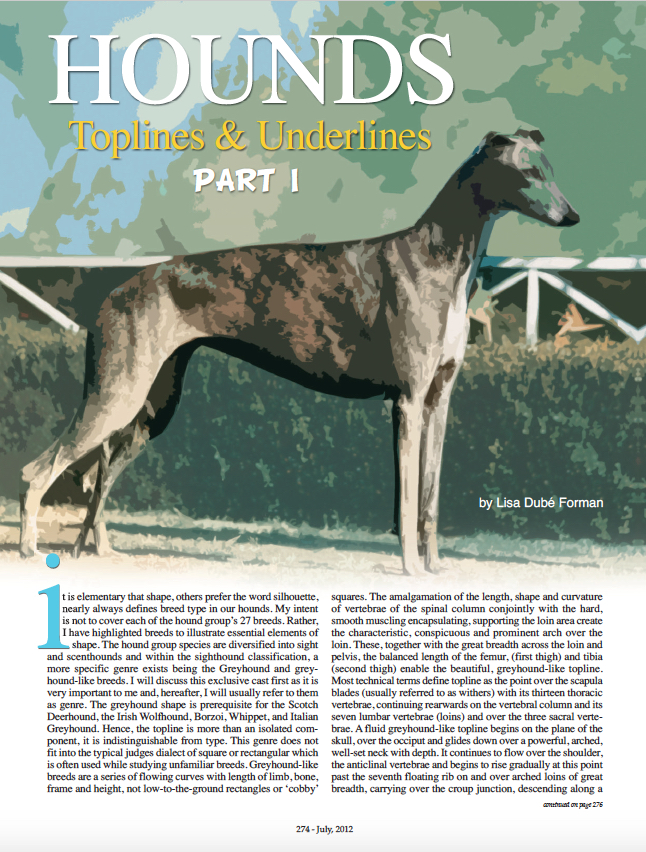
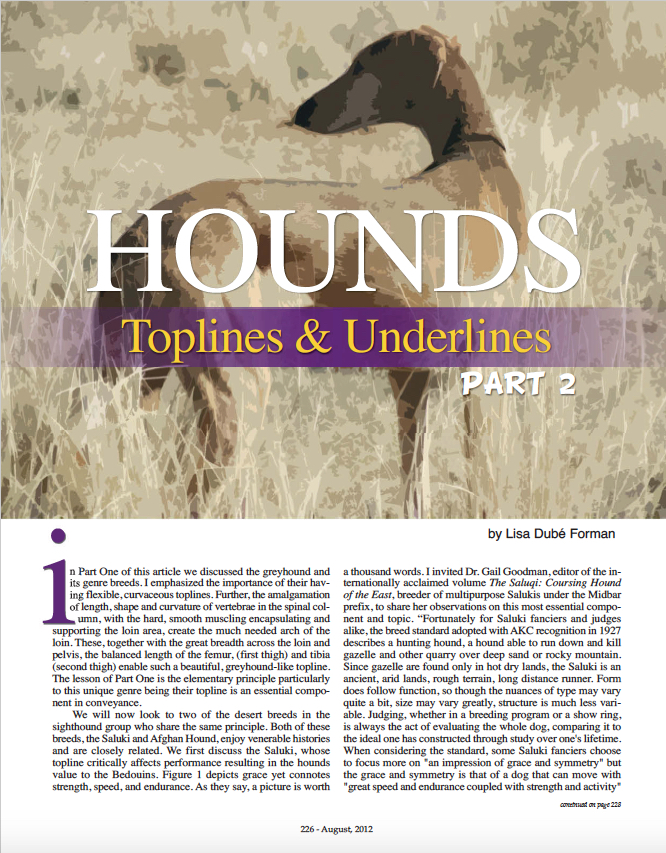
A Picture is Worth a Thousand Words
We all are familiar with the above aphorism which I believe is perfectly suited for purebred dog conformation events and its show photography. However, I feel that people unknowingly pay lip service to this truism. Almost all our typical dog show photographers shoot only stacked, profile ‘win’ show photos. Preferably, they should be focusing on, and we should demand movement shots........
We all are familiar with the above aphorism which I believe is perfectly suited for purebred dog conformation events and its show photography. However, I feel that people unknowingly pay lip service to this truism. Almost all our typical dog show photographers shoot only stacked, profile ‘win’ show photos. Preferably, they should be focusing on, and we should demand movement shots. Why? Well, what does that profile photograph tell you? How many times have you observed a dog about to be photographed at a show and instantly appear a flock of people fussing, brushing, whistling, straightening, readjusting, throwing toys to arouse the dog or to lift its head? When you see the photo, you can assess breed type, and you may be able to assess forequarter and hindquarter assembly, depending on the breed. In a few cases, seasoned fanciers can predict how that dog will move out around the ring based on its static profile. However, having been in sighthounds for 32 years, I can confidently say that the still-life is not always accurate. Mostly, inaccurate nowadays because that little army of hairdressers and assistants are styling that dog just like a film star has to go to makeup before appearing in a scene. Even further, some photographers will take ¾ shots to shorten up the dogs’ body length.
Gaiting photographs are worth a thousand words. Knowledgeable breeder/exhibitor/handlers relish locomotive shots in succession because movement is a critical aspect in almost all breeds. Seeing our dogs digitally, frame by frame, speak volumes on anatomy and muscling physiology. The experienced observer and breeder can see what is wrong and what is right, and these photos illustrate what is needed to improve upon the dog. Show win photos do not fulfill this function.
Ballyhara Darley gaiting photo by Andra O'Connell
Movement shots are vital learning tools to assist all of us in improving our breeding programs and the welfare of our dogs. Why welfare? With all other things being equal, e.g. genetic good health, a sound, properly constructed, proportionate, and well-muscled dog will have a greater life expectancy than a dog that is unsound and improperly built who will require chemical supplementation to relieve arthritis and strained muscles. Why the need for drugs such as Rimadyl and the host of other anti-inflammatory and steroidal medications? Incorrect angulation and poor assembly cause additional stress to tendons predisposing dogs to bone injury. Inferior muscling or unbalanced muscling increases susceptibility to injury as well. As a result, in many of these cases, these medical issues necessitate a need for pain relievers and anti-inflammatory medications (chemicals) to comfort the dog over the course of his lifespan.
In conclusion, the advancement of the sport of purebred dogs and its reputation is heavily dependent on the dog’s ability for locomotion. The origin of purebred dog shows was not established on nor did they award the dog who stood still the longest. Lastly, consider that companion dog owners do not buy dogs who cannot move. It would defeat the purpose of having a dog.
This edited article first appeared on the Canine Chronicle digital website. Short URL: http://caninechronicle.com/?p=7711
More Thoughts From Florence Nagle on the Irish Wolfhound
Though unique to the Irish Wolfhound breed, this brief conversation with famous sportswoman, Florence Nagle is befitting of all our giant Sighthound hunters. It is solid, basic logic that should prevail within the attitude of good breeders today. Unfortunately, over these many decades, I believe that our sport's mentality has devolved, rather than evolved. Moreover, in the case of the Irish Wolfhound breed, the overall state of mind has degenerated, having lost the mental and moral qualities that were once normal and desirable.
Type or Soundness, Which Do You Choose?
A long time ago, in what seemed to be a different world from that of today's purebred dog conformation sport, conversations used to take place regarding type and soundness. Back then, we read magazine interviews of well-known judges and one paraphrased question often put to them was "Which would you choose, type or soundness?" As was often the case, many all-breed judges replied, "You cannot have one without the other."
A long time ago, in what seemed to be a different world from that of today's purebred dog conformation sport, conversations used to take place regarding type and soundness. Back then, we read magazine interviews with well-known judges and one paraphrased question often put to them was "Which would you choose, type or soundness?" As was usually the case, many all-breed judges replied, "You cannot have one without the other."
In these earlier times, there was some fluidity of type in a sundry, but not many, of the breeds. As we fast forward to today, this archetypal question should be reexamined. In general, many dogs have experienced vital losses in "characteristic qualities that distinguish their breed" (The Complete Dog Book) and particularly, the sport now comprises an unusual audience with the majority of participants having varying skill-sets.
Unfortunately, countless hobbyists are unschooled and therefore, define soundness in miscellaneous ways. They do not understand the science behind the function of the parts as do educated breeders long familiar with the academics of soundness. The concept, state or being sound is fittingly described by Edward Gilbert & Thelma Brown as "Soundness is fitness to function" in their famous book K-9 Structure & Terminology. They expand on the definition of soundness by adding that it is a dog who is fit to perform whatever function it is designed to carry out, and that unsoundness can be due to poor conformation, lack of coordination or condition.
An antithesis to this dictum, "soundness is fitness to function" would be, for example, a wolfhound specimen who, in the judges opinion, has a typical outline and gaits cleanly, coming and going. However, the dog has 'stuck-on' forequarters. This is a structural condition of inadequate shoulder angulation with the legs forwardly placed on the skeleton accompanied by a flat, or shallow prosternum indicating there is insufficient muscling. Thus, this dog is both unsound and atypical; he lacks breed type and the qualities essential to the breed standard.
The reasons are that a wolfhound’s chest is part of the dog's mass developed for impact and is a tool for wounding fierce game. Above all, a properly developed chest is necessary to prevent injury to the frontal portion of the dog's skeletal structure. When the wolfhound hunts and launches itself on the prey (typically on the backside of the neck) a lack of fill and forechest, along with incorrect forequarters (set too far forward), can maim the wolfhound as it hits the prey. If the impact is too jarring the Wolfhound may suffer disorientation, depending on the game, this may provide an opportunity for the hunted to turn on the hunter. This is an affirmed doctrine applicable to Sighthounds that hunt large game and is as old as time. It is a familiar requirement to the ancient Afghan Hound breed as well as the Northern Scenthound breed, the Norwegian Elkhound, that requires ‘fill’ to protect the dog from the harmful impact of hooves.
In former decades, unsound or bad forequarters had always been a leading issue throughout the breeds, but today this is not the case. Now, there are even more 'bad front ends', but interestingly the magnitude of so many has seemed to lessen their objectionability while increasing their permissibility. Go ahead and stand outside a conformation show ring and behold the number of poorly structured exhibits. Presently, many hobbyists wrongly conclude that the term 'soundness' only pertains to the gait action while coming and going; single or double tracking towards the observer, driving off while going away and the absence of lameness. Any variations while traveling, such as moving wide, padding, weaving in the front, and narrow or hockiness in the rear are faulty. Remarkably, to many a fancier, the term 'soundness' is subjective with many believing that a dog is sound as long as it moves cleanly. In reality, the true definition of soundness, as applied to canines, has been hijacked or in a sense has devolved.
Just a small percentage of exhibitors and judges understand that soundness relates to the whole construction of the dog, meaning correctly constructed forequarters and hindquarters. Faulty or otherwise unsound examples would be steep shoulders, stuck-on forequarters, straight upper arms, over-angulation of the stifle and or length of the tibia, steep or flat croups, etcetera.
However, we are faced with yet another dilemma: the era of generic show dogs. I am fond of challenging people to take photographs of selected breeds, then crop out the heads and show them to hobbyists. I believe numerous people would be unable to identify the breeds because a large number of dogs have become plain, they lack type. Just plain ole' vanilla. Breed type is a principal component in judging. Phenotype and the quintessence of a breed are what characterizes a dog from not just an average specimen, but from other breeds as well. Breeding programs and dogs who are lacking type, in my opinion, is a sobering misdeed. Judging and awarding those deficient in type is as well since judges can cause great harm to a breed. Adjudicating is a responsibility that should never be taken lightly as losing breed essence is not trivial. Moreover, it can be very hard to recover.
By and large, all-breed dog show judges will fault a dog for less than ideal 'down and back' movement. To illustrate, Dog A embodies breed essence, therefore, is 'typey' but may move slightly wider while traveling towards a judge. Shamefully, this dog most probably will be undervalued as compared to Dog B, which is ordinary or not distinctive in appearance, yet single tracks cleanly. Or, if Dog A moved somewhat close behind as compared to Dog B whose hocks were parallel. In my year's of observation, there is a significantly greater tendency for all-breed judges to award generic Dog B over 'typey' Dog A.
This is why, in my opinion, the original question needs to be reexamined. If we are forced to identify with the limited and widespread interpretation of soundness today, then let it be said that even a mixed breed dog can move soundly. It is important to mention that I do not refer to, include nor forgive locomotive faults and failings such as sickle-hocked, padding, and hackney action, to name just a few. These are the obvious effects of unsound engineering.
Specialty breed judges are often guilty of the same type of adjudication as many all-breed judges. It is referred to as 'fault judging' as both sets of judges cannot see the forest for the trees. Often, we see these judges 'paint themselves into a corner,' having limited their choices to such an extent that they ended up with an apparent mishmash of specimens. Consequently, they have done a disservice to the breed. For instance, one time a specialty breed judge informed me that my bitch had "beautiful type, and was a gorgeous mover" but commented that she was moving slightly close behind and excused her from further competition. A situation like this is disheartening when a judge recognizes distinguishing characteristics that embody the breed's structure, gait, and shape but is unconcerned with awarding them.
I wholly subscribe to the dictum 'soundness is fitness to function.' Nevertheless, I also believe that mediocrity is not a goal nor is ordinariness the level of the bar that determines success. Despite what is happening regularly at our dog show competitions.
I agree with Samuel Evans Ewing III, when in 1978, he stated the following:
“…if I had to choose between the two. I would go first to type and then to soundness. I think the soundness is determined somewhat by the type of the animal and its purpose in life.”
The Front End
Lately, having returned from a specialty breed show, as well as an all-breed dog show, I am now, more than ever, flummoxed with the quality of purebred dogs. I will add more conversations and thoughts on several other topics, but this post is concerning the forequarter assembly. I am speechless about the condition of front ends on dogs.
The central and important principle to understand is that a canine’s front end is responsible for supporting more than half of the dog’s weight. These bones are not useless or trivial components of the canine anatomy.
Lately, having returned from a specialty breed show, as well as an all-breed dog show, I am now, more than ever, flummoxed with the quality of purebred dogs. I will add more conversations and thoughts on several other topics, but this post is concerning the forequarter assembly. I am speechless about the condition of front ends on dogs.
I ask myself over and over again, the same questions. Do breeders not understand what comprises a correct, faultless, forequarter detailed for their breed? Do breeders not care about a front assembly? What's more, the judges themselves, ignore or are unable to recognize an unsound, faulty, just-plain-wrong, front end! For longtime fanciers who read this, they will recall the comprehensive conversations among hobbyists and judges, in all-breeds, which took place a decade and more past about forequarters. It was an ongoing hot topic issue. Magazines abounded with articles on the defective, bad front assemblies of purebred dogs at our conformation shows. You could not get away from it. Whenever you joined a conversation at a dog show, inevitably, the conversation turned to bad fronts. Still, here we are today with the same old issue. But, I believe it is even more pervasive now than 10-20 years ago.
I just don't get how a major anatomical abnormality has been neglected, disregarded and overlooked, to such an extent that, it has been deemed acceptable and has frequently been rewarded? Have we rewritten all the science books and literature on canine anatomy and I missed all the book signing events? Why didn't anyone tell me!?
Here I include an edited article I wrote several years ago that was published in the Canine Chronicle magazine, titled, "The Front End." It is not just a tedious discussion on shoulder layback or stuck-on fronts but rather; it talks about the outcomes of 'breeders' lacking anatomy education or concerns who are producing litters of puppies which they place into companion homes. A poorly informed, undiscerning breeder affects new pet owner’s lives. A breeder may be cultivating a bloodline of dogs that are structurally unsound and incorrect, or that have congenital defects such as poor muscle development. Due in large part to their lack of schooling, in some a willful lack of concern, the breeder is unaware of their dog's engineering problems, and the importance of the musculoskeletal system which affects, by way of perpetuation in their breeding programs, future quality of life. Incorrect angulation and poor assembly cause additional stress to tendons predisposing dogs to increased injuries to their bones, joints, muscle, tendons, ligaments, and feet. Inferior muscling or unbalanced muscling increases susceptibility to injury as well.
The repercussions, in almost all cases, are that the defects cause pain making it necessary for pain relievers and anti-inflammatory medications over the course of a dog’s lifespan as they age and break down, due to poor conformation. I can only hope that my article makes a difference somehow and with someone.
The Front End