
DOG BLOG
Musings
Tuxedo Park and Somerset Hills Kennel Club Shows Still Got It!
Just returned from two days at the acclaimed Tuxedo Park and Somerset Hills Kennel Club dog shows that are just two in the usual show circuit in Somerset, New Jersey this past weekend. What classic shows but, oh boy, was it hot! Excruciatingly and unbearably hot. Most of us had on our persons either a towel or paper towels to wipe our faces as the perspiration flowed off your body. In fact, the Show Chairperson announced over the loudspeaker that due to the temperature and humidity levels that all gentlemen exhibitors were encouraged to shed their sports coats and ties. As for the women, it was both senseless and useless to wear make-up, particularly not mascara, as it melted off our faces. It was so hot & humid that despite our hydrating with large quantities of fluids every 10 minutes or so; there was infrequent, if any, use of the restrooms. Literally, for all the water we took in every few minutes, the body used it to cool our bodies via evaporation, and it had nothing left to process.
As for the shows, Saturday is always a special time to attend as the Somerset Hills Kennel Club has a wonderful, old-fashioned band playing tunes throughout the day under an enormous shade tree. The Greek Gyro food truck was, as usual, present for the dog show circuit offering a wide variety of entrees, vegetables, salads and fresh fruit. Even breakfast sandwiches, burgers, hot dogs, and french fries. The Flip Bar smoothie truck was present as well and is always a popular option on stifling hot days.
Ballyhara Ki exhausted from the stifling heat
But hot, oh my goodness, Friday was unendurable forcing us to give up as we waited for Group competition to begin. I could not take it any longer and had to leave for the comfort of an air-conditioned room. My full ton, Super Duty dog show van with its heavy-duty alternator and battery ran for six or more hours straight as I attempted to cool down two Irish Wolfhounds with ice, air conditioning, and water. I went through a quarter of a tank of fuel to make certain the dogs were comfortable. Naturally, we cannot control Mother Nature, and I have attended this circuit in the past where I do not recall it being this hot before. Nevertheless, it is a famous dog show circuit that appears to possess its glory still. Though as I pointed out in my previous post on September 7, "More on All-Breed Dog Shows," this circuit is also experiencing difficulty attracting Major Entry competition even in a favorite breed such as Long Haired Dachshunds.
After returning home, I checked in mid-week with friends who also spectated at the Westchester Kennel Club show held on Sunday of this circuit. My friends are long-time dog fanciers of forty plus years who no longer are active in the sport but do enjoy coming out to observe at close to home shows. Interestingly, she remarked what a shame it was to see that few people stay any longer to watch Group Judging competition on the last or closing day of the circuit, this being a Sunday. Although this Sunday had lovely weather with comfortable temperatures as compared to the previous several days, she said barely a few people were observing, and it was a sad sight to see. Ah, yes, I said, it is a sign of the times......
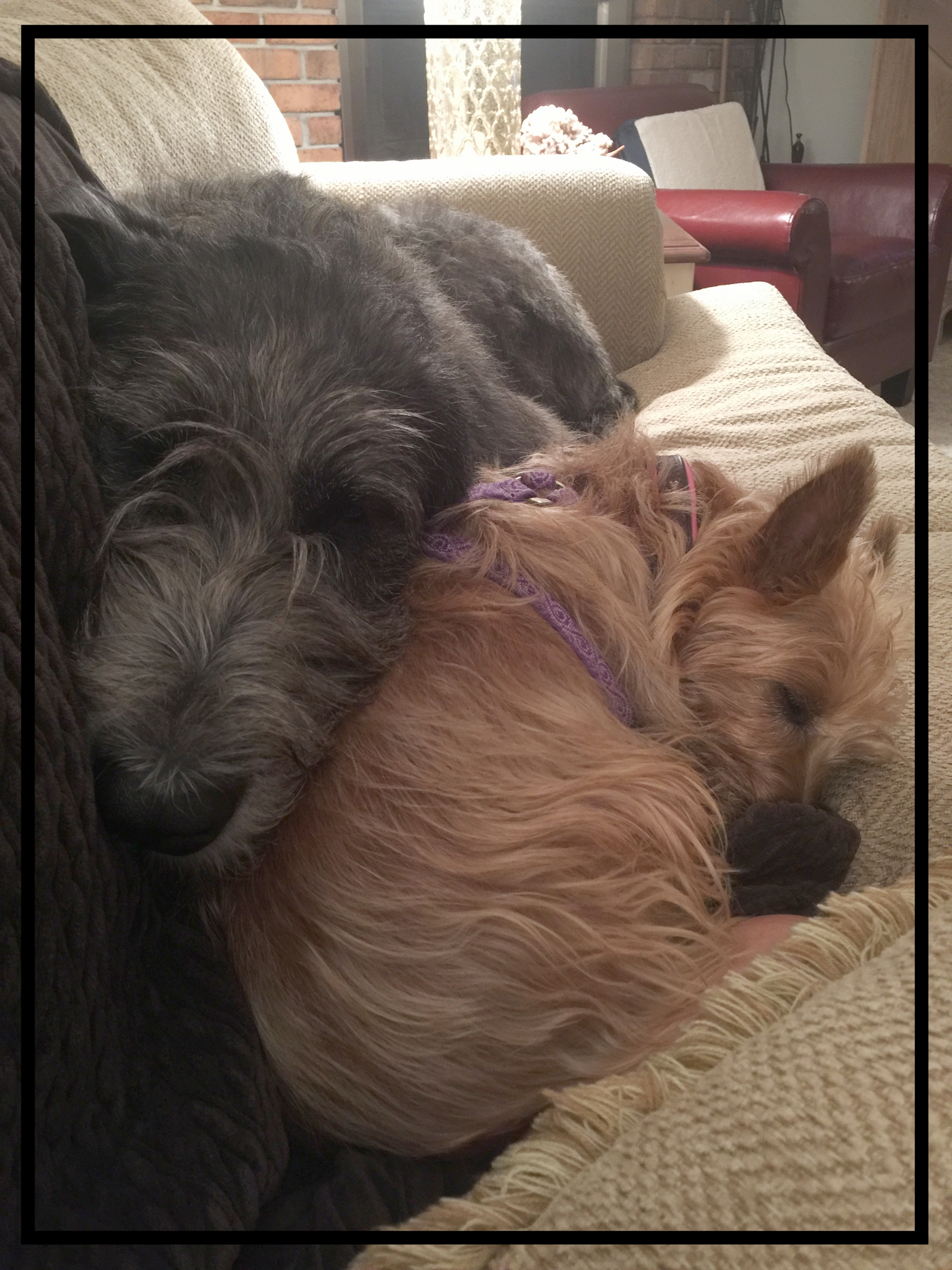
Ballyhara Kate and Lucy passed out on the couch after all the stifling heat
More on AKC All-Breed Dog Shows
A friend of mine and I were conversing about the decline of dog entries at AKC conformation shows, and I wondered how the loss of 384,000 entries over a ten-year span had affected her and her breed. She regularly exhibits and is well-known in Longhaired Dachshunds, not only here on the East Coast but she also travels great distances such as to the mid-west and Florida's Eukanuba. I was keenly interested in her feedback and the experiences she has encountered in her breed....
I believe it is necessary to share more information on the topic discussed in my previous post titled "AKC Conformation Events, A Closer Look." A friend of mine and I were conversing about the decline of dog entries at AKC conformation shows, and I wondered how the loss of 384,000 entries over a ten-year span had affected her and her breed. She regularly exhibits and is well-known in Longhaired Dachshunds, not only here on the East Coast but she also travels great distances such as to the mid-west and Florida's Eukanuba. I was keenly interested in her feedback and the experiences she has encountered in her breed.
Wow, was I surprised with her response, though, actually, I should not have been. First, a quick point that the AKC Most Popular Dog Breed list ranks Dachshunds as number 13 out of 184 breeds in popularity. However, her reporting of few to no entries at all-breed shows led me to believe that we could have been talking about a low-entry or rare breed!
To illustrate, she referenced an upcoming and usually very popular New Jersey all-breed dog show circuit beginning on Thursday with the Central New Jersey Hound Show, followed by Tuxedo Park, Somerset Hills, and Sunday's conclusion with the Westchester Kennel Club Dog Show. Starting with Thursday's Hound Show, she reported that there is only 1 class entry of each sex in the Longhaired Dachshunds competition -- no points. Friday's Tuxedo Park Kennel Club Show, again, only 1 of each sex entered in the classes -- no points. Interestingly, there are no majors in the other two varieties as well at this particular show. On Saturday, Somerset Hills hosts the long-time Dachshund Club of New Jersey Specialty, which she continued, has only 1 class male and 3 class bitches offering just 1 point total for Long-Haired Dachshunds classes! Sunday, the Westchester Kennel Club has only one of each sex in the classes with, again, no points.
How dismal is it that a highly respected, competitive East Coast all-breed show circuit cannot attract enough entries of a favorite breed variety, which ranks 13 of the most popular breeds, to offer even 2 points, let alone a major win? My friend added that there were several mid-west specialties in which, again, no major championship points were available in her breed, but she went further listing a recent number of familiar dog shows, to include one or more upcoming events, that had or have no points available. In fact, she concluded that she could not recall any major points offered for Long-Haired Dachshunds at an all-breed show this year. Frankly, she stated, she was sick of it.
Inevitably, I inquired if the Long-Haired variety was more scarce or rarer than the other two varieties, those being Smooth and Wire-Haired. She was emphatic in her reply stating that there is nothing rare about Long-Hairs. Indeed, she went on to recount that this variety is so popular that, in past decades, it used to take 12 entries in competition to make-up a Major in which she had neither difficulty in finding nor winning.
Well, her feedback certainly mimics what I said previously about my breed, Irish Wolfhounds, when I also recalled there was a time, here on the East Coast, when I could finish a wolfhound with three or four majors amid a large number of competitors.
AKC Conformation Events, A Closer Look
After writing my post, "Sad to See," I decided to look closer into how many AKC conformation all-breed events are held annually. If you read my earlier article you would be familiar with the argument by many, many fanciers that there are too many dog shows today, and as a result, the number of entries are spread very thin but also membership and volunteerism as well.
First, do you believe that there are fewer entries at conformation dog shows? Take a look at the data concerning AKC conformation events and for those who disbelieve, this will change your mind........
After writing my post, "Sad to See," I decided to look closer into how many AKC conformation all-breed events are held annually. If you read my earlier article you would be familiar with the argument by many, many fanciers that there are too many dog shows today, and as a result, the number of entries are spread very thin but also membership and volunteerism as well.
First, do you believe that there are fewer entries at conformation dog shows? Take a look at the data concerning AKC conformation events and for those who disbelieve, this will change your mind. The AKC Annual Reports state the following:
2015, there were 1,599 all-breed shows with 1,326,737 entries
2014, there were 1,610 all-breed dog shows with 1,356,066 entries.
2013, there were 1,614 all-breed shows with 1,386,727 entries.
2012, there were 1,604 all-breed shows dog shows 1,435,266 entries.
2011, there were 1,589 all-breed dog shows with 1,455,971 entries.
2010, there were 1,586 all-breed dog shows with 1,473,751 entries.
2009, there were 1,548 all-breed dog shows with 1,516,098 entries.
2008, there were 1,534 all-breed dog shows with 1,641,004 entries.
2007, there were 1,548 all-breed dog shows with 1,698,840 entries.
2006, there were 1,519 all-breed dog shows with 1,710,265 entries.
Get the picture? This reveals a significant decrease of nearly 384,000 entries between 2006 through 2015. However, more spectacularly, it has been accompanied by an increase in the number of all-breed dog shows. What do you think happens when there is a loss of 384,000 entries but an increase of 80 plus conformation all-breed dog shows? Here is what happens: 2015's 1,326,737 entries are spread very thin. Ahh, some might feel that AKC should have been more responsive to the situation. Let us take a look at that as well for every dog show entry is accompanied by the following verbiage: "Including $3.00 AKC event service fee per entry & $.50 AKC recording fee first entry only."
Translation: revenue. Here are the AKC Recording and Event Fee Revenue breakdowns:
2015 — $11,313,000
2014 — $11,366,000
2013 — $11,317,000
2012 — $11,249,000
2011 — $10,912,000
2010 — $9,955,000
This is certainly not chump change but a healthy profit, and as you can see, the revenue has grown meanwhile there has been a marked decrease in conformation dog show entries. I suppose someone will logically ask the following question: "If there are fewer entries, AKC revenue should also be down." Perhaps, and this is speculation, that the two do not necessarily go hand in hand.
First, recording and entry fees most likely have risen over these many years. Moreover, the increase in the number of shows affords easier access to closer or even doorstep all-breed shows. The decreased entries are spread throughout the plethora of all-breed shows, and now, it is not uncommon to see shows with a number of breeds having only one or two breed entries. Few to no points are offered, but your entry money is nonrefundable after the Closing Date. AKC receives their cut, no matter. Fanciers do get discouraged and feel that it is not worth it any longer. They usually do not attend a show when there are either one of two entries or the only entry! Instead, years past, many of us old timers would have to wait with great anticipation to exhibit at a singleton show or a well-known circuit. We would have large entries, sometimes enough for 5-point Majors or when I could exhibit a wolfhound to their championship winning four Majors. Those were the days my friends.....
I speculate that AKC's answer to this dilemma is to lower the number of dogs required in their Points Schedule for two points to 5-point Majors. Just don't touch their revenue stream.
By the way, I did look to see the comparison for the circuit I spoke of in the "Sad to See" blog post. According to the earliest data on infodog.com, the Southern Adirondack Kennel Club dog show has been in the same location throughout these many years. On Saturday, August 1999 there were 1025 Total Dogs Present and Competing out of 1374 entries. On Saturday, August 2016 there were 664 Total Dogs Present and Competing out of 859 entries. That is a difference of 515 entries and tells us something right there.
AKC Revises Driving Distance for Dog Shows
I am providing an update to my earlier Blog Post titled, "Sad to See" which discussed the issue of far too many AKC all-breed conformation dog shows and the impact it is having on long-established all-breed kennel clubs. Now, the AKC has lowered the barriers for even more dog shows which, by the way, generates more entry revenue for the AKC. If many of you were not aware, every Premium List includes the following verbiage: "Including $3.00 AKC event service fee per entry & $.50 AKC recording fee first entry only"......
I am providing an update to my earlier Blog Post titled, "Sad to See" which discussed the issue of far too many AKC all-breed conformation dog shows and the impact it is having on long-established all-breed kennel clubs. Now, the AKC has lowered the barriers for even more dog shows which, by the way, generates more entry revenue for the AKC. If many of you were not aware, every Premium List includes the following verbiage: "Including $3.00 AKC event service fee per entry & $.50 AKC recording fee first entry only."
During the July 2016 BOD Meeting, the AKC Directors approved a modification to the Limited Number of Events Policy which revises the road mileage or distance between show sites. Specifically, to balance with the existing policy of 75 straight-line miles between territories the optional criteria for isolated status will now be reduced from 100 miles to 75 miles. This change will provide additional clubs the opportunity to apply for isolated status which means, even more, dog shows!
What determines club isolation? Here is AKC's definition: "Geographically isolated clubs are determined by there being no AKC club within 75 straight-line miles between territories unless the clubs show site is greater than 75 driving miles from the nearest show site" -- (Their definition and not mine)
As a result and by AKC's calculations, verbatim: "In an analysis of potential shows sites, it was determined that 47 sites/clubs may be allowed to hold additional shows at their show sites by decreasing the driving mile threshold to 75. (This includes 21 clubs currently considered isolated in the continental US). When compared to the 100-mile driving distance this is an increase from 9 to 26 additional potential isolated sites.
Wow, just 75 miles creates isolationism for an AKC purebred dog event. I am amazed -- it is no wonder that we are envisioning tumbleweeds at the show circuits that I already discussed in my Sad to See blog post! As an influential encore, Judges are not allowed to judge the same Breed, Group, and Best in Show assignment within a 200-mile straight line distance of one another, yet, we have AKC all-breed shows only 75 miles distant and to boot, anything over that is considered a remote territory!
What a farce! No one can complain to me about having to drive hours to get to a dog show since I have lived in the Adirondack mountain resort of Lake Placid, New York for approximately 32 years. The nearest kennel club association is either Montreal, Quebec that is two hours distant or the Glens Falls Kennel Club. The latter is an hour and a half distant at a minimum -- depending on the season and good weather -- because we have to come down and out from the mountains which can be treacherous in the winter and painfully slow in the warmer months due to the tourists. However, even then, this is not to reach a conformation dog show event. Member kennel clubs are permitted to hold two shows annually, and as so many kennel clubs have done in recent decades, almost all in the Eastern region of upstate New York have clustered together to make ends meet, and the location of choice is the Eastern Exposition Center in West Springfield, MA. As a result, the usual distance for me to drive so that I can exhibit my hounds in the United States is 3 hours and forty minutes or 222 miles each way.
Despite the hardships that I endure in exhibiting my hounds, even I believe there are too many all-breed conformation events! Pray tell, why? I enter an event at a typical cost of $32.00 per entry -- often taking two to make it worth my while -- and the breed judging attracted low or minimal entries. Therefore, only one point is available in either sex. My familiar scenario is that the scheduled ring time judging is 8:30 AM and the show is nearly four hours away so I must pack up and drive down the day before and pay for a hotel room. All this for just one point and when I arrive at the show ring; the competition is absent because it was not worth their time. You can substitute 2 points for the one point -- it does not make a difference as it frequently happens for two points as it does for one point. Now, do this time and time again and you might just begin to get an inkling of what I have experienced for decades now. As I am fond of saying, "Welcome to my world." In my opinion, the system and sport are broken.
The facts are, according to AKC, it has over 600 independent member clubs who send delegates to AKC meetings to vote on rule changes and policy issues, and over 4,500 licensed and sanctioned clubs who conduct AKC-approved events. Still, why do we need more shows to bankrupt the previously fiscally sound kennel clubs or to steal more volunteers, and members away from once esteemed associations that fanciers once felt privileged to belong? The answer, is that we do not but, if not then why is this happening? Is it all about the money?
Sad to See
I recently attended a dog show cluster that used to be called "The Adirondack Circuit, The Place to Be," which is a well-known eastern cluster of five back-to-back shows held in Ballston Spa, New York during August. Wednesday through Sunday, these shows have provided an opportunity for exhibitors to "park and plant it" for as long as I can remember and in years past attracted large entries. Admittedly, I have not exhibited at this circuit since 2009 but boy, what a surprise it was for me when I arrived. I entered one day out of the five being a Saturday and it was, as I alluded to, something of a shock for me and my friend....
Last weekend, I attended a dog show cluster that used to be called "The Adirondack Circuit, The Place to Be," which is a well-known East Coast group of five back-to-back shows held in Ballston Spa, New York during August. Wednesday through Sunday, these shows have provided an opportunity for exhibitors to "park and plant it" for as long as I can remember and in years past attracted large entries. I have not exhibited at this circuit since 2009, but oh boy, what a surprise it was for me when I arrived. I entered one day out of the five being a Saturday and it was, as I alluded to, something of a shock for me and my friend.
This circuit used to attract scores of entries and with it came the vendors and great food. In fact, I recall one vendor whom I believe used to come from Massachusetts and they had delicious sandwiches on the freshest bakery rolls available -- the owner once informed me that they picked up the rolls on the way to the show. One had to wait in a long line just to get their food. Alternatively, there was also a favorite Greek food truck which had the most pleasant and refreshing food options such tzatziki, gyros, and the like. I cannot remember if they were one and the same but no matter because they are all gone now. We walked over to the vendor area and just turned around in an empty circle where once, years before, there were at least one to two isles of merchants. All gone -- no more food vendors except the solitary fairground stand and the smoothie Flip Bar. Gone are the dog bed vendors who used to have large assortments of dog beds as well as the numerous show dog supply vendors. Save for just three small, economical set-ups -- two show dog supply merchants with a small assortment of leads, bowls, and toys, and then another who was selling grooming tables.
It was sad to see and as I said earlier, very surprised. It was similar to looking sentimentally at a structure that held many memories for you, and now, it is rundown, forlorn and dilapidated. Perhaps I sound melodramatic but looking around at this circuit, on a Saturday to be precise, and not just a busy workday excuse like Wednesday or Thursday; my friend and I just felt pity, as it seemed so empty. There was a sundry of rings set-up, but nothing near the number I recall and it appeared that several rings had been taken down already. However, again this was a Saturday, the busiest day for any circuit and as far as I could ascertain, they were not taken down but were just empty spaces. In today's day & age, with all-breed kennel club shows losing entries like a fractured dam losing water, at least this Saturday show still had a respectable *859 entries with 804 present and competing. It goes without saying that I commend the volunteers who turn up, time after time, to host this conformation dog show but it must be a bittersweet experience.
A woman was walking her dog, and we stopped to ask her what happened -- where were all the retailers and food options as there were in yesteryear? She sighed and said, "This is what it is now, all that you remember are gone." There was just emptiness; how somber.
The stranger offered that it is an expensive hobby and after the financial crash in 2008, many people did not return to the sport. Though the points she made were valid, I feel that the most influential factor today is that there are far too many all-breed kennel club dog shows. Indeed, there exists a gluttony of all-breed kennel club shows to the detriment of the sport and exhibitors. How so? Well, harmful because old-established kennel clubs are dissolving. Not just because of low entries, but also because of a lack of membership. With so many kennel clubs vying for fanciers membership and volunteerism, some of the once stalwart kennel clubs have few members remaining, with many who are, I am sorry to point out, elderly. One example is Pennsylvania's Chester Valley Kennel Club which is in the process of dissolution. They simply did not have enough members where once this was an esteemed all-breed kennel club. We will see much more of these in the future. How do the vast number of all breed shows hurt exhibitors? Easy, the more shows, the fewer the entries. The fewer the entries, the fewer the breed points and or Major Wins. Many people today cannot afford to, or have the time to enter a dog show every weekend, every other week or every month. So, the far too many assemblages of clubs divide exhibitors attention, attendance, and money. This affects the number of dogs in competition and any possible points accrued towards their championship.
Take for example the dog show circuit I discussed above which ran from August 10 - 14, 2016, with five back-to-back all-breed kennel club shows located in Ballston Spa, New York. Just four days later, beginning Thursday, August 18 - 21, 2016, four back-to-back all-breed kennel club shows are being held in Apalachin, New York. The distance between these two clusters is only 158 miles or 2 hours and change, all highway. Let's go the other direction where six days later, on August 20-21, 2016, two back-to-back all-breed kennel club shows are being held in Marlborough, Massachusetts at a distance of only 175 miles from Ballston Spa, NY, or about 2 hours and 45 minutes distant, all highways. These above shows represent just a minority in what most likely is happening in the most populous areas all around our country. People are kidding themselves if they do not believe that the abundance of these all-breed kennel club dog shows is not affecting entries.
Consider that an AKC judge is not approved to judge the same breed, Group or Best in Show if it falls within 200 straight-line miles and or within 30 days of another assignment. So, why then are we allowed to have all-breed kennel club dog shows located within a 200-mile marker week after week? Exhibitors are going to pick and choose and as a result, down go the entries, and our hard earned money with them. How many times have you entered a show and there was just one, maybe two points and then once you are there, the other competitor is absent having said to heck with this. There went your $32.00 and more --depending on your drive time -- and if you had to get up at 4:00 AM to make an 8:00 AM ring time. It certainly gets old fast, especially when this happens time after time. Then after awhile you just say, "No more."
*UPDATE and Correction:
The Stats should read "664 Total Dogs Present and Competing out of 859 total entries." The previously cited and incorrect stats were taken from the AKC website three days after the show and obviously do not coincide with the Superintendant's records.
Toxins in Motel & Hotel Rooms
Recently, my husband and I attended an all-breed dog show and our ring time made it necessary for us to get a motel room the night before. Because we would not arrive until 11:00 PM and were checking out at around 6:30AM, I reserved a room at a budget hotel chain. It was only for 6 or 7 hours so why spend the extra money on a higher priced hotel room. It was here that I had growing concerns on an issue that I do not believe has even crossed people's minds: formaldehyde emissions from substandard flooring and furniture in budget motel accommodations.....
Recently, my husband and I attended an all-breed dog show and our ring time made it necessary for us to get a motel room the night before. Because we would not arrive until 11:00 PM and were checking out at around 6:30AM, I reserved a room at a budget hotel chain. It was only for 6 or 7 hours so why spend the extra money on a higher priced hotel room. It was here that I had growing concerns on an issue that I do not believe has even crossed people's minds: formaldehyde emissions from substandard flooring and furniture in budget motel accommodations.
This is a credible concern, especially for dog show exhibitors who frequently stay overnight in motels while traveling to distant dog shows. Although gasoline costs have lessened dramatically from several years back, many people try to save their hard-earned money and typically, the motel accommodation is the largest expense for dog show clusters or specialties. So, it is both sensible and natural that people choose a budget motel as inevitably, they spend most of the day at the dog show anyway and are only in their rooms in the evening. This budget motel we overnighted briefly in was fully booked with dog show exhibitors as is usually the case for many of the economical chains for weekend dog shows.
Everyone saves money, but, at what cost?
Here is the concern. Economical motel rooms commonly contain substandard quality furniture and on average, are usually smaller in size than mid-range hotels. Why does this matter? Formaldehyde emissions: The U.S. Environmental Protection Agency (EPA) has classified formaldehyde as a known human carcinogen. Many budget motel rooms are small and due to the lack of square footage, they have less ventilation. These tight quarters, combined with the low-grade furniture made of composite wood products and laminated flooring may have higher emissions of this colorless, flammable gas. Breathing in the air that has off-gassed formaldehyde can have adverse health effects. Even more, formaldehyde can and will continue off-gassing, polluting the indoor air for great lengths of time, though for how long is hotly disputed between the experts. Some say years, some say indefinitely, some say shorter durations.
According to the EPA: Formaldehyde is found in resins used in the manufacture of composite wood products (i.e., hardwood plywood, particleboard, and medium-density fiberboard). It is found in building materials and insulation and products such as glues, permanent press fabrics, paints and coatings, lacquers and finishes, and paper products, to name a few. Keep in mind that much economical furniture is composite products with veneer or laminate, all held together with added formaldehyde based glues then pressed together. Most people watched or had heard about the 60 Minutes segment that investigated a national flooring company, Lumber Liquidators. The investigators found that Lumber Liquidators' Chinese-made laminate flooring contained amounts of toxic formaldehyde that did not meet health and safety standards, in accordance with the California Air Resources Board (CARB) regulation. Currently, this is the only regulation in the country that reduces public exposure to formaldehyde through the establishment of strict emission performance standards.
How does this affect us? Many dog shows are held throughout the colder seasons, and people turn on the heat in their hotel room. According to the EPA, the rate at which formaldehyde is released is accelerated by heat and may also depend somewhat on the humidity level. The EPA recommends that people use air conditioning to control or reduce humidity which can help reduce formaldehyde emissions. They also recommend increasing ventilation which can be impossible in many motel accommodations. However, even with the air conditioning unit running, especially in such a tight quarters, this only helps to reduce, not eliminate the off-gassing. As we sleep, we breathe in this colorless gas in very close proximity to and parallel with the bed frame furniture, sometimes just inches away. Notably, we are also elevated just a few feet off the laminated floor. Formaldehyde causes irritation of the skin, eyes, nose, and throat and can also cause symptoms such as headaches, fatigue, and dizziness. Moreover, high levels of exposure may cause some types of cancers.
Most likely many people are not aware of the exposures. It just dawned on me this past weekend. What to do about it? Well, there are no hotel industry guidelines that I can find on the subject, except for the American Hotel & Lodging Association's sustainable greening guidelines. But, we all know that green hotels are a significant minority and very hard to find. We may very well be stuck between a rock and a hard place. For those exhibitors who are frequent motel guests, if possible, staying in larger deluxe accommodations may be helpful. Also, using the air conditioner regardless of the season can decrease humidity in the room, although panting dogs will elevate this level back up again. I am not an environmental air quality expert but if you begin to experience symptoms of headaches, sinus and eye irritations you should alert hotel management and, if possible, be moved to another room. Keep in mind that even deluxe hotels may be newly furnished or had recently undergone renovations. If so, the room's renovations and furniture initially will contain higher emissions of formaldehyde via off-gassing, unless they were refurbished with organic wood furniture or carpeting, which is highly unlikely. Inquire when making reservations if a the motel or hotel has recently undergone restorations or improvements. You might base your decision then on the quality level of the hotel and the room size, such as a suite with greater square footage allowing for greater ventilation, or that has windows that can open.
Just know that the EPA currently has no national standards in place for formaldehyde in composite wood products. They are supposedly reviewing regulations. So, at present, there are no safeguards for your respiratory health while staying in any accommodations, unless of course, one resides in California.
It's All About the Money!
Our purebred dog conformation events have been transformed. The first sentence in the AKC Mission Statement is, “The American Kennel Club is dedicated to upholding the integrity of its Registry, promoting the sport of purebred dogs and breeding for type and function.” I would suggest “...and breeding for type and function” needs reconsideration and updating......
Our purebred dog conformation events have been transformed. The first sentence in the AKC Mission Statement is, “The American Kennel Club is dedicated to upholding the integrity of its Registry, promoting the sport of purebred dogs and breeding for type and function.” I would suggest “...and breeding for type and function” needs reconsideration and updating.
Just about everyone will agree that conformation dog shows no longer highlight the best breeding stock to perpetuate the breeds. Clearly, many of today’s breed exhibits are not products of breeding for type and function. Rather they are the results of breeding for the accepted and often sought after exaggerations and extremes which produce dysfunctional show dogs. Such as bird dogs with keels similar to a prow of a sailing boat; spaniels with incredibly domed skulls; dogs with necks like a swan; galloping sighthounds with short legs and level toplines; or shepherds standing on nearly horizontal metatarsal bones, to name just a few.
The breed ring is commonly a crapshoot. The exception to this rule is if a professional handler is exhibiting then this may improve the odds of winning. Breed metamorphosis usually influences the unknown or uncertain aspect of dog show adjudication’ by incompetent or uninformed judges. In my article “What Are They Looking For?” I discussed the lack of knowledge and capability for some judges to explain ‘why they did what they did’ after they quickly point to a dog(s) in a class for a win.
There are numerous, interesting articles by respected adjudicators who recognize and discuss the transmutations taking place throughout the breeds. We talk about the arbitrary state of judging, and though everyone hears what we say, it seems no one is LISTENING because nowadays, to win, extremes and or generics are how you have to play the game. It is àpropos to quote AKC Judge and long-time breeder Katie Gammill here.
“The best of the best or one that looks like the rest? Let’s be honest. Something called “preferred type” is flooding the rings today and in many breeds, it has little to do with the Breed Standard. When “current type” does not equal correctness, the best dog can lose because in many rings, the fatal flaw is being a stand-out. Should we just BREED TO WIN or should we BREED TO THE STANDARD and expect judges to judge to the Standard?”
There is an abundance of ‘show breeders’ these days whose primary goal is to breed litter after litter after litter, often selling many or even all pups as show prospects in their maniacal obsession to achieve the most number of AKC champions produced for their breed. This itself has become its individual competition. Some may consider me to be very old-fashioned, or out-of-touch in my attitude towards conformation dog shows. The truth is I am only interested in conserving the original purpose of purebred dog show competition, breeding for and preserving type and function and protecting a breeds welfare. Sadly, it appears that an overwhelming anxiety stokes some breeders modus operandi, this being 'who will buy their puppies' and 'who will breed to their stud dog(s).' Setting aside any principles for the sake of a win.
Our sport has shifted gears. In the all-breed ring it is about marketing, positioning your dog to reach the highest pinnacles of achievements. It is about public relations and money. Money spent on advantageous grooming products, shampoos, conditioners, gels, hair spray, colored chalk, enhancing powders, Snoods and blow dryers. It is about money spent on training, shipping and freighting dogs off to handler’s kennels for extended periods. It is about money spent on airfare for handlers/owners/dogs, private planes, luxury dog haulers/vehicles, Professional Handler fees or exclusive contracts, and $$$ magazine advertisements.
Breed ring competition now is a contest about who has the disposable income and or time to campaign their dog to accumulate Grand Champion achievement levels. Group level competition is about who has even more affluence and time to achieve Top-Ten group rankings. As one advances to the all-breed ranking system, it is an entirely different ballgame and parlay. It comes down to money and sometimes perseverance -- as to which of the financiers, breeders and owner(s) have the most fortune to finance their All-Breed Top-Ten quest and yes, career. It is all about the money and all about coming out on top.
This edited article was published in a previous version on the Canine Chronicle website. Short URL: http://caninechronicle.com/?p=9751
The Disappearance of the Old-Guard
The Old Guard, canine husbandry’s authorities, are sadly leaving us. Indeed, as unfortunate as this is, it also leaves us with a very pressing issue. Many of the Old-Guard had an underlying foundation of knowledge of other species such as horses and cattle and were able to apply it efficiently and successfully to canine breeds. Their departures are especially worrisome when you consider who may be filling their ranks....
The Old Guard, canine husbandry’s authorities, are sadly leaving us. Indeed, as unfortunate as this is, it also leaves us with a very pressing issue. Many of the Old-Guard had an underlying foundation of knowledge of other species such as horses and cattle and were able to apply it efficiently and successfully to canine breeds. Their departures are especially worrisome when you consider who may be filling their ranks. Owner-handlers who, although after having many, many years of experience attending shows and breeding litters, nevertheless lack the discipline and intuition to understand fully animal husbandry, including canine husbandry and the study of various species anatomy. The architectural reference, ‘form ever follows function’ is essential to living, breathing working animals. As often is the case, many of those above ‘invested’ fanciers lack the intellect of the old-guard. Indeed, everyone can admit knowing, at least, one dog fancier who has exhibited and or bred dogs for decades who simply has not the ability, the finesse, the expertise to breed or recognize superior animals. A fact that does not take away from the accreditation of many reputable, honorable fanciers whose valuable participation over these many years has been indispensable. Preferably, and quite logically, it is an innocuous truth that all our ranks cannot be virtuoso’s in canine husbandry despite well-intended efforts.
I refer to livestock often in my writings on canines because it is extremely pertinent. In centuries past, authorities were exceptionally erudite in the development of horse and cattle breeding. Their knowledge was formidable and was not limited to livestock but, likewise, to dogs. Many of these arbiters developed and controlled almost all of our canine breeds except for a few whose origins reach into the mists of antiquity, so ancient that no records exist today as to their advancement. Their routine husbandry also involved canine reproduction, thereupon nearly all canine stock were selected carefully according to the dog’s purpose, performance, quarry, and terrain. It is safe to conclude that present-day canine fanciers are not so learned as these progenitors were.
Additionally, another troubling effect of the Old-Guard’s passing is our diminishing ranks evidenced by the significant loss in AKC dog registrations. This should concern everyone as our long-term replenishment rate is dismal. Apart from the younger professional handlers and assistants, we look at the familiar all-breed show ring today, and there is a majority of senior and middle-aged exhibitors. Keep foremost in mind that AKC data supposedly reveals that 80% of exhibitors are owner-handlers. For our sport to thrive and ensure continuity, we need the passion and participation of the younger generations. For many of us who have participated in the game for decades and who have raised families, it is the same old story. Many but not all of our children have grown up displaying little to no interest in the sport. In truth, some dog fanciers children, now adults, harbor resentment towards “the dogs” and are indifferent or even belittling of the sport. I can count on one hand the number of my acquaintances and friends’ children who participate in conformation dog shows. We have and are losing precious assets.
I am not suggesting that canine husbandry is going the way of the dodo bird as mankind’s bond with and love for canines is from time immemorial. There will always be corrupt, disreputable commercial puppy mills and auctions which will take up the reins and supply the American public with unhealthy, poor quality breed specimens raised in appalling conditions to satisfy and profit from the economics of supply and demand. Likewise, there will always be unscrupulous ‘backyard breeders’ and ‘show-mill breeders’ to fulfill the same purpose. I liken myself as a boutique breeder, and I have my self-imposed limitations as to the number of hounds we keep and when I breed, coupled with maintaining a healthy balance in my schedules of work, judging and exhibition. I, along with all the others like me, can only do so much. Perhaps we dedicated, knowledgeable, intuitive breeders will be the one’s going the way of the dodo bird.
This edited article first appeared on the Canine Chronicle website. Short URL: http://caninechronicle.com/?p=13789
What Are They Looking For?
Have you recently heard this question ringside at a dog show? Perhaps even you have asked this a hundred times over. More often than not, it is posed rhetorically as a reflection or criticism of your observation. I am referencing the deliberations and decisions made by the AKC dog show judge. We all at one time or another have stood ringside and observed judges that have left us shaking our heads and muttering, “I must have missed something!” Even more frustrating is attending our breed specialties, and we are left altogether bewildered. Here, in particular, we ask, “What are they looking for?” ...
Have you recently heard this question ringside at a dog show? Perhaps even you have asked this a hundred times over. More often than not, it is posed rhetorically as a reflection or criticism of your observation. I am referencing the deliberations and decisions made by the AKC dog show judge. We all at one time or another have stood ringside and observed judges that have left us shaking our heads and muttering, “I must have missed something!” Even more frustrating is attending our breed specialties, and we are left altogether bewildered. Here, in particular, we ask, “What are they looking for?” The judges explanation is not forthcoming unless you attend a dinner where the judge says a few words about their selections, or you may read it later in the club’s publication.
At the all-breed level, we can surely solve this issue while improving upon the adjudication process. In recent times, there have been debates about adopting a few practices of the FEDERATION CYNOLOGIQUE INTERNATIONALE (FCI). For instance, we now offer a Reserve Best in Show, and although I do not see a restructuring of the classes I believe we can and should adopt one other highly useful and logical method. We need to embrace the custom of judge’s grading and critiquing each dog entry. This is not just an enlightening tool for exhibitors, but a valuable tool for judges and AKC Field Representatives, as well. The latter I touch on further down. For those who are unfamiliar with FCI Regulations for Show Judges,
“The candidate has to produce a consequent critique with the good and less good points of the outline and movement of the dogs and he must pay attention to the health and welfare of the dog.”
From there, the FCI qualifications given by the judges must correspond to the following definitions:
EXCELLENT may only be awarded to a dog which comes very close to the ideal standard of the breed, which is presented in excellent condition, displays a harmonious, well-balanced temperament, is of high class and has excellent posture. Its superior characteristics in respect of its breed permit that minor imperfections can be ignored; it must however have the typical features of its sex.
VERY GOOD may only be awarded to a dog that possesses the typical features of its breed, which has well-balanced proportions and is in correct condition. A few minor faults may be tolerated. This award can only be granted to a dog that shows class.
GOOD is to be awarded to a dog that possesses the main features of its breed. The good points should outweigh the faults so that the dog can be considered a good representative of its breed.
SUFFICIENT should be awarded to a dog which corresponds adequately to its breed, without possessing the generally accepted characteristics or whose physical condition leaves a lot to be desired.
DISQUALIFIED must be awarded to a dog which does not correspond to the type required by the breed standard; which shows a behaviour clearly not in line with its standard or which behaves aggressively; which has testicular abnormalities; which has a jaw anomaly; which shows a colour or coat structure that is not according to the breed standard or clearly shows signs of albinism. This qualification shall also be awarded to dogs that correspond so little to a single feature of the breed that their health is threatened. It should furthermore be awarded to dogs that show disqualifying faults in regard to the breed standard. The reason the dog was rated DISQUALIFIED has to be stated in the judge’s report.
Mandatory judging critiques have numerous advantages with the most obvious being that exhibitors receive an immediate explanation and grade. Moreover, the process can strengthen the overall quality of the judges pool. When a judge has to grade and explain ‘why they did what they did,’ it may accentuate incompetence. Frankly, most judges prefer not to look like a fool. Similarly, this process benefits both Judges and AKC Executive Field Representatives, as well. The critique is a written opinion and rating that serves as a tool to enforce an AKC Field Rep’s evaluation on a permit or regular status judge. Likewise, it can act as validation for a judge’s quality of selection when confronted and challenged by an AKC Field Representative, hopefully preventing an unfair, unfavorable evaluation.
Moreover, this elaborating and grading process may give some judges pause in accepting breed assignments that they may be both unqualified and uncertain in. If they are compelled to expand on the virtues or merits of a breed, they may hesitate to accept the assignment in the first place. This sure sounds better than the current system at all-breed shows where we have judges hastily, all in a cloak of secrecy, flick a finger or wave their hand at placements and awards, then rush to fill out their judging book. The satin ribbons and rosettes are handed out and finito!, the judge is on to the next breed...
This article was first published in a previous version on the Canine Chronicle website. Short URL: http://caninechronicle.com/?p=12388