
DOG BLOG
Musings
AKC Revises Driving Distance for Dog Shows
I am providing an update to my earlier Blog Post titled, "Sad to See" which discussed the issue of far too many AKC all-breed conformation dog shows and the impact it is having on long-established all-breed kennel clubs. Now, the AKC has lowered the barriers for even more dog shows which, by the way, generates more entry revenue for the AKC. If many of you were not aware, every Premium List includes the following verbiage: "Including $3.00 AKC event service fee per entry & $.50 AKC recording fee first entry only"......
I am providing an update to my earlier Blog Post titled, "Sad to See" which discussed the issue of far too many AKC all-breed conformation dog shows and the impact it is having on long-established all-breed kennel clubs. Now, the AKC has lowered the barriers for even more dog shows which, by the way, generates more entry revenue for the AKC. If many of you were not aware, every Premium List includes the following verbiage: "Including $3.00 AKC event service fee per entry & $.50 AKC recording fee first entry only."
During the July 2016 BOD Meeting, the AKC Directors approved a modification to the Limited Number of Events Policy which revises the road mileage or distance between show sites. Specifically, to balance with the existing policy of 75 straight-line miles between territories the optional criteria for isolated status will now be reduced from 100 miles to 75 miles. This change will provide additional clubs the opportunity to apply for isolated status which means, even more, dog shows!
What determines club isolation? Here is AKC's definition: "Geographically isolated clubs are determined by there being no AKC club within 75 straight-line miles between territories unless the clubs show site is greater than 75 driving miles from the nearest show site" -- (Their definition and not mine)
As a result and by AKC's calculations, verbatim: "In an analysis of potential shows sites, it was determined that 47 sites/clubs may be allowed to hold additional shows at their show sites by decreasing the driving mile threshold to 75. (This includes 21 clubs currently considered isolated in the continental US). When compared to the 100-mile driving distance this is an increase from 9 to 26 additional potential isolated sites.
Wow, just 75 miles creates isolationism for an AKC purebred dog event. I am amazed -- it is no wonder that we are envisioning tumbleweeds at the show circuits that I already discussed in my Sad to See blog post! As an influential encore, Judges are not allowed to judge the same Breed, Group, and Best in Show assignment within a 200-mile straight line distance of one another, yet, we have AKC all-breed shows only 75 miles distant and to boot, anything over that is considered a remote territory!
What a farce! No one can complain to me about having to drive hours to get to a dog show since I have lived in the Adirondack mountain resort of Lake Placid, New York for approximately 32 years. The nearest kennel club association is either Montreal, Quebec that is two hours distant or the Glens Falls Kennel Club. The latter is an hour and a half distant at a minimum -- depending on the season and good weather -- because we have to come down and out from the mountains which can be treacherous in the winter and painfully slow in the warmer months due to the tourists. However, even then, this is not to reach a conformation dog show event. Member kennel clubs are permitted to hold two shows annually, and as so many kennel clubs have done in recent decades, almost all in the Eastern region of upstate New York have clustered together to make ends meet, and the location of choice is the Eastern Exposition Center in West Springfield, MA. As a result, the usual distance for me to drive so that I can exhibit my hounds in the United States is 3 hours and forty minutes or 222 miles each way.
Despite the hardships that I endure in exhibiting my hounds, even I believe there are too many all-breed conformation events! Pray tell, why? I enter an event at a typical cost of $32.00 per entry -- often taking two to make it worth my while -- and the breed judging attracted low or minimal entries. Therefore, only one point is available in either sex. My familiar scenario is that the scheduled ring time judging is 8:30 AM and the show is nearly four hours away so I must pack up and drive down the day before and pay for a hotel room. All this for just one point and when I arrive at the show ring; the competition is absent because it was not worth their time. You can substitute 2 points for the one point -- it does not make a difference as it frequently happens for two points as it does for one point. Now, do this time and time again and you might just begin to get an inkling of what I have experienced for decades now. As I am fond of saying, "Welcome to my world." In my opinion, the system and sport are broken.
The facts are, according to AKC, it has over 600 independent member clubs who send delegates to AKC meetings to vote on rule changes and policy issues, and over 4,500 licensed and sanctioned clubs who conduct AKC-approved events. Still, why do we need more shows to bankrupt the previously fiscally sound kennel clubs or to steal more volunteers, and members away from once esteemed associations that fanciers once felt privileged to belong? The answer, is that we do not but, if not then why is this happening? Is it all about the money?
Update on a Previous Post "Here We Go Again, Foreign Dog Show Judges"
I recently have been told that one or more members of the Potomac Valley Irish Wolfhound Club were allegedly upset that I publicly aired their April specialty show debacle involving the foreign judge, Knut Olav Wille. Although out of politeness, I originally did not mention their specialty association by name, nor the Judge's, I am doing so now for several reasons......
I recently have been told that one or more members of the Potomac Valley Irish Wolfhound Club were allegedly upset that I publicly aired news of their April specialty show debacle involving the foreign judge, Knut Olav Wille. Although out of politeness, I originally did not mention their specialty association by name, nor the Judge's, I am doing so now for several reasons.
Clearly, the situational irony is thick here. This club and therefore, its show officials were happy to accept my hard earned money for my five dogs and their individual entries, yet, they assail me for talking about how their foreign judge was not adjudicating by AKC Rules, Policies, and Guidelines for Conformation Dog Show Judges! As if I were to blame for their failures.
When a specialty club is administered by people who have little to no regard for AKC Rules Applying to Dog Shows, there are after-effects. These by-products are consequential insofar as; first, it makes a mockery of the proceedings. The Best of Breed competition was a parody and several people outside the ring were bitterly criticizing what was happening. Read my Blog Post, "Here We Go Again, Foreign Dog Show Judges" to experience it almost first-hand. Even more, after all was said and done, a few exhibitors mentioned that they were not returning to the show again. If a show giving club does not intend for the Judge to adjudicate in a manner conforming to the established rules of the governing body, AKC, then why not hold your show independent of AKC? Just host a self-governing specialty show without championship points and allow the judge to adjudicate willy-nilly and then let the chips fall where they may.
Why did I mention the foreign judge Knut Olav Wille by name this time? For the very reason that even after his gaffes during the Potomac Valley Irish Wolfhound Specialty's Best of Breed competition, evidently, he did little to nothing to educate himself on how to adjudicate properly according to AKC dog shows. While judging at The Irish Wolfhound Association of the West Coast's two-day specialty in which his assignment was Friday, he allegedly attempted to disqualify an Irish Wolfhound entry for a narrow underjaw. This time, thankfully, there was an AKC Executive Field Representative present who intervened because there are NO disqualifications in the IWCA Breed Standard. How embarrassing for the unfairly censured exhibitor who paid an entry fee and then was publicly wronged. A few may excuse this blunder by saying the judge made a mistake so, what is the problem? These are the same people who are ready to forgive an evident lack of judgment until it happens to them and they are the exhibitors on the end of the lead who are singled out and disqualified in a breed with no DQs at a Breed Specialty dog show. Finally, think about this obvious, uncomplicated reason why this was yet another problem: It was and is disrespectful to the exhibitors and our wolfhounds.
Sad to See
I recently attended a dog show cluster that used to be called "The Adirondack Circuit, The Place to Be," which is a well-known eastern cluster of five back-to-back shows held in Ballston Spa, New York during August. Wednesday through Sunday, these shows have provided an opportunity for exhibitors to "park and plant it" for as long as I can remember and in years past attracted large entries. Admittedly, I have not exhibited at this circuit since 2009 but boy, what a surprise it was for me when I arrived. I entered one day out of the five being a Saturday and it was, as I alluded to, something of a shock for me and my friend....
Last weekend, I attended a dog show cluster that used to be called "The Adirondack Circuit, The Place to Be," which is a well-known East Coast group of five back-to-back shows held in Ballston Spa, New York during August. Wednesday through Sunday, these shows have provided an opportunity for exhibitors to "park and plant it" for as long as I can remember and in years past attracted large entries. I have not exhibited at this circuit since 2009, but oh boy, what a surprise it was for me when I arrived. I entered one day out of the five being a Saturday and it was, as I alluded to, something of a shock for me and my friend.
This circuit used to attract scores of entries and with it came the vendors and great food. In fact, I recall one vendor whom I believe used to come from Massachusetts and they had delicious sandwiches on the freshest bakery rolls available -- the owner once informed me that they picked up the rolls on the way to the show. One had to wait in a long line just to get their food. Alternatively, there was also a favorite Greek food truck which had the most pleasant and refreshing food options such tzatziki, gyros, and the like. I cannot remember if they were one and the same but no matter because they are all gone now. We walked over to the vendor area and just turned around in an empty circle where once, years before, there were at least one to two isles of merchants. All gone -- no more food vendors except the solitary fairground stand and the smoothie Flip Bar. Gone are the dog bed vendors who used to have large assortments of dog beds as well as the numerous show dog supply vendors. Save for just three small, economical set-ups -- two show dog supply merchants with a small assortment of leads, bowls, and toys, and then another who was selling grooming tables.
It was sad to see and as I said earlier, very surprised. It was similar to looking sentimentally at a structure that held many memories for you, and now, it is rundown, forlorn and dilapidated. Perhaps I sound melodramatic but looking around at this circuit, on a Saturday to be precise, and not just a busy workday excuse like Wednesday or Thursday; my friend and I just felt pity, as it seemed so empty. There was a sundry of rings set-up, but nothing near the number I recall and it appeared that several rings had been taken down already. However, again this was a Saturday, the busiest day for any circuit and as far as I could ascertain, they were not taken down but were just empty spaces. In today's day & age, with all-breed kennel club shows losing entries like a fractured dam losing water, at least this Saturday show still had a respectable *859 entries with 804 present and competing. It goes without saying that I commend the volunteers who turn up, time after time, to host this conformation dog show but it must be a bittersweet experience.
A woman was walking her dog, and we stopped to ask her what happened -- where were all the retailers and food options as there were in yesteryear? She sighed and said, "This is what it is now, all that you remember are gone." There was just emptiness; how somber.
The stranger offered that it is an expensive hobby and after the financial crash in 2008, many people did not return to the sport. Though the points she made were valid, I feel that the most influential factor today is that there are far too many all-breed kennel club dog shows. Indeed, there exists a gluttony of all-breed kennel club shows to the detriment of the sport and exhibitors. How so? Well, harmful because old-established kennel clubs are dissolving. Not just because of low entries, but also because of a lack of membership. With so many kennel clubs vying for fanciers membership and volunteerism, some of the once stalwart kennel clubs have few members remaining, with many who are, I am sorry to point out, elderly. One example is Pennsylvania's Chester Valley Kennel Club which is in the process of dissolution. They simply did not have enough members where once this was an esteemed all-breed kennel club. We will see much more of these in the future. How do the vast number of all breed shows hurt exhibitors? Easy, the more shows, the fewer the entries. The fewer the entries, the fewer the breed points and or Major Wins. Many people today cannot afford to, or have the time to enter a dog show every weekend, every other week or every month. So, the far too many assemblages of clubs divide exhibitors attention, attendance, and money. This affects the number of dogs in competition and any possible points accrued towards their championship.
Take for example the dog show circuit I discussed above which ran from August 10 - 14, 2016, with five back-to-back all-breed kennel club shows located in Ballston Spa, New York. Just four days later, beginning Thursday, August 18 - 21, 2016, four back-to-back all-breed kennel club shows are being held in Apalachin, New York. The distance between these two clusters is only 158 miles or 2 hours and change, all highway. Let's go the other direction where six days later, on August 20-21, 2016, two back-to-back all-breed kennel club shows are being held in Marlborough, Massachusetts at a distance of only 175 miles from Ballston Spa, NY, or about 2 hours and 45 minutes distant, all highways. These above shows represent just a minority in what most likely is happening in the most populous areas all around our country. People are kidding themselves if they do not believe that the abundance of these all-breed kennel club dog shows is not affecting entries.
Consider that an AKC judge is not approved to judge the same breed, Group or Best in Show if it falls within 200 straight-line miles and or within 30 days of another assignment. So, why then are we allowed to have all-breed kennel club dog shows located within a 200-mile marker week after week? Exhibitors are going to pick and choose and as a result, down go the entries, and our hard earned money with them. How many times have you entered a show and there was just one, maybe two points and then once you are there, the other competitor is absent having said to heck with this. There went your $32.00 and more --depending on your drive time -- and if you had to get up at 4:00 AM to make an 8:00 AM ring time. It certainly gets old fast, especially when this happens time after time. Then after awhile you just say, "No more."
*UPDATE and Correction:
The Stats should read "664 Total Dogs Present and Competing out of 859 total entries." The previously cited and incorrect stats were taken from the AKC website three days after the show and obviously do not coincide with the Superintendant's records.
Danny's Ongoing Physical Therapy Session Update and Video
On Monday, Danny our Irish Wolfhound began his first Physical Rehabilitation therapy. I have embedded the video of the last half of the 10-minute session in order that others with dogs who are injured or who have a neurological issue can see the process for themselves. These underwater treadmills are state-of-the-art machines that are basically built into the floor with underground water lines coming up from beneath supplying heated H20 that is 85-degrees Fahrenheit. The benefits of the hydrotherapy machines, as advertised by the manufacturers, are that they provide a low-impact treadmill workout to help increase muscle strength and endurance without the damaging effects of land-based exercise. Water provides resistance throughout the range of motion, providing a closed-chain, hydrokinetic exercise.
Danny did very well for his first session and immediately afterwards, he had approximately a half-hour of cold laser therapy. See my previous posts with photos showing Danny receiving such with his Chiropractor. This time, cold laser therapy is included with the physical rehabilitation. Additionally, after laser therapy, Danny began basic balance exercises on large soft, squishy plastic balls called Balance Doughnuts and others similar for core strengthening exercises. Quite similar to the benefits of yoga, these along with his homework exercises are meant to recondition and strengthen his core muscles to offset the ataxia. For those who are curious about costs: each physical rehabilitation session is 1 1/2 hours long and ideally should be done twice weekly. Packages can be purchased for 12 sessions or 6 sessions -- approximately $760 for 12 and $375 for 6 sessions. For Danny, unfortunately, we can only attend one weekly session per week due to geographics. All told it is a minimum of 6 hours out of my day so, we have homework that we perform daily to strengthen him. These include walking backwards exercises for 30 feet and base standing exercises in addition to leash walks for 20 minutes daily.
My 8-year-old Danny is a trooper and we will continue with his chiropractic care as well which is ongoing on a weekly basis. I'll keep you posted so check back for more!
Danny receiving laser therapy
We just completed our fourth chiropractic session today and underwent his second theraputic laser.

Danny and Dr. Baroody, DVM Chiropractor administering second laser session


Money. It's All About the Money
I am quite proud of my Ballyhara Irish Wolfhound website. I strive to provide practical information on this splendid and often heartbreaking breed to all newcomers, and I endeavor to share valuable advice to other veteran fanciers. My maxim is that we learn from experience....As my site has been gaining popularity, I have a respectable audience size or unique visitors perusing its information as well as my "Dog Blog Musings." As is the case with most all website analytics, I can see what pages of information are most popular, determined on a daily, weekly and a monthly basis. In my considered opinion, one of the most important and influential pages I have published on my site is "Irish Wolfhound Typical Expenses," but it ranks only 18th in popular content for the past 30 days. The low level of attendance and attention this relevant page has received is worrisome. This spells trouble for our breed. I have regularly urged prospective owners and newcomers to consider the economic costs that it can take to raise, sustain and be responsible for an Irish Wolfhound....
I am quite proud of my Ballyhara Irish Wolfhound website. On my site I strive to provide practical information on this splendid and often heartbreaking breed to all newcomers, and I endeavor to share valuable advice to other veteran fanciers. My maxim is that we learn from experience.
As my site has been gaining popularity, I have a respectable audience size or visitors perusing its information as well as my "Dog Blog Musings." As is the case with most all website analytics, I can see what pages of information are most popular, determined on a daily, weekly and a monthly basis. Because one of my main purposes is to enlighten and educate breed novices, my Irish Wolfhound Required Fencing & Acreage is the most frequented page. Strangely enough, another page nearly similar in popularity is my Irish Wolfhound Spay-Neuter Considerations and Concerns. The regular appearance of this page's top rankings is puzzling, and in a moment, I will share my thoughts as to perhaps why it shares such high frequency. Another well-attended page is Irish Wolfhound Health Concerns, and the list goes on. However, one of the most important and influential pages I have published on my site, "Irish Wolfhound Typical Expenses," ranks only 18th in popular content for the past 30 days.
The low level of attendance and attention this relevant page has received is both disappointing and worrisome. An issue that I have attempted to remedy over and over. Although, this web page enjoys a prominent spot in the evidence-based list of information that I provide, still, it is poorly ranked on my overall accessed content. This spells trouble for our breed. Over these many years, I have regularly urged prospective owners and newcomers to consider the economic costs that it can take to raise, sustain and be responsible for an Irish Wolfhound. Be prepared is my motto!
Folks, the reality is that we are NOT talking about, let's say, a Labrador Retriever. The Irish Wolfhound is high-maintenance, and a "special needs" breed. Preparing for as well as the initial expenses to obtain a wolfhound can be expensive. Initial Investments such as appropriate, secure Wolfhound fencing (NOT garden fencing strung up on metal stakes or garden posts, nor four-foot high ornamental aluminum fencing) that surrounds suitable acreage is a starter, but it may also involve, on occasion, land that had to be cleared and opened up by a landscaper. Ka-ching!
Even considerations such as a proper vehicle that can accommodate such a tall hound and most likely his MidWest Solutions Series XX-Large Heavy Duty 54-inch giant breed traveling crate will have a direct effect on new owners. We have only just begun! Wellness and Veterinarian medical care; annual Snap3DX tests and the subsequent heartworm prevention tablets; initial vaccinations and adult titers; annual heart EKG and Echocardiogram screenings, and highly recommended Holter Monitor tests; plus any necessary antibiotics, CBC blood work, medicines and the like will add up VERY quickly! Need we even discuss surgery and hospitalization costs for such a huge animal?
There is no getting around the truth. This breed is not for the faint of heart nor for someone who is on a budget. I am incensed when I hear stories of some breeders and fanciers informing newcomers that owning a giant breed Irish Wolfhound is no more expensive than having a medium or large breed dog. Most frequently heard claims are that their wolfhound never had a sick day in its life or that they never used fencing because their wolfhound never roamed or ran away. Blah, blah, blah -- just irresponsible senseless hogwash.
Nine out of ten disturbing accounts concern ignorant, novice wolfhound owners complaining about veterinarian expenses. As a breed contact, I have fielded many of these calls. Such as an upstate New York family who obtained a puppy from out-of-state. This buyer visited a well-known breeder kennel and brought home a male only to have the poor lad allegedly experience anal gland issues. These continued over time along with another separate infection, and the new owner asserted that he had spent upwards of $3,000 in veterinary costs and that finally, he wanted to return the puppy for a full refund. The pups breeder refused a full settlement; the Buyer severed ties with the breeder and it is entirely possible the owner disposed of the wolfhound, one way or another. Another incident involved a wolfhound, obtained from Canada, who was having chronic intestinal issues. The man was seeking nutritional and dietary advice explaining that he was tired of paying the costly veterinarian and medication bills. When I made relevant suggestions about the young hound's diet, the man recoiled stating he had no time to do so, and she would eat what she was given. Another sad incident was from a new owner who euthanized her ten and a half month-old wolfhound male puppy supposedly because he was continuously ill due to an irreconcilable illness, along with having skin and allergy issues. Apparently, the veterinarian(s) could not correctly diagnose his illness; the lad was not eating, and therefore she maintained that he was failing and needed to be put down.
Whether the circumstances of this latter case are true or not -- I have my opinion as to what health issue that pup was suffering from, but I was only contacted after the fact. What it does comes down to with many beginners is the money, money, money. Conscientious breeders need to start educating potential puppy buyers to the pleasures and difficulties --translation expenses -- of owning an Irish Wolfhound. Tell them there may very well be medical costs that, if any should arise, can escalate into the multiple thousands of dollars. These buyers MUST be prepared for such and, at the least, be advised or better yet required to purchase pet health insurance. Understand that I am not declaring that there are no healthy wolfhounds. What I am saying is that there are far too many people who are unprepared for any and all medical eventualities and the costs associated with this GIANT breed.
Returning to the Spay-Neuter Considerations and Concerns information page on my website: I suspect this page is regularly accessed because there are many, many wolfhound pups obtained from unscrupulous, reprehensible, so-called "breeders" producing litters for the economic model of supply and demand. The puppies keep coming, whether they are from show breeders, backyard breeders, commercial puppy mills; it does not matter. Apparently, the supply of wolfhounds is being met and as of February 2016, AKC's list of the most popular dogs in America has the Irish Wolfhound ranked #69 and climbing, out of 184 recognized breeds. Many of these new owners have no Irish Wolfhound breed mentor to guide them. They do not know as to when is the best age to spay-neuter their Wolfhound, so they turn to the Internet. However, in a few cases, they have a Breeder insisting that the hound NOT be sterilized to preserve his or hers breeding potential under the guise that they may want to exhibit the dog at an AKC Conformation event.
Precision Pet Little Stinker Heavy Duty Poop Scoop with Spade Feedback
Well, I have yet to find a well-made, long-lasting spade and scoop set to pick up dog waste for our property. I have tried nearly each and every model sold today and have had to replace each and every set within one year's time as they have broken. It is so maddening to have to replace these tools so quickly and, of course, when you are purchasing at least three sets at a time it can be expensive. Our most recent selection was the Precision Pet Little Stinker Heavy Duty Poop Scoop with Spades.
Product feedback: Within two months the retractable handles broke with the top telescoping wand coming apart entirely from the lower wand because the flimsy, plastic band meant to hold the wands together cracked. We attempted jury rigging with good ole' Duct Tape but that lasted for only so long. Then by 8 months, the 44-inch long handle tubes bolted into the steel pans just snapped off rendering the zinc plated steel pans useless. Out to the garbage they went, one set after another, and now I am back to the drawing board.
Precision Pet Little Stinker Heavy Duty Poop Scoop with Spade
I purchased these sets from Cherrybrook.com, a well-known retailer of pet supplies, on sale, for $36.00 per set, including shipping and I was going to complain to the company about the inferior product. Interestingly, though, Cherrybrook no longer sells these sets and I have to wonder if this is the reason why they discontinued these products. Valuable feedback before you spend your money!
Continuing Canine Chiropractic Update
Whew!!
Like I said it has been busy. Too busy for my tastes but sometimes life throws curveballs at us, so what are you going to do? Anyhow, more updates on Danny, the veteran eight-year-old wolfhound male who is recovering from an injury that compressed his 7th & 8th cervical vertebrae. He has had three chiropractic adjustments and manipulations and also at the last visit he also received therapeutic laser.
He seemed to appreciate the laser therapy as he relaxed the entire time. Next week he begins physical rehabilitation using an underwater treadmill to build back up his muscles in his hindquarters. Time will tell if these alternatives prove to be helpful. We remain concerned as he continues to lose weight, gradually. On the date of the injury, Danny weighed 187 pounds. The first week of chiropractic care he weighed 183 pounds. The second week Danny weighed 181 pounds. The third week he weighed 179 pounds. His appetite is excellent which means that he is losing muscle mass, the most concerning of all.
Canine Spinal Injury Update
In my earlier post from June 24, 2016, I described the injury my 8-year veteran male wolfhound sustained while roughhousing with his littermate. In my efforts to provide what may be valuable feedback on our experience, I will continue to update the therapy, instead of surgery, that our male, Danny, has and will be undertaking.
He had his first chiropractic consultation and treatment last week. He is a patient at The North Country Veterinary Referral Center located in Glens Falls, New York. Some may ask what is certified veterinary chiropractic care? The chiropractor is certified with either the American Veterinary Medical Association (AVMA) or the International Veterinary Chiropractic Association (IVCA). Both institutions are nearly interchangeable regarding their requirements for certification. More information about these programs is found on their appropriate links. It is important to find the services of a certified practitioner, and for giant breed owners, especially a doctor who works on horses. It goes without saying that doctor's who have worked with equines in chiropractic care state early in their diagnosis and examination of an Irish Wolfhound, "Well, it is like working on a horse." Those were the first words my veterinarian chiropractor stated as she pulled, massaged and worked my 183-pound male wolfhound, who by the way, has lost at least 5 pounds since his injury due to muscle loss.
It is important to note that the geographical location in the mountain resort in which we live dictates the ease of which I can access Certified Chiropractic care for my wolfhound. The care is available but at some distance being nearly one hour and forty minutes each way, albeit closer though than my other Board Certified Specialists who are 2 hours distant. As such, I cannot commit to two weekly sessions per week but only one. Danny's first session involved a thorough gait analysis and treatment in which the chiropractor manipulated his cervical muscles which were inflamed and a lengthening process of his spinal column. Due to the ataxia (incoordination) in his hindquarters as a result of the injury, she strongly recommends hydrotherapy in the form of rehabilitation of the muscles on an underwater treadmill. This physical rehabilitation center is located at the same facility, and she suggests two sessions per week, however, one visit each week for 6-12 weeks could be beneficial. I have agreed to this arrangement and will combine both the chiropractic therapy session and the underwater treadmill rehab on the same day with back-to-back appointments.
After Danny's first chiropractic session I noticed a moderate improvement in his forequarters and movement of his neck. His rear remains weak and uncoordinated but, we can hope that in time during his hydrotherapy, this too may improve. On a side note: he is not incontinent. Importantly, we have decided to try chiropractic care first along with the hydrotherapy before adding the methylprednisone (a potent anti-inflammatory steroid) protocol. Time will tell if this will work but for those who may find themselves in similar positions, my updates and reports should be beneficial.
Some may be wondering what the costs are related to these therapeutic treatments, apparently not inexpensive but at this point, a fraction of the costs associated with surgery and hospitalization. The chiropractic care for the initial appointment was $215 with subsequent weekly treatments at $115 each for a minimum of 4 weeks. The physical rehab package of 12 visits is $750.00.
The next or second therapy appointment is in two days, so I will post an update then.
Ch. Ballyhara Danny, 3 years
Breed Club Rescuers
I strongly feel that commentary is in order about an article I recently read in the Dogs in Review March 2016 issue. On page 84 is the article "Breed Club Rescuers" by Elaine Waldorf Gewirtz and reports on several, but not all, notable breed rescues that have taken place since 2012. Gewirtz's piece is on breed club rescuers who jumped into action for 200 English Shepherds, 160 Cavalier King Charles Spaniels, 66 Chinese Shar Peis, 61 Shetland Sheepdogs and 47 Samoyeds. Sincerely painful, shocking stories but at the same time also heartwarming and comforting....
If you have read my earlier post, you would know that I am behind schedule on several pieces and works. My belatedness is due to multiple personal commitments and a nearly overwhelming schedule. With that said, I strongly feel that commentary is in order about an article I recently read in the Dogs in Review March 2016 issue. On page 84 is the article "Breed Club Rescuers" by Elaine Waldorf Gewirtz and reports on several, but not all, breed rescues that have taken place since 2012. Gewirtz's piece is on breed club rescuers who jumped into action for 200 English Shepherds, 160 Cavalier King Charles Spaniels, 66 Chinese Shar Pei's, 61 Shetland Sheepdogs and 47 Samoyeds. Sincerely painful, shocking stories but at the same time also heartwarming and comforting. I, for one, am grateful that there were and are generous, decisive, organized fanciers who prevailed, well deserving of celebration.
I was surprised though that there was no mention of what is now commonly referred to as the Texas 72 Irish Wolfhound rescue. What was an extraordinary and enormous seizure and liberation of a reported 72 emaciated, neglected, abused dead and dying Irish Wolfhounds in Texas of 2014 went unmentioned in this piece. Why did it NOT merit an inclusion? Any dog industry magazine publisher could recognize this undertaking for what it was and appreciate that it was a logistical nightmare. Still, the rescuers involved in this event were not covered. I can only surmise about the possibilities as to why.
Was it because the journalist did not have the space to include an abstract on the Texas rescuers as it did the others? If that were the case, why wouldn't the Editorial staff have made a concerted effort to accommodate such an exceptional event, particularly when dealing with a GIANT breed? Of course, only after the taking did wolfhound society discover that mostly all these Irish Wolfhounds were so greatly atypical in height and weight for their breed that under normal circumstances, they would not be classified as "giant." Nonetheless, putting aside their cadaverous physiques due to lack of any nutrition and feed, along with poor breeding and most likely high coefficients of inbreeding levels, this was nevertheless a monumental undertaking that deserved to be shouted out around the world. It was the first in the history of our breed, most certainly not to be celebrated but to have been recognized for what it was -- a terribly, loathsome man-made tragedy at the hands of a person who can only be described as pure evil. On that note: To hell with the excuses that he was very ill and to hell with the unresponsive people that had knowledge of the situation and to hell with those who stood by him. If terminally ill, an empathetic human being would make concerted efforts to ensure these CAGED dogs' welfare was supreme.
"Evil, I think, is the absence of empathy" Captain Gilbert, Army Psychologist stated at the Nuremberg Trials after the atrocities of World War II. Many people might agree that the Texas event was akin to the crimes against humanity in WWII. Just because the victims were dogs does not lessen the severity of the crime. In my opinion, it magnifies the depravity as these caged creatures could only rely on this evil human for all their needs, there was no escape. Simply, he had no humanity; he was void of empathy.
Perhaps another plausible reason for the omission of the Texas incident was that someone wanted it swept under the rug, in a 'just let the story die' reasoning. Mind you, Dogs in Review is the same publication that Gretchen Bernardi, one of our senior Wolfhound breeders has been a regular contributor. She previously had written a brief article on the rescue of the Texas 72 for the magazine and in doing so blunted the ordeal stating that other published accounts on the wretched incident had been exaggerated. Rather, this implied criticism was directed at me as I wrote about this appalling incident, 'Born to Die,' for a competing magazine, The Canine Chronicle in its October 2014 issue. Interestingly, this was the same magazine that Bernardi once also contributed to, that is until I joined the magazine's roster.
In Bernardi's original piece for Dogs in Review, she included a report from the Texas rescue coordinator Melanie Mercer who unashamedly wrote, and I paraphrase here, that on the whole, the conditions of the rescued wolfhounds were not that bad. As I understand, this vastly brazen understatement raised more than a few eyebrows within the wolfhound community. Breed fanciers were aghast at such a claim causing many to question her motives behind such an alarming distortion of the facts. We could not fathom how a rescue coordinator, moreover a veterinarian, could so innocuously describe the scene. A crime scene with dead dogs; starving and emaciated Irish Wolfhounds sheathed in ticks; several pregnant but still living skeletons (for that is the best way to describe these bitches); rampant heartworm infestation; and the presence of severe upper respiratory infections that killed several post-rescue, to name just a few horrors. How is this NOT seen as grievous? Just look at the attached photo to see for yourself as this was but one of the living skeletons after impoundment by the Houston SPCA.
Perhaps Dogs in Review Gretchen Bernardi was unaware that Gewirtz's article on Breed Club Rescuers was in development, but I find that hard to swallow. Could it be that another reason for the exclusion of the story about the Texas 72 liberators is that, still, over a year and a half later, finger pointing and blame games persist about the tragedy? Accusations continue to swirl about the mishandling, mismanagement of the entire rescue process beginning with an alleged delayed response to saving the hounds. Then the purportedly acrimonious dispute surrounding fostering and placements of these pitiful, undomesticated shells of wolfhounds and the timing of such because The Irish Wolfhound Foundation was paying over $5,000 per week in boarding costs. Legitimate criticism abounds as to how and why groups of these 'skin and bone', severely distressed hounds, were transported cross-country to different regions of our country. Some of whom were pregnant; nearly all untamed, only to find that one or more died during or shortly after the arduous journeys. One, for example, dying of aspiration pneumonia. Even more, some foster homes did not have extensive experience in the breed, and others lacked valuable knowledge of working with abused dogs. Dogs whose mentality is desperate and requires great caution.
Sadly; these concerns proved well-founded to the detriment and life of one wolfhound when a female escaped her foster guardian while traveling to her new home. Frantic and wild, the bitch managed to survive for a few days while almost taking refuge at a stranger's home who was reportedly trying to feed her, and who were slowly gaining some of her trust. Alas, the female was killed by a passing vehicle. What a pity. Having survived the unimaginable cruelty only to die tragically after tasting freedom. Today, disagreements continue about adoption homes who supposedly are still receiving reimbursements for medical costs related to a rescued wolfhound(s). There are many reasonable, valid concerns and questions circulating still today about the whole operation. I, for one, am perplexed as to why this rescue did not have one of our most skilled and schooled rescue coordinators in the country, Mrs. Shirley Pfarrer, either at the helm or on constant speed dial consultation before, during and after this unprecedented crisis?
Who knows the real reason why our tragic tale was excluded but it goes without saying, I do have admiration for many of the fanciers who volunteered their time, money and emotions attempting to save and rehabilitate these hounds. It was a heart-wrenching, profound experience for many of these people and they deserve commendation. However, I doubt that many people in our wolfhound community learned any lessons from this inescapable nightmare. It's the "sweep it under the rug" mentality. Meanwhile, the puppies keep coming, whether they are from show breeders, backyard breeders, commercial puppy mills; it does not matter. Apparently, the supply of wolfhounds is being met and as of February 2016, AKC's list of the most popular dogs in America has the Irish Wolfhound ranked #69 and climbing, out of 184 recognized breeds.
Texas 72 Irish wolfhound rescue renamed Rosie
Canine Spinal Column Injury
His symptoms began with a lameness in his left forequarters, and he was panting heavily. The pain was not specific to the foot, Radius, Humerus, Scapula or muscling and he would not lie down on his left side, crying out when he tried to do so. With a doctor present, we palpated but could not elicit pain from him though this is not unusual for an Irish Wolfhound. This breed is so damn stoic that they often are on their death bed before being symptomatic of a critical illness or injury. Although he was kept quiet, his lameness did not diminish but worsened along with his having measurable neurological weakness in his rear hindquarters. Digital radiographs were taken of his left forequarter vertical bones and joints looking for the dreaded "C" and, for good measure, his lungs and chest cavity as well. All appeared normal. I had a suspicion and diagnosed that he had either a pinched nerve or a disc injury and also, his panting was due to the extreme pain. We had to wait several days for an appointment with a Board Certified Neurologist, and we now have our answers....
Wow, I have been terrifically busy lately, and frustratingly, I have had little to no time to post on this Blog. I have several interesting pieces I am working on and hopefully will be published soon, but there does not seem to be enough hours in the day. Of course, this is a familiar complaint, particularly with many "dog people" as we spend a great deal of our time caring for our animals. Naturally, something always goes wrong requiring unexpected medical care, more trips to the veterinarian, then the pharmacy, then staying close to home because of an injured or sick dog, and so on.
Take a recent example involving my Veteran male wolfhound of almost eight years of age who was apparently roughhousing with his sister and they must have collided with one another. Though I did not witness this particular event, many times I had seen their horseplaying and have had to step in quickly before someone got hurt. They frequently have done so without previous trauma but this time was different. To boot, one would naturally expect that the bitch would have sustained injuries, but mine is not your average wolfhound bloodlines. In my bloodlines, many of my bitches average 160 pounds and are built like linebackers. My males usually range 180-190lbs. This particular litter sister he was playing with is built like a tank, as solid as a log, and hitting her would be like running into a brick wall. Though my male weighs in at 183 pounds, he was the one who got hurt. Apparently, she did not feel a thing.
His symptoms began with a lameness in his left forequarters, and he was panting heavily. The pain was not specific to the foot, Radius, Humerus, Scapula or muscling and he would not lie down on his left side, crying out when he tried to do so. With a doctor present, we palpated but could not elicit pain from him though this is not unusual for an Irish Wolfhound. This breed is so damn stoic that they often are on their death bed before being symptomatic of a critical illness or injury. Although he was kept quiet, his lameness did not diminish but worsened along with his having measurable neurological weakness in his rear hindquarters. Digital radiographs were taken of his left forequarter vertical bones and joints looking for the dreaded "C" and, for good measure, his lungs and chest cavity as well. All appeared normal. I was suspicious that he had a disc injury and also, his panting was due to the extreme pain. We had to wait several days for an appointment with a Board Certified Neurologist, and we now have our answers.
First, let me back up here to make an important point. I like and have great admiration and respect for this Neurologist, who unarguably is an expert in his field. But, as I discussed with my husband, we are quite fortunate that I am not just a typical pet owner. Due to my having 32 years of experience in seeing just about everything in this breed, I have developed an innate diagnostic talent along with a finely tuned intuition. I am not gloating, but truly I have relied on this ability for years now and moreover, I am pragmatic. Here is how this skill has aided me in this particular situation.
After a detailed examination of my hound including a thoroughgoing outdoors gait analysis, the neurologist's first recommendation was to perform an M.R.I., which is a medical imaging that is superior for producing images of soft tissue injuries or tumors, nerves, and internal organs. This is today's "go to" diagnostic ideal, with starting costs of $2,500--$3,000 aside from the $200 office visit. This is just an initial expense. I thoughtfully listened to his opinions and considered his top three typical and possible causes for my wolfhound's disability and pain. These being soft tissue tumor, degenerative lumbosacral stenosis -- a disorder of the vertebrae in the lower back that causes compression of the nerve roots often found in large breeds, or, lastly, caudal cervical spondylomyelopathy. The latter is frequently seen in giant breeds and is known as "Wobblers Syndrome" but is seen mostly in younger animals less than two years of age.
Then, I initiated the "what if" treatments or solutions discussion to any MRI findings, of which there was just one, surgery. As a significant adjunct, one factor that would determine the length of recovery is the angle of the surgical entry to repair or remove the issue. For example, a Hemilaminectomy approach (from the left or right side); or a Dorsal approach (from the top); or a Ventral Slot (approaching the spinal cord through the bone from the bottom). Hospitalization times would depend on the surgical method, and are usually up to a week or slightly longer and then "at home" recovery of approximately 3-6 months. Such surgical procedures and stays at a 24/7 Specialty Hospital as this 37,000 square foot facility range from $6,000 to $8,000, without an MRI. Now, how does my valuable intuition and experience aid me in this situation? Well, many average pet owners with disposable income, especially in our giant breeds, would comply with a Specialist's urging and have the expensive but accurate and valuable diagnostic tool. Though I have spent countless tens of thousands of dollars on one or more hounds surgeries and specialty care, my sense was that this male got injured in boisterous, rough play. Roughness and rowdiness unlike what this doctor, or for that matter, most all other doctors have ever seen. Regardless if this boy is eight years old as most all our veterans are lively and uproarious, and this particular stallion hound is especially powerful.
You see, the most significant contrast in experience between Veterinarians and Specialists who see thousands of canine patients per year -- many of whom have diagnostics down to a science -- and me is that I live and have lived with a pack of Irish Wolfhounds for 32 years. It is amusing because, over these years, I have attempted to explain the breed as well as my Wolfhound's daily lifestyle, their habits, and personalities, play and exercise routines, and so on to new specialists. Yet, the new Doc's -- not my regular veterinarians -- don't seem to get it. When I narrate how these hounds roughhouse and describe the extent of their power, or when I discuss prey drive; there is often a blank or disbelieving look on their faces. This vacant look is similar to the expressions on that of non-dog persons and dog persons from other breeds faces as well, after I explain how traumatic an Irish Wolfhound fight can be. They just look at you as if you must be exaggerating. This Doctor did not disappoint.
Having received all the information needed, I opened the discussion of compromise for proceeding conservatively. That is to say, no M.R.I., suggesting and requesting instead that we have digital radiographs of the hounds spine and cervical vertebrae to ascertain, if any, disk damage. Further, I inquired, and it was explained that, yes, we might be able to rule out a tumor which is often found in giant breeds spinal columns though we cannot have absolute certainty because radiographs can only depict a tumor that is typically 50% in size or larger. Most importantly, I pointed out that the hound was not a candidate for surgery due to his age, and consequently, the MRI would be unfulfilling. My Specialist softened and yielded to my logic and experience.
After having five digital radiographs of his spinal column and cervical vertebrae (neck) with a machine built for horses allowing for the dog to stand while being x-rayed, thankfully, no soft tissue tumor was detected. Instead, we saw the obvious issue. His cervical 6th and 7th vertebrae are compressed, bone on bone. Consequently, the pain and the injury has radiated down the spinal cord and has caused ataxia of his hindquarters (incoordination). My veteran hound is now being maintained on a painkiller, along with a brief steroid therapy that I dread. However, the steroid that I chose to administer -- yes, there are several to select from all with varying side effects -- Methylprednisone -- has somewhat fewer side effects but is expensive. We will begin chiropractic therapy on Monday and go from there with the goal to alleviate this poor gentleman's pain. We will have to see if this mediates or diminishes his obvious discomfort but at the very least, my practical and intuitive approach saved me an initial $3,000.
Danny's sister, Ballyhara Dallas 8 years of age. "The tank" is what we fondly call her...
Irish Wolfhound Club of Canada Quebec Branch Specialty
Though this post is geared mostly to Irish Wolfhound fanciers, particularly in the Northeast, I think others may find it interesting. Though we have attended this specialty twice before, last weekend was the first time since I began writing my "Musings Dog Blog" and so this is my first opportunity to comment on this club and the show......
Though this post is geared mostly to Irish Wolfhound fanciers, particularly in the Northeast, I think others may find it interesting. Though we have attended this specialty twice before, our attending last weekend's specialty was the first time since I began writing my "Musings Dog Blog" and so this is my first opportunity to comment on this club and the show.
What I feel is the most memorable and enjoyable aspect of this Quebec Irish Wolfhound specialty club are its members and their hospitality towards guests. To illustrate, the members sponsor a luncheon buffet that is delicious and enormous. Homemade food set out as a huge spread under the tent incorporating fresh salads, hot foods, wraps, fresh turkey and roasted hams, desserts, water & soda and the like. A little something for everyone but the club asks only for a token donation.
We do not frequently see such hospitality in the dog clubs any longer. Friendly, welcoming and generous, these members are proud of their show from beginning to end. They host it on a military college campus in St.Jean-sur-Richelieu, Quebec along the Richelieu River at the northern end of Lake Champlain. The show site itself is alongside a sports gymnasium on a large, level, grassy area with giant shade trees adjacent to one side of the ring. Parking is limited near the show ring, though, and because it is held on a military campus, the security guards patrolling are usually quite stern if one is parked irregularly. The show officials, especially the show steward, were wonderfully patient and entertaining, organized and quite efficient. It is a small show offering down-home Quebec hospitality and Wolfhound enthusiasts should mark it on their calendar for the future. Keep in mind that they do have an official limit on the number of entries being 175, but this is a smaller specialty in which these figures most likely would not be met. Intriguingly, this club, for several years now, has sponsored an international judge to adjudicate and to be honest, I am amazed as to how they can afford to do so!
My only qualm involving our lovely experience this past weekend is an issue in which I have written about several times previously, and that is the level of unpreparedness of some foreign dog show judges for North American dog show assignments. Meaning, they are not knowledgeable in the American, rather, in this case, the Canadian Kennel Club judging procedures. Officiating was an international judge, Mrs. Csilla Juhash, of Glor Na Gael Kennels in Hungary, who has a lovely personality and was very polite and organized. Moreover, she possessed confident mannerisms throughout her adjudication process. However, we exhibitors and spectators became quite confused during the Best of Breed competition, although; it was clear that the judge most certainly was not. She proceeded confidently in what we assumed was according to the Federal Cynologique Internationale (FCI) judging system, instead of the CKC judging process.
As is typical, the Champion Dog entries, Winners Dog, and Veteran Dog were judged separately from the females. She finished examining all the Champion males but did not re-examine Winner's Dog or Veteran Male, which was her prerogative though she did re-gait them. However, it was here that our puzzlement began. The judge declared her top three best males from the entire line-up announcing them as first, second and third. First place was awarded to a Champion as Best Male; the "second best male" was given to Winners Dog and third place to another Champion dog.
Next, she judged all the Champion Bitches, along with Winners and Veteran Bitch, in the same manner as the dogs and selected, as I recall, two females, the first place being Winners Bitch. Now, all the top five re-entered the ring together where she awarded Winners Bitch as her Best of Breed, which by default was then also Best of Winners. After presenting the ribbon, she then awarded her Best of Opposite of Sex to her previously named Best Male. Next, she gave an Award of Merit to her "second best male" who was also Winners Dog. She then awarded Select Dog to the previously named "third best male" and then awarded Select Bitch to the remaining champion female from the top five. So, she apparently was very comfortable and confident in her procedure, demonstrating that she clearly knew what she was doing. However, for those of us who have never shown in Europe, we were bewildered. It would be entertaining to listen to the replay of the gallery of onlookers and the puzzled pleas and questions as to what was going on, if I only had the foresight to record it on my iPhone.
It think it would be particularly useful if the AKC and CKC provided a simplified handbook for the international judges to study before arriving to complete an assignment in our countries. Though the CKC has a "Handbook-for-Conformation-Judges," as well as AKC has their "Rules, Policies, and Guidelines for Conformation Dog Show Judges," neither are streamlined for the foreign judge, though they both do, in fact, require that judges proceed and award in a specific order. But, neither pointedly detail in one small, quick handbook our judging process from beginning to end.
Though certainly not relevant to this specialty show, the foregoing and current guidelines do not discuss frequently seen errors that repeatedly occur at other specialty shows, such as foreign judges asking exhibitors the age of a dog, or bestowing the Select Award on a class dog. Quite often, many international judges are unaware that Select awards will be disallowed if conferred on a class dog/female who is not a champion of record, to include Veterans class winners. Although, in fact, many foreign judges do not know that a Veteran class winner is indeed eligible for the Select Award. Allowable because some, but not all, Veteran class winners are champions of record. Still, most foreign judges are not aware that they are not permitted to ask if a Veteran is a champion. How's that for a vicious cycle?
Other details that would be very helpful to an unfamiliar judge include suggestions useful in judging large classes. For instance, it is not recommended to make a cut leaving only five dogs, for obvious reasons, and that six or more is appropriate. One of the most common mistakes I witness foreign judges make in our breed, Irish Wolfhounds, is during Best of Breed competition. The judge makes a cut and dismisses one of their Winners and or one or both of their Veteran winners. They should know that it is proper protocol to keep both Winners and, if weather permitting, the pair of Veterans for consideration until the conclusion of their awards. Perhaps I might create a helpful, simplified handbook that clubs can provide to their foreign judges before their assignments to facilitate theirs and the exhibitors experience.
One last note, for Americans traveling to Canada, a solution for the passport quandary is simple. Instead of having to retrieve one's passport from your safety deposit box to cross the border, I suggest that fanciers obtain a Passport Card. The passport card is valid for travel between the United States, Canada, Mexico, the Caribbean and Bermuda and can be used at land border crossings or sea ports-of-entry, but not international travel by air. It is much more convenient and less expensive than a passport book. The size of a drivers license, the passport card can be kept continuously in your wallet in its protective sleeve with your driver's license and is obtained from the U.S. Passports and International Travel agency.
Hopefully, we will see you next year in Quebec as I am sure you will enjoy yourself!
Beware, the Dark Side!
Some years past, I read an interview with a well-known dog breeder in which, and I am mostly paraphrasing here, she was asked what she had learned over her many decades. She responded that unfortunately, there is a downside to the sport, referring to the "dark side" of people's personalities. She was refreshingly candid, as, in fact, there are dark sides to individuals as well as bad-natured characters in this sport, and at one time or another, you will encounter them both.....
Some years past, I read an interview with a well-known dog breeder in which, and I am mostly paraphrasing here, she was asked what she had learned over her many decades. She responded that unfortunately, there is a downside to the sport, referring to the "dark side" of people's personalities. She was refreshingly candid, as, in fact, there are dark sides to individuals as well as bad-natured characters in this sport, and at one time or another, you will encounter them both.
Experienced fanciers are well-informed about "the dark side," or at the very least, conscious of it. As, unfortunately, a large number of us in this sport have been the target of anger, hatred and aggression. Amazingly, everyone seems resigned to the dark side's ubiquity but on the other hand, we cannot legislate morality.
A person's dark side is equaled only by their amorality. How many times have you been the victim of targeted slander or the recipient of someone's warfare? Have you had an individual or individuals campaign aggressively against yourself stopping at nothing to tear you down? Has your dogs' safety been jeopardized? Perhaps, while exhibiting, you experienced menacing behavior? The dark side reveals itself in various forms and degrees of which at times can be tedious and other times, frightening.
I suffered an abusive "dark side" attack many years ago. One that many people believed to be considerably threatening and most certainly was intended to shut me up. A fellow breeder judge filed, in bad faith and with malice, an AKC complaint against me containing fabricated and falsified accusations. This complainant went so far as even to collect my personal electronic mail (email) sent to the secretary of our regional specialty club. As an active member, we were permitted to email our future Specialty Judge nominations, and this correspondence contained my confidential judge selections. The complainant acquired these emails and then attempted to persuade the AKC that I was soliciting judging assignments for myself with my votes! She then concocted fictitious meetings and telephone conversations accusing me of solicitation and additionally, charged me with intimidation. She invented incidents that while my handler was showing my hounds, I intimidated judges from outside the ring. Only for her to find out that I was and still am an Owner/Handler. It suffices to say that the AKC, after a brief investigation, dismissed all charges explaining that I was, "a victim of someone’s target." How very disturbed people are and shocking to witness the lengths in which a bad-natured dog fancier will go to hurt another person.
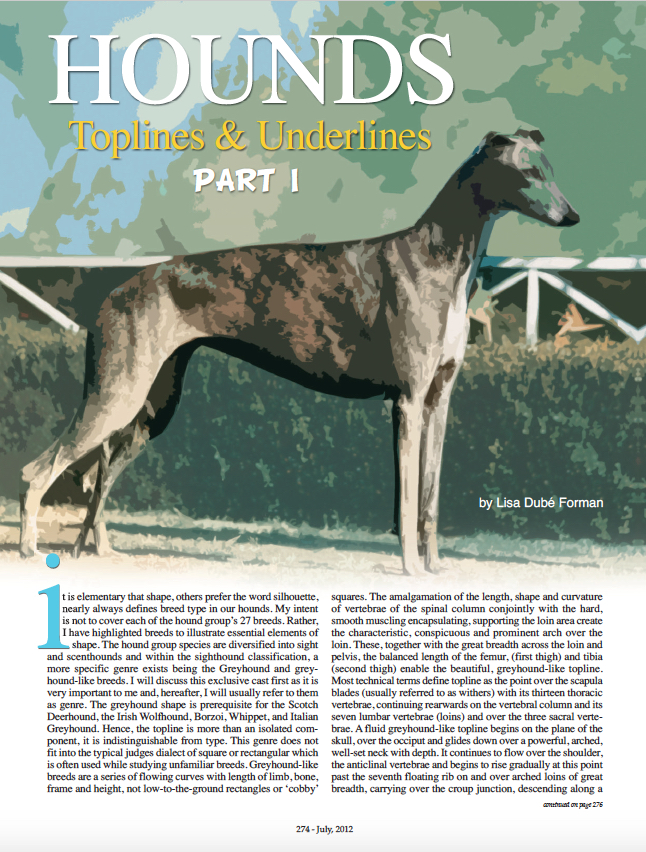
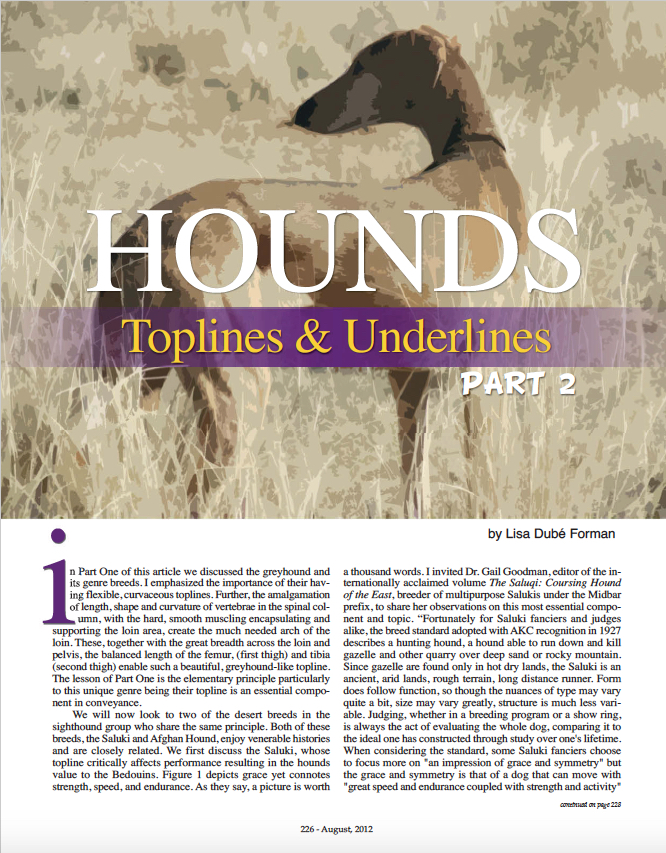
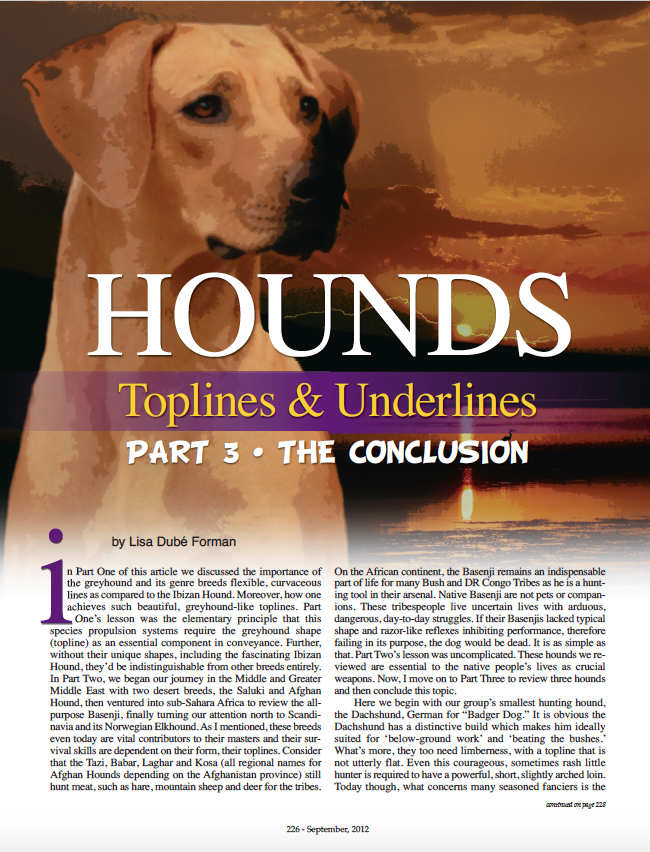
Once again I recalled this old interview just recently when I experienced yet another run-in with the dark side. Though dissimilar in comparison, nevertheless it was another character strike. A foreign breeder judge had posted a statement on Facebook regarding a well-received, three-part article I wrote which was published in The Canine Chronicle magazine while I was a regular, monthly contributor. This 2012 piece, "Hounds, Toplines & Underlines" has been circulating on the Internet, in particular among the sighthound breeds. In a very public, worldwide declaration, this active dog show judge stated,
"I sometimes read articles like this and wish the authors had bred sufficiently wonderful hounds themselves for me to be able to resonate -- without remembering back to certain judging assignments."
This was followed-up by praise from at least one Facebook friend via the "grin emoticon." Emoticons are communication icons in the faceless Facebook social community which itself is a remote and impersonal environment that often cultivates shamelessness, as many people do not have the courage of their convictions in a one-on-one confrontation.
Oh, the dark side has reared its hideous head, again. Notably absent were any valid disagreements on canine anatomy or debates on toplines and underlines. Fueled by aggression and resentment, the only avenue left for this passive aggressor was to impugn my breeding program and my abilities as a breeder. While it is the aggressor's prerogative not to like my bloodlines, as an international dog show judge, they have no exemption to forever conducting themselves in a sportsmanlike manner. How disgracefully conceited and foolish they, as a judge, must be to make outstandingly bad, public commentary about an active breeder, owner/handler, journalist, and fellow dog show judge? By her volition, and in writing no less, she announced her opinion of a contemporary's breeding program and by doing so, any semblance of neutrality went out the window, especially if she were assigned to judge the breed again.
Unaware of or indifferent to questions of right or wrong, during a past American specialty assignment, this same judge awarded Winners to a dog who she previously co-owned, having removed her name from co-ownership prior to the specialty show. Of course, the cloud of impropriety was so dense and unmistakable that the American Kennel Club administratively disallowed the award.
Yes, people behave deplorably in just about any social association or community. It certainly is not exclusive to purebred dog sports. One only has to take a look at the political arena to learn about the dark side. It is also true that various dog breeds attract different types of people. So, it is likely that there are varied levels of quality of character amongst fanciers in other dog breeds.
Thankfully, on the flip side, I have had the opportunity to make many delightful acquaintances in many breeds of our sport over these decades. These are fanciers, though dedicated to their passion, who have maintained healthy, stable perspectives in their lives. For us sane people who find ourselves as targets, we shake our heads and take deep breaths to ground ourselves as the disbelief is often overpowering -- and often, we are forced to deliver a proportional response to the attack. Still, some fanciers seemingly do not have a grip on reality and to a degree, I pity them. They are so wrapped up in the sport of dogs rather, their compulsion is so enormous, that they no longer think rationally. Rather, for some it is hard to separate reality from passion as their level of consumption is at the least, decidedly unhealthy, and ominous on the extreme. I think it is sad how many people have lost themselves, so obsessed that they live, eat, and breathe dogs.
For those interested, I included the links to the three-part article below.
Hounds, Toplines & Underlines, Part One
Just back from the 2016 Scottish Deerhound National Specialty!
Just back from the Scottish Deerhound National Specialty and once again, we loved it. This location is very special and so is this club....
The Scottish Deerhound National Specialty (SCDA) was held at a lovely, long established resort situated on Lake Champlain in Vergennes, Vermont. The Basin Harbor Club is a terrific location for a Parent Club Specialty Show, and this club takes advantage of every opportunity this locale affords. The patina of the huge resort property is reminiscent of the Catskill's in their heyday era. You are transported back in time with the Basin Harbor Club bungalows and cottages nestled throughout the resort property, with some on or near Lake Champlain. The accommodations are very comfortable, and there is a surplus of grassy lawns, lanes, and paths among hundreds of acres of land to stroll with your dogs. Dinner functions are held on site in the main lodge as well as daily, complimentary breakfasts. If one so desires, there is a separate restaurant serving lunch and dinner as well. For those spouses who like to change things up, there is an 18-hole championship golf course to enjoy. All right at your fingertips and all quite marvelous.
The show ring site itself is superb with polo grounds-like turf surrounded by two enormous sided tents. A section of one tent is reserved for a ringside luncheon that is offered on all three days of judging. Arranged in this area are clothed dinner tables, and guests are provided with dinner plates, cloth napkins, silverware, and glass salt & pepper shakers. Absent were Chinet heavy-weight paper plates, paper napkins or traveling packets of salt & pepper as there is an easily perceived air of graciousness and etiquette at this function. The Lure coursing performance events were held adjacent to the show grounds, after the conclusion of Best of Breed, on a fabulous grassy area called the airstrip. It could not have been more convenient for both the lure spectators and its entrants.
I must also mention that the spectators and exhibitors were friendly and welcoming to outsiders. Moreover, among the Deerhound fanciers, I perceived a cheerful camaraderie and benevolence but also a conscious respect for one another that was wholly refreshing to see, especially for we fanciers from other breeds. There also was a large contingency of friendly foreigners at the show who appeared as if they were having a perfectly lovely time. Personally, I enjoy seeing our fellow, global brethren because our interests are all very much interconnected. What happens to our breed here will happen across the pond and visa versa.
As for continued learning, there were two seminars held that appeared quite interesting and refreshing, not only for their subjects but also because of the apparent effort this organization advances to educate its members. Unlike other Specialty Clubs who sponsor inane grooming and handling seminars, this club is unquestionably earnest in their purpose. Both Seminars were presented by Dr. R. Scott Dove, DVM. On the Wednesday, from 2:00 – 4:30 pm, there was an "In Depth Breeders Seminar and Wet Lab."
This hands-on practicum allows participants to use cadaver puppies while learning how to stomach tube feed, draw blood, give injections, as well as other potential lifesaving techniques. Participants will also learn how to collect semen and inseminate this semen. There is a limit of 10 participants due to the nature of this seminar.
The cost for the Wetlab was $50.00 per person limited to 10 participants with the proceeds donated to a particular Health Fund. On Thursday, there was a "Health & Wellness Seminar" presented in the evening after dinner.
This seminar covers the Scottish Deerhound throughout his lifespan, from puppy to veteran. Age-related issues, gender specific issues and breed specific issues will be covered. Other topics covered will include proactive and preventative measures to maximize the health of your dogs, as well as current viruses and concerns will be discussed. This is an interactive seminar, and discussion will be encouraged.
Both Best of Breed and the highly regarded and much-anticipated Veteran class judging were and customarily are honored on each separate day with heartwarming Parades bringing tears to one's eyes as the competitors are led in by Scottish Bagpipes in full dress. On the second day of judging, twenty of twenty-three Veteran entries marched into the ring with ages ranging from 7 to 11 years, and was a wonderful sight to behold! The third and final day of judging opened with 35 Champions parading behind the harmonic, emotional sounds of the bagpipes as the show judge and club officials led the way.
I must say that I saw some beautiful specimens of the breed, and I was impressed with so many possessing overall balance and symmetry with the greyhound-like contours and length of limb very critical for our galloping sighthound. I saw mostly long frames and classic, long heads with tapering aquiline muzzles. Additionally, there were many entries with a light, springy gait. I did see occasional instances of very concerning flat-backed toplines, short backs, and an absence of the much-desired nape or crest so characteristic of this breed.
Still, it fills my heart with gladness that the Scottish Deerhound Parent Club and its devoted fanciers continue to embrace, honor and celebrate this magnificent breed. They have refused to relinquish their breed's illustrious origins both in spirit and phenotype and, I for one, am confident that their ancestors would be proud.
Show turf and ringside banquet area
Darling Deerhound puppy not quite 6 months old
Deerhound expression
Bagpipes leading the way
Scottish Bagpiper
Parade of Champions with bagpipes
Kilts at the Scottish Deerhound National Specialty 2016
Sweeps class on the turf at the Scottish Deerhound National 2016 Specialty
More Alerts on Canine Flu Across the Nation!
BLOOMINGTON — Canine influenza has sickened "hundreds" of dogs in the Bloomington-Normal area in the past few days so veterinarians are urging dog owners to keep their pets away from other dogs and to call their vet if their dog shows symptoms.
"The most important thing we should do is to keep our dogs at home until we have this (outbreak) under control," said Dr. Kirsten Pieper of the Animal Emergency Clinic of McLean County.
Though rarely fatal, canine influenza is worrisome because few dogs have been exposed to it or vaccinated against it so they have no protection, said Pieper and Dr. David Bortell of Bortell Animal Hospital. That means that nearly every dog exposed to the highly contagious respiratory infection gets sick for a week or two.
Pieper and Bortell were not aware Monday of any dogs in the area who have died during the outbreak. Dogs that have died after getting dog flu because it develops into pneumonia generally are older dogs, puppies or dogs with weakened immune systems, Bortell and Pieper said.
Bortell estimated that "hundreds" of dogs in the area have suspected or confirmed cases of canine influenza.
The first case of dog flu was confirmed two weeks ago. But the number of suspected or confirmed cases began to rise several days ago "and this weekend, it really hit," Bortell said.
"It was a bad weekend at the emergency clinic," Pieper said.
"If dogs are around other dogs, it could continue to spread like wildfire," Bortell said.
"People can't get this but it is easily spread from dog to dog by sneezing or coughing," Pieper said.
No one knows why the outbreak is happening now. Bortell guesses that a dog from the area was with a dog from elsewhere who had the flu. The local dog then spread the infection to other dogs.
As of Monday, the animal emergency clinic had treated at least 15 dogs with confirmed cases of dog flu and another 15 with suspected cases that weren't confirmed by a test, Pieper said.
Bortell's clinic had treated at least 20 dogs as of mid-day Monday.
In addition, the emergency clinic and many veterinary practices were getting dozens of calls from people whose dogs were experiencing symptoms, including coughing, sneezing, runny nose, sore throat, lethargy, fever and not eating or drinking, the vets said. In many cases, pet owners were opting to keep their dogs at home and treat their symptoms.
People whose dogs are experiencing symptoms should call their vet or, if it's after hours, the emergency clinic at 309-665-5020. In many cases, vets — to control the spread of the disease — are treating dogs in their owners' cars or are asking owners to bring their dogs to separate clinic entrances, Bortell and Pieper said.
Dogs are given supportive care, such as medicine for their symptoms. "With supportive care, dogs are recovering quite well," Bortell said.
There is a vaccine that can reduce the duration and intensity of flu. But the vaccine is a series of two shots — two to four weeks apart — and a dog doesn't have immunity until two to four weeks after the second shot, Bortell said.
"If you are planning an upcoming boarding or grooming or daycare, call your vet and ask about the vaccine," Bortell said.
Follow Paul Swiech on Twitter: @pg_swiech
Connecticut Veterinarian Medical Association Canine Influenza Outbreak
Update: Severe Canine Respiratory Infection Outbreak
All of the dogs from the facility in Windsor have been treated and released. One new case from the same facility was admitted on Monday. The dog was very ill, but improved overnight and hopefully will recover. It appears that this outbreak was contained to just one facility.
Last week, two of the dogs tested positive for Canine Pneumo virus and Streptococcus equi, subspecies zooepidemicus. One dog also tested positive for Bordetella.
Canine Pneumo virus can be spread by direct contact and by aerosolized routes. Strep equi requires direct contact. At present there are no vaccinations available for Canine Pneumo virus. Vaccinations exist against Bordetella and both strains of Canine Influenza virus.
Click here for more information about Steptococcus equi, subspecies zooepidemicus in dogs.
Dogs have presented with fever, pneumonia and bleeding from the nose. If you see a dog with symptoms, please contact the office of the CT State Veterinarian at (860) 713-2505.
The CVMA is encouraging pet owners to consult with their veterinarians to help decide if their dog should be vaccinated for Bordetella and/or Canine Influenza virus.
Connecticut Veterinary Medical Association (CVMA)
P.O. Box 107
Glastonbury, CT 06033
860-635-7770 (FAX)860-892-6077info@ctvet.org
A Picture is Worth a Thousand Words
We all are familiar with the above aphorism which I believe is perfectly suited for purebred dog conformation events and its show photography. However, I feel that people unknowingly pay lip service to this truism. Almost all our typical dog show photographers shoot only stacked, profile ‘win’ show photos. Preferably, they should be focusing on, and we should demand movement shots........
We all are familiar with the above aphorism which I believe is perfectly suited for purebred dog conformation events and its show photography. However, I feel that people unknowingly pay lip service to this truism. Almost all our typical dog show photographers shoot only stacked, profile ‘win’ show photos. Preferably, they should be focusing on, and we should demand movement shots. Why? Well, what does that profile photograph tell you? How many times have you observed a dog about to be photographed at a show and instantly appear a flock of people fussing, brushing, whistling, straightening, readjusting, throwing toys to arouse the dog or to lift its head? When you see the photo, you can assess breed type, and you may be able to assess forequarter and hindquarter assembly, depending on the breed. In a few cases, seasoned fanciers can predict how that dog will move out around the ring based on its static profile. However, having been in sighthounds for 32 years, I can confidently say that the still-life is not always accurate. Mostly, inaccurate nowadays because that little army of hairdressers and assistants are styling that dog just like a film star has to go to makeup before appearing in a scene. Even further, some photographers will take ¾ shots to shorten up the dogs’ body length.
Gaiting photographs are worth a thousand words. Knowledgeable breeder/exhibitor/handlers relish locomotive shots in succession because movement is a critical aspect in almost all breeds. Seeing our dogs digitally, frame by frame, speak volumes on anatomy and muscling physiology. The experienced observer and breeder can see what is wrong and what is right, and these photos illustrate what is needed to improve upon the dog. Show win photos do not fulfill this function.
Ballyhara Darley gaiting photo by Andra O'Connell
Movement shots are vital learning tools to assist all of us in improving our breeding programs and the welfare of our dogs. Why welfare? With all other things being equal, e.g. genetic good health, a sound, properly constructed, proportionate, and well-muscled dog will have a greater life expectancy than a dog that is unsound and improperly built who will require chemical supplementation to relieve arthritis and strained muscles. Why the need for drugs such as Rimadyl and the host of other anti-inflammatory and steroidal medications? Incorrect angulation and poor assembly cause additional stress to tendons predisposing dogs to bone injury. Inferior muscling or unbalanced muscling increases susceptibility to injury as well. As a result, in many of these cases, these medical issues necessitate a need for pain relievers and anti-inflammatory medications (chemicals) to comfort the dog over the course of his lifespan.
In conclusion, the advancement of the sport of purebred dogs and its reputation is heavily dependent on the dog’s ability for locomotion. The origin of purebred dog shows was not established on nor did they award the dog who stood still the longest. Lastly, consider that companion dog owners do not buy dogs who cannot move. It would defeat the purpose of having a dog.
This edited article first appeared on the Canine Chronicle digital website. Short URL: http://caninechronicle.com/?p=7711
Musings on the Moods at All-Breed Conformation Dog Shows
Another dog show experience that needs telling. Let me say, this experience, to begin with, can be vexing and chaotic. The judge has only a few minutes to provide his services, he has a tight schedule to keep, and there is a throng of people waiting. Need I remind you that it is widely known that some exhibitors can be quite nasty and rude....
Recently, having returned from an all-breed show, I was anticipating the arrival of my hound's show win 8x10 photograph taken by Fritz Clark Photography. Fritz has been a fixture on the dog show scene here in the Northeast for what seems decades and decades and is not an amateur.
When the photo(s) arrived, I felt very let down for many good reasons. Allow me to explain. Our ring assignment was at 9:45 AM where we won two, three-point majors in both sexes of our breed with the male going up BOW. As a courtesy to judges, I usually will make a determined effort to get a show photograph. So, we sat and waited with our hounds several hours until the Judge's morning assignment schedule was completed. However, this available time slot was also the time set aside for the judge to eat lunch, finally, before going right back into the thick of things. Also, to make matters worse, there were a dozen or more exhibitors, many of them who had just gotten done with their competitions, who also wanted show photographs with this judge.
Let me say, this experience, to begin with, can be vexing and chaotic. The judge has only a few minutes to provide his services, he has a tight schedule to keep, and there is a throng of people waiting. Now, of course, it is widely known that some exhibitors can be quite nasty and rude. So, you get the idea, as if you were there. Well, it is our turn, and as I approach it is evident that my giant breed is not going to be photographed on a base, so I proceed to set up in the foreground closer to the judge. The photographer waves me off telling me I am fine where I am. Of course, as time is of the essence, I naively trust him as many others are waiting, and I set up right there or at least attempt to do so as he gave me less time to set up than we are allotted by an all-breed judge before examination! The photographer, without any helpful corrections, starts snapping away and exclaims, "all done."
We were so rushed and with all the other people remaining, I was unable to get my bitch's Major win show photograph taken. That was a disappointment as well. Fast forward to the arrival of the show photo and it is a poor example of his work. See below. Thoroughly vexed, I decided to write Mr. Clark and express my objections and disappointment. Why? Because I am sick and tired of both me and my money being underappreciated while attending all-breed dog shows. Further, I believe I speak on behalf of many owner-handlers, and those who do not complain but grin and bear it, especially those who are not part of the dog show cult exhibiting dogs every weekend from here to Timbuktu. I felt cheated. We fork over the $42.00 for two 8x10 photographs and do not say anything? Here is the excerpt of what I wrote.
"Having been involved in our sport for nearly 33 years and having numerous show win photographs taken over these many years, I must say that these two 8x10’s you just sent were poorly done. Look at the photograph, of which there were two identical shots, where clearly you could have taken a moment to ask me to reset the wolfhound’s front legs underneath himself. Instead, you just clicked away and said, “All done.” Additionally, as I approached the staging area and was in the process of moving the wolfhound forward, you interrupted me stating, “No, right there is fine.” Clearly, looking at the photo, it was not fine depicting an uncomfortable gap between ourselves and Mr. Edward Hall, and this had to be apparent to you at the time. Despite that I am not a Professional Handler nor do I regularly campaign my hounds to accrue points in the all-breed system, both my hound and I should not be trivialized. Our hard-earned money is as valuable as other exhibitors, and frankly, the photographs are disrespectful."
I sent this off, and surprisingly, I did not receive a reply. Why would he reply? Because he is in the business of client services; he is a Retailer selling his work. He should care if we buy or do not buy his product. Evidently I was being ignored so, thirteen days later, I contacted him again and asked if he received my initial complaint. Only then, did I receive a one-word response, "Yes."
To sum it up, he simply did not give a damn which I believe is indicative of a much larger issue, and not just this dog show photographer's attitude. It is suggestive of an overall mentality as civility and gratefulness rank well down on the list of positive aspects involving conformation dog show experiences. No 'thank you's' for coming, missing are any welcoming elements that make exhibitors feel convivial and appreciated. It is a 'get them in and get them out', 'let's get this over with' atmosphere, which can be very tiring and frustrating over the decades.
This particular all-breed show in question offered our New England Regional Club's supported entry. Although I did see our club show representative, who also happens to be the all-breed show chairperson, not at any time did this person say "thank you" for supporting the entry, of which I brought three entries. Despite the fact that my attendance involved expenses for an overnight stay at a hotel, food, home dog caretaker expenses, gasoline and entries of nearly $100.00. All that is left these days at many of these conformation dog shows, in my somewhat pessimistic but realistic opinion is, an "I don't give a damn" attitude.
Take a look at it yourself. Truthfully, if you find this photo acceptable, then perhaps you may be desensitized to poor quality shots and most likely have been a victim as well, one too many times.
More Thoughts From Florence Nagle on the Irish Wolfhound
Though unique to the Irish Wolfhound breed, this brief conversation with famous sportswoman, Florence Nagle is befitting of all our giant Sighthound hunters. It is solid, basic logic that should prevail within the attitude of good breeders today. Unfortunately, over these many decades, I believe that our sport's mentality has devolved, rather than evolved. Moreover, in the case of the Irish Wolfhound breed, the overall state of mind has degenerated, having lost the mental and moral qualities that were once normal and desirable.
Thoughts From the Past on Forequarters
Perhaps one may think I am haranguing dog fanciers about correct forequarter assemblies, but I believe that this excerpt is well worth a quick glance, especially for Irish Wolfhound fanciers. Many purebred dog fanciers, as well as Thoroughbred Race Horse enthusiasts, are familiar with the name Mrs. Florence Nagle. For those who may not be, just click on her name for more information, though, suffice to say she was the Grand Dame of Irish Wolfhounds.