
DOG BLOG
Musings
Best to Grind Your Dogs Heartworm Pill!
Grind your dog’s and cat’s heartworm preventatives! If your pet does not chew the pill then it loses its effectiveness!
Just because we're entering into the Autumn season does not mean that dog owners can slack off about giving heartworm preventative. On my website, under Recommended Vaccinations & Wormers, I have advice from Dr. Jean Dodds, Hemopet.
She advises using heartworm preventatives for healthy dogs if the ambient temperature is above 57 degrees Fahrenheit (14 degrees Centigrade) for approximately two weeks and mosquitoes are prevalent. A basic rule of thumb is Mid-April through November for the majority of the country and basically year-round for the southern states.
However, we are experiencing climate change worldwide. Therefore, it would be wise for those living in the four-seasons regions to keep dosing with heartworm preventative through December just to be safe. This past late Autumn into early winter, I recall mowing my pastures despite the calendar being the end of December! At the same time, be prepared to begin dosing earlier than April if there is a much warmer than usual forecast. Still, first, you must have a heartworm blood test performed. I prefer Snap 4DX tests, which also screen for Anaplasma, Ehrlichia, and Lyme tick diseases.
The most important tip for everyone to know when dispensing heartworm preventatives is that the dog MUST chew the tablet. Since many heartworm preventatives are in chewables forms, people get complacent and think that when they give it to their dog, they'll munch on it. But, if your dogs are like mine, they simply swallow it without chewing. So my policy is to GRIND the pills into tiny pieces or even a powder in a small bowl and add it to a small handful of ground meat. Then I administer it to each of the hounds. This method guarantees that the pill has been crushed without chewing!
Why the big deal? Because pharmaceutical companies require dogs to chew and NOT to swallow their preventative whole for the effectiveness of the pill. Many, many dog owners are completely unaware of this issue. Over the years, I have heard stories about dogs diagnosed with the disease despite taking monthly preventatives. The owners contacted the company and were informed that, most likely, their dog never chewed the pill! That is not what you want to hear after the fact.
Lastly, I urge you to use heartworm preventative medicines. But choose carefully, as there are several options on the market with varying degrees of side effects for specific breeds. For example, some Herding Breed dogs have a genetic mutation that makes them dangerously oversensitive to ivermectin, as well as white colored-dogs, and dogs prone to seizures. Additionally, Sighthounds are very sensitive and are best suited with plain milbemycin oxime. I discuss heartworm preventatives and wormers in detail on my website, so please take a moment and visit Recommended Vaccinations & Wormers.

Saving Sighthounds from Anesthetic Drug Death
Saving Sighthounds from Anesthetic Drug Death! Due to Sighthound’s peculiar quirks, they have a potentially life-threatening, slow recovery reaction to and from anesthetic drugs.
There have been a proportional number of sighthounds who have died on the operating table, especially Greyhounds, Scottish Deerhounds, and Irish Wolfhounds, and or who have had significant difficulty awakening from anesthetics….
This article is important for Sighthound owners and most certainly applies to Wolfhounds. The original article can be found here.

The locomotion of the long, lean muscles of running Greyhounds is simultaneously elegant and breathtaking. Like other ancient sighthound breeds hardwired to pursue prey by speed and sight, the Greyhound has idiosyncrasies that include having a potentially life-threatening, slow recovery from anesthetic drugs.
Identifying gene mutations responsible for breaking down, or metabolizing, commonly used drugs in Greyhounds and other sighthound breeds is the focus of research underway at Washington State University. Lead investigator Michael Court, BVSc, PhD, professor and the William R. Jones Endowed Chair, says the goal is to develop a drug sensitivity test from saliva, urine or blood that will identify dogs with a slow drug metabolism of certain drugs.
“This would allow a veterinarian to make dose adjustments or select an alternative drug for optimal drug treatment,” he says. “A personalized or individual approach to drug selection would be the ideal outcome for affected dogs.”
A veterinary anesthesiologist who has worked in research since 1983, Dr. Court is revolutionizing a cocktail drug phenotyping approach to use in dogs that will enable several drugs to be tested at the same time to determine their metabolism ratio in the body. The test would produce results classifying a dog as a slow, normal or fast metabolizer for a specific group of drugs.
“The original problem drug in sighthounds was a barbiturate, thiopental, which is used to induce anesthesia,” Dr. Court says. “Greyhound owners in Australia and the U.S. reported that it took their dogs 48 hours to stand unassisted after having thiopental anesthesia. Although thiopental is no longer used in the U.S., its use continues in most of the world. The replacement drug in the U.S. is propofol, though even with this drug, recovery in Greyhounds can be double what is normal, taking 40 minutes instead of 20 minutes.”
Since all of the problem anesthetic drugs are highly fat-soluble, the sensitivity of Greyhounds and other lean-bodied sighthounds to these drugs was originally thought to result from a reduced ability of their tissues to “soak up” the drug, keeping it away from the brain. However, more recent work has implicated a reduced ability of the dog’s liver to break down and remove the drug from the body. Specifically, there appears to be deficiency of an important drug metabolism enzyme, called cytochrome P450 (CYP).
“Using a candidate gene approach to identify gene mutations in Greyhounds that decrease anesthetic drug metabolism, we found two mutations that may explain the slow metabolism,” says Dr. Court. “One is a mutation in one of the CYP (CYP2B11) genes, and the other is in a gene for an enzyme needed for CYP to work efficiently, called P450 oxidoreductase (POR). Together, these drug-metabolizing enzymes make the drugs more water soluble, so they can be easily flushed out through the kidneys.
“Both mutations are found primarily in Greyhounds and some sighthound breeds. Rarely in non-sighthound breeds.”
Developing A Novel Drug Sensitivity Test
The sighthound adverse drug reaction research, now in phase two, focuses on developing a cocktail drug phenotyping test. Funding of $172,765 for the two-year study that began in June 2018 is provided by the AKC (American Kennel Club) Canine Health Foundation. Phase one of the research, which ran from 2016 to 2018, received funding of $150,000 from the AKC Canine Health Foundation. This work involved functional studies of the mutations in the laboratory.
“The AKC Canine Health Foundation is committed to advancing a future for personalized medicine for canine patients,” says Dr. Diane Brown, CEO of the AKC Canine Health Foundation. “We consider Dr. Court’s work in this area as an important series of first steps toward that future, and have dedicated funding to these efforts since 2016.”
Although the adverse drug reactions in sighthounds is similar to the MDR1 gene mutation in herding breeds that causes a neurotoxic reaction to ivermectin and other drugs (see below), there are differences. While the mutations in sighthounds dramatically reduce the function of the enzymes, they do not wipe them out, as occurs with dysfunction of the P-gp transporter protein in herding breeds.
“These are two different processes with the same goal, essentially trying to limit the amount of a drug that gets into the body,” Dr. Court explains. “P-gp keeps drugs out of the body, and especially the brain, by pumping the drug out. Drug-metabolizing enzymes like CYP2B11 make drugs in the body water soluble, so they can be easily flushed out, usually through the kidneys. The slow metabolism also changes the drugs chemically so they often lose their effect.”
Stephanie Martinez, PhD, a postdoctoral research associate in the Veterinary Clinical Pharmacogenetics Laboratory at Washington State University, is working with Dr. Court on the sighthound research. “In the first two-year study, we saw a significant loss of enzyme function from the mutations when we tested them in the lab,” she says.
In May 2018, Dr. Martinez adopted two retired Greyhound racers, “Seamus” and “Otis.” As a new Greyhound owner, she relates to concerns about having her dogs anesthetized for even a dental cleaning procedure. “To be honest, I am a little nervous to put them under anesthesia,” she says. “I had them genotyped right away. Both are heterozygous for one of the anesthesia adverse reaction mutations, which means they have one copy of the mutated allele, though I do not know how significantly they are affected.
“In addition to the delayed anesthesia recovery issues, some sighthound breeds like Scottish Deerhounds and Greyhounds experience bleeding issues that occur 24 to 72 hours after surgical procedures. We think it is caused by a genetic mutation that causes the blood clot to break down prematurely. Otis is homozygous for a candidate gene we’re currently investigating, which means he may experience postoperative bleeding problems.”
A separate study of delayed postoperative bleeding, funded in part by the Scottish Deerhound Club of America, is underway in conjunction with the anesthesia research. The team is seeking DNA samples from sighthounds that experienced delayed bleeding 24 to 72 hours after surgery, as well as DNA from littermates of dogs that died from this condition.
The cocktail drug phenotyping research involves testing 12 dogs with three drugs to evaluate their rate of metabolism. “The drug cocktail includes an antidepressant, which we believe will be metabolized slowly in dogs with the mutation, because it is only metabolized by CYP2B11,” Dr. Court explains. “The other drugs are an over-the-counter acid reducer and a cough suppressor. These latter two should be metabolized normally in dogs with the mutation because they are metabolized via other CYP enzymes.”
Currently, the research team is working to ensure that the three drugs can be safely given at low doses together without interfering with one another. They also want to be sure the saliva concentrations of the drugs and metabolites match the blood and urine concentrations so that saliva can be used for the test.
“The power of this approach is that we can readily test hundreds of dogs,” says Dr. Court. “Once we have this cocktail phenotyping test worked out, then we plan to use it in dogs with and without the mutations to show that the metabolism of the CYP2B11 enzyme is slow, but metabolism of the other CYP probes is normal.
“Ultimately, owners could perform a saliva test at home that would determine the ability of individual dogs to handle drugs that could be affected by rare mutations, even those not yet discovered,” he says. “The impact of non-genetic factors, such as age, disease, diet, and environment, on drug metabolism would also be detectable by this novel drug sensitivity test.”
“I hope that owners of sighthounds will not have to worry when their dogs need to undergo necessary medical procedures,” Dr. Martinez says. “The potential of being able to proactively customize drugs used for anesthesia for individual dogs to reduce the risk of slow recovery or identify a dog that is prone to a fatal bleeding problem and ensure they get lifesaving drugs is exciting.” n
Sighthound Owners Can Contribute to Research
Researchers at the Program in Individualized Medicine (PrIMe) at Washington State University are seeking DNA samples from sighthounds for two separate ongoing studies. One study is examining adverse drug reactions to anesthesia, and the other is investigating delayed postoperative bleeding. For information, go to https://prime.vetmed.wsu.edu or send an email to courtlab@vetmed.wsu.edu.
To read the abstract of the adverse drug reaction grant that is funded by the AKC Canine Health Foundation, go to: https://bit.ly/2FG1vjh. You also may donate to this research via the link.
MDR1 GENE MUTATION IN HERDING BREEDS TIED TO ADVERSE DRUG REACTIONS
The discovery in 2001 of a mutation in the MDR1 (multidrug resistance) gene in Collies and other herding breeds that causes a neurotoxic reaction to ivermectin, a parasitic preventive, provided insights into treating affected dogs. It also initiated the use of pharmacogenetics to determine how an individual dog’s genetic makeup impacts its response to drugs.
Katrina Mealey, DVM, PhD, DACVIM, DACVCP, professor and the Richard L. Ott Endowed Chair in Small Animal Medicine and Research at Washington State University, identified a 4-base pair deletion mutation in the MDR1 gene that causes a stop codon prematurely terminating P-glycoprotein (P-gp) synthesis.
“The MDR1 gene encodes the P-gp transmembrane protein that functions in a protective capacity by transporting a variety of drugs from the blood-brain barrier into the body,” explains Dr. Mealey. “Dogs with the MDR1 mutation do not have this protective barrier. Thus, drugs like ivermectin can cause toxic reactions that result in debilitating illness and even death.”
In the affected dogs, high concentrations of ivermectin accumulated in their brain tissue after a single dose of the drug. Since ivermectin is processed from the brain through P-gp into the body, Dr. Mealey hypothesized that ivermectin-sensitive collies had altered MDR1 gene expression.
Her research led to the MDR1 gene mutation discovery and development of a genetic test that is available through the Veterinary Clinical Pharmacology Laboratory at Washington State University (www.vcpl.vetmed.wsu.edu). A DNA cheek swab test that identifies a dog’s phenotype for the mutation can be ordered and processed for $60.
The autosomal dominant gene mutation impacts homozygous and heterozygous affected dogs. Dogs that are homozygous inherit two copies of the mutant allele and pass one copy of the defective gene to their offspring. Homozygous dogs are more likely to have severe, life-threatening drug reactions.
Affected dogs that are heterozygous have one copy of the mutant allele and one copy of the normal allele, meaning they have a 50 percent chance of passing the defective gene to their offspring. These dogs have less severe adverse drug reactions compared with those that are homozygous.
The MDR1 mutation primarily occurs in herding breeds. Affected dogs are thought to be descendants of a single dog that lived in Great Britain in the early 1800s before breeds were selectively bred. The mutation also occurs in two sighthound breeds, the Longhaired Whippet and Silken Windhound, believed to share a collie ancestry. Mixed breeds — any dog with a herding breed in its ancestry — may be at risk for drug toxicity.
“As a pharmacologist, the most fascinating aspect of the MDR1 gene mutation is the sheer number of drugs that are affected by a single gene mutation,” Dr. Mealey says. “Not all drugs must be avoided in dogs with altered P-glycoprotein function. Many drugs can be used safely with no need to alter the dose.”
However, adverse drug reactions involve over a dozen different drugs. The most serious adverse drug reactions involve antiparasitic preventives, such as ivermectin and milbemycin, the antidiarrheal medication loperamide (Imodium®), and several anticancer drugs, including vincristine and doxorubicin.
Since the genetic test was first offered in 2004, there has been a reduction of the mutation in some breeds via selective breeding. Importantly, identifying dogs with the P-gp dysfunction allows veterinarians to decrease the drug dose or consider alternate drugs to avoid a potentially fatal drug reaction.
Breed Frequency of MDR1 Gene Mutations1
Breed Approximate Frequency
Collie (Rough- & Smooth-Coated) 70 Percent
Longhaired Whippet 65 Percent
Australian Shepherd 50 Percent
Miniature Australian Shepherd 50 Percent
McNab Shepherd 30 Percent
Silken Windhound 30 Percent
English Shepherd 15 Percent
Shetland Sheepdog 15 Percent
German Shepherd Dog 10 Percent
Herding Breed Cross 10 Percent
Mixed Breed 5 Percent
Old English Sheepdog 5 Percent
Border Collie <5%
1Veterinary Clinical Pharmacology Laboratory at Washington State University (www.vcpl.vetmed.wsu.edu)
Drugs Affected by the MDR1 Gene Mutation1
Drug Category Drug
Analgesic/Sedative Acepromazine
Butorphanol
Antibacterial Erythromycin
Antiparasitic* Doramectin
Ivermectin
Milbemycin
Moxidectin
Selamectin
Chemotherapeutic Doxorubicin
Vinblastine
Vincristine
Vinorelbine
Paclitaxel
Antidiarrheal Loperamide (Imodium®)
*Note that giving dogs FDA-approved heartworm preventive products according to the recommended doses is safe, even in dogs with the MDR1 mutation.
1Veterinary Clinical Pharmacology Laboratory at Washington State University (www.vcpl.vetmed.wsu.edu)
Sighthound Necessities
The Importance of Free Exercise for Large Sighthounds
Sighthounds love to gallop, to chase and stretch out. They experience unmistakable, sheer glee as they are bending, folding and leaping. You can see it in their expression. So, why is it that so many of these admirable Sighthounds are found living in unsuitable homes, having little or no fenced, secured acreage?
The Importance of Free Exercise for Large Sighthounds
Sighthounds love to gallop, to chase and stretch out. They experience unmistakable, sheer glee as they are bending, folding and leaping. You can see it in their expression. So, why is it that so many of these admirable Sighthounds are found living in unsuitable homes, having little or no fenced, secured acreage? As responsible fanciers and hobbyists, fulfilling their needs should be a primary concern when we place our hounds in their new, permanent homes. Our stewardship of these unique breeds obliges us to proceed with utmost care and concern while considering a new home.
I am not an elitist who snubs a potential puppy owner, turning up my nose at those whose accommodations are not ideal for our Sighthounds. On the contrary, I encourage them to contact me so that I may educate them about the exceptional needs and characteristics of our breeds. More importantly, though, I am aware that urban population growth has changed significantly over the past 60 years in our nation. We all live in an evolving landscape. "Metropolitan areas are now fueling virtually all of America's population growth," as reported in the Washington Post by Emily Badger. In an interesting article, unwittingly she corroborates what many conscientious breeders have realized, that ideal Sighthound companion homes are harder and harder to find. Small population centers with less than 50,000 people have had infinitesimal growth changes. Rural populations have dwindled. Today, one in three Americans lives within the metro areas of 10 cities — or just a few spots on the nation's map. The relevancy of the census data must not be under-appreciated, as this means that, slowly but surely, there are fewer opportunities for us to find homes for our galloping hounds.
The reality I face is that significantly more inquiries than in the past hail from people with no land. From the 36 puppy requests I have received in the past six months alone, 32 (90%) were from persons who did not have what I consider sufficient area to accommodate a Sighthound. Furthermore, this percentage includes some individuals who either currently have or previously owned a Sighthound — from another breeder — in their home.
I readily anticipate the question "How much land does she require?" Ideally, a home for a large breed Sighthound should have at least one acre of property secured with breed-appropriate fencing, but from my experience of three-plus decades in dogs, this often seems like an unrealistic requirement. A bare minimum of half an acre of open land, again properly fenced, not including the house, is my condition. I have received some requests from potential puppy buyers who own half an acre of land that included the home as well as an accessory building; one memorable inquiry offered half an acre of land that included the house, an in-ground swimming pool with a cabana and what appeared to be a Bocce ball court. All that was left was a postage-sized space for the hound to defecate in, without any area to run and play.
I politely refuse to place my large Sighthound puppies in these environments, notwithstanding the usual promises of the on-lead daily exercise that the hound would receive. You must be familiar with this type of dialog. A potential owner asserts that, although there is no acreage for free running, they regularly walk so-and-so many miles and they also live near a park where the hound can be off-lead. Almost all of us understand that Sighthounds are not candidates for off-lead running on public grounds. Simply, this is a hazardous situation due to their prey drive — a good subject for another article I plan on writing.
As for good intentions and best-laid plans, how many times has life thrown us curve balls? Life has a habit of bringing unexpected, unwanted changes or accidents. If a hound’s principal caregiver is injured or becomes ill, ultimately the hound is handicapped as well. The Sighthound will no longer have lengthy walking excursions to release energy and obtain needed exercise. Likewise, if an owner’s work responsibilities increase, this almost invariably impacts the time spent with the hound on a leash. Regrettably, because the properly fenced acreage was initially sacrificed, the hound does not have an area for self-exercise and running. So, ultimately, he suffers.
Self-exercise for a Sighthound is not only the freedom to stretch out his legs, to leap, twist and turn, all of which releases energy. It also is key to a Sighthound's development, both physical and mental. Strong, hard muscles are vital to proper maturation and longevity, as well as to protecting the body from unwarranted injuries. Secured exercise provides valuable mental stimulation: simply, it is good for a Sighthound's psyche or soul, mind, and spirit. His personality and character can develop to their full potential, which is especially crucial in the powerful, giant Sighthound breeds where it is especially important that they must be even-tempered and well adjusted.
Some may feel that placing companion-quality Sighthounds in a loving home where they receive individualized attention is far better than allowing these hounds to languish in a kennel environment. To a great extent, I agree, but the compromises that some breeders make are worrisome. The trade-offs are unfair and incompatible for galloping hunters bred for running, especially when we hear that Wolfhound puppies are placed in townhomes, not as temporary but as permanent quarters. Where is the line drawn for responsible breeders to reject a potential home?
Others may belittle this discussion by stating that one cannot keep every puppy, and who am I to decide what is enough space for a Sighthound to live on comfortably? Some may claim that leashed exercise is sufficient for our hounds and that many of the hounds exercised only on leash are in better physical condition than a hound with acreage. Now and again, this statement could prove true. Having been a longtime Wolfhound fancier, I know from first-hand experience that, on occasion, some Wolfhounds will not use the available space for running but just sit at the gate. Despite having one hundred fenced acres, there they were, lying on the opposite side of the fence gate waiting for me. On the other hand, Sighthounds living on considerably less acreage may happily explore and bound about their areas.
Today's average homeowner does not have acres of property, in fact, much, much less. For those fortunate to have some but still acceptable amount of property, it can be transformed to accommodate a galloping hound, as long as the homeowner is willing to do so. Indeed, the initial fencing investment is costly, but our sighthound breeds can be expensive. Expenses are a certainty all prospective puppy owners must be prepared for, though, in the end; these hounds are well worth the investment.
Returning to the subject of alternative leashed exercise, I frequently pose this logical question. Which athlete would have the better overall cardiovascular condition? A person who runs or walks daily? Granted, walking is far superior to no workout and also offers benefits. I always recommend puppy owners frequently walk with and socialize their hounds, regardless if they have one or ten acres of fenced land. However, what about the muscle-toning obtained while the Sighthound enjoys fenced but free exercise that is not achieved by just leash-walking? While placing a Sighthound, maybe future fitness is not a priority for some breeders, despite the health benefits. If care, love, and clean accommodations are all that a breeder requires from their puppy owners, they are, in my opinion, doing a disservice to our Sighthounds.
If we cannot respect these breed's noble heritage, why then do we bother having them? There is a myriad of other Group breeds who require only small areas and some exercise who are entirely satisfied residing on the couch. In fact, AKC generates several suggested dog breed lists that correspond to homeowners lifestyles. You can see the links to these from my website page, Irish Wolfhound Breed Character. Several times in these past years, after I called attention to inadequate property conditions and discussed such concerns with a few rational, prospective owners who had fallen in love with the Irish Wolfhound breed, they did, in fact, resist the urge of instant gratification. These people understood my objections; they respected my advice and my decision, recognizing that it would be simply unfair for them to have a giant, galloping hound. As a long-standing breed custodian, a rational resignation like this is one of the best things that I could wish for my wonderful sighthound breed, the Irish Wolfhound.
Beware, the Dark Side!
Some years past, I read an interview with a well-known dog breeder in which, and I am mostly paraphrasing here, she was asked what she had learned over her many decades. She responded that unfortunately, there is a downside to the sport, referring to the "dark side" of people's personalities. She was refreshingly candid, as, in fact, there are dark sides to individuals as well as bad-natured characters in this sport, and at one time or another, you will encounter them both.....
Some years past, I read an interview with a well-known dog breeder in which, and I am mostly paraphrasing here, she was asked what she had learned over her many decades. She responded that unfortunately, there is a downside to the sport, referring to the "dark side" of people's personalities. She was refreshingly candid, as, in fact, there are dark sides to individuals as well as bad-natured characters in this sport, and at one time or another, you will encounter them both.
Experienced fanciers are well-informed about "the dark side," or at the very least, conscious of it. As, unfortunately, a large number of us in this sport have been the target of anger, hatred and aggression. Amazingly, everyone seems resigned to the dark side's ubiquity but on the other hand, we cannot legislate morality.
A person's dark side is equaled only by their amorality. How many times have you been the victim of targeted slander or the recipient of someone's warfare? Have you had an individual or individuals campaign aggressively against yourself stopping at nothing to tear you down? Has your dogs' safety been jeopardized? Perhaps, while exhibiting, you experienced menacing behavior? The dark side reveals itself in various forms and degrees of which at times can be tedious and other times, frightening.
I suffered an abusive "dark side" attack many years ago. One that many people believed to be considerably threatening and most certainly was intended to shut me up. A fellow breeder judge filed, in bad faith and with malice, an AKC complaint against me containing fabricated and falsified accusations. This complainant went so far as even to collect my personal electronic mail (email) sent to the secretary of our regional specialty club. As an active member, we were permitted to email our future Specialty Judge nominations, and this correspondence contained my confidential judge selections. The complainant acquired these emails and then attempted to persuade the AKC that I was soliciting judging assignments for myself with my votes! She then concocted fictitious meetings and telephone conversations accusing me of solicitation and additionally, charged me with intimidation. She invented incidents that while my handler was showing my hounds, I intimidated judges from outside the ring. Only for her to find out that I was and still am an Owner/Handler. It suffices to say that the AKC, after a brief investigation, dismissed all charges explaining that I was, "a victim of someone’s target." How very disturbed people are and shocking to witness the lengths in which a bad-natured dog fancier will go to hurt another person.
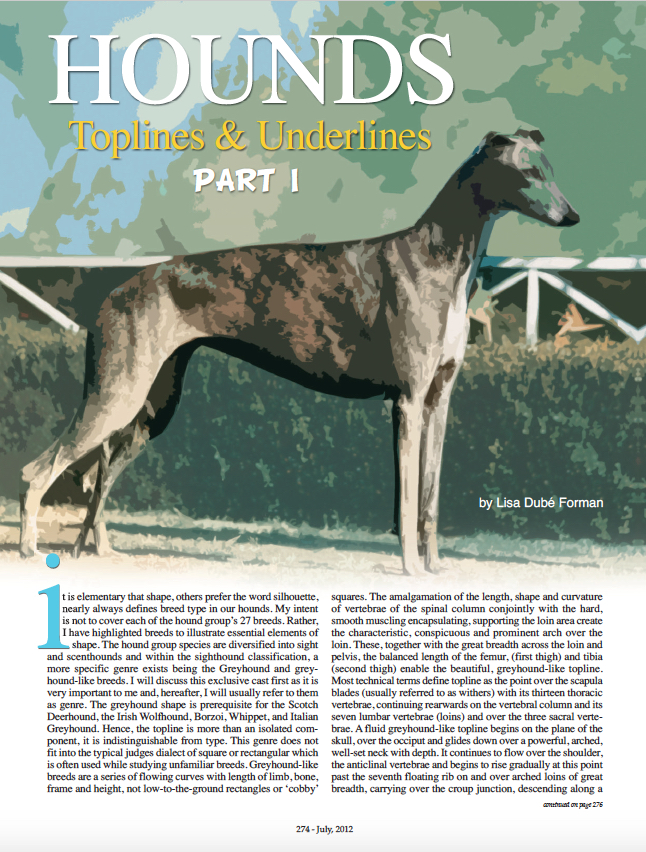
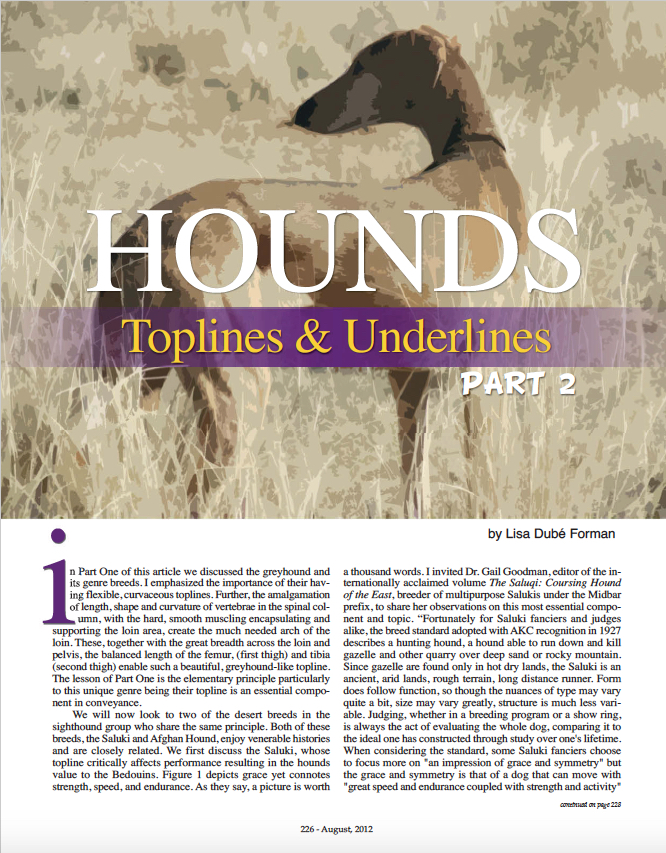
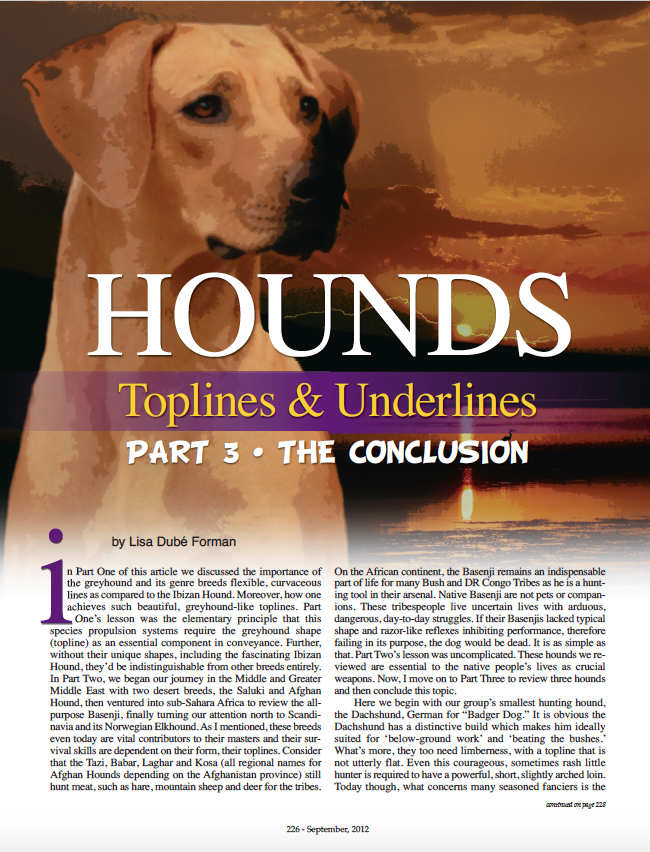
Once again I recalled this old interview just recently when I experienced yet another run-in with the dark side. Though dissimilar in comparison, nevertheless it was another character strike. A foreign breeder judge had posted a statement on Facebook regarding a well-received, three-part article I wrote which was published in The Canine Chronicle magazine while I was a regular, monthly contributor. This 2012 piece, "Hounds, Toplines & Underlines" has been circulating on the Internet, in particular among the sighthound breeds. In a very public, worldwide declaration, this active dog show judge stated,
"I sometimes read articles like this and wish the authors had bred sufficiently wonderful hounds themselves for me to be able to resonate -- without remembering back to certain judging assignments."
This was followed-up by praise from at least one Facebook friend via the "grin emoticon." Emoticons are communication icons in the faceless Facebook social community which itself is a remote and impersonal environment that often cultivates shamelessness, as many people do not have the courage of their convictions in a one-on-one confrontation.
Oh, the dark side has reared its hideous head, again. Notably absent were any valid disagreements on canine anatomy or debates on toplines and underlines. Fueled by aggression and resentment, the only avenue left for this passive aggressor was to impugn my breeding program and my abilities as a breeder. While it is the aggressor's prerogative not to like my bloodlines, as an international dog show judge, they have no exemption to forever conducting themselves in a sportsmanlike manner. How disgracefully conceited and foolish they, as a judge, must be to make outstandingly bad, public commentary about an active breeder, owner/handler, journalist, and fellow dog show judge? By her volition, and in writing no less, she announced her opinion of a contemporary's breeding program and by doing so, any semblance of neutrality went out the window, especially if she were assigned to judge the breed again.
Unaware of or indifferent to questions of right or wrong, during a past American specialty assignment, this same judge awarded Winners to a dog who she previously co-owned, having removed her name from co-ownership prior to the specialty show. Of course, the cloud of impropriety was so dense and unmistakable that the American Kennel Club administratively disallowed the award.
Yes, people behave deplorably in just about any social association or community. It certainly is not exclusive to purebred dog sports. One only has to take a look at the political arena to learn about the dark side. It is also true that various dog breeds attract different types of people. So, it is likely that there are varied levels of quality of character amongst fanciers in other dog breeds.
Thankfully, on the flip side, I have had the opportunity to make many delightful acquaintances in many breeds of our sport over these decades. These are fanciers, though dedicated to their passion, who have maintained healthy, stable perspectives in their lives. For us sane people who find ourselves as targets, we shake our heads and take deep breaths to ground ourselves as the disbelief is often overpowering -- and often, we are forced to deliver a proportional response to the attack. Still, some fanciers seemingly do not have a grip on reality and to a degree, I pity them. They are so wrapped up in the sport of dogs rather, their compulsion is so enormous, that they no longer think rationally. Rather, for some it is hard to separate reality from passion as their level of consumption is at the least, decidedly unhealthy, and ominous on the extreme. I think it is sad how many people have lost themselves, so obsessed that they live, eat, and breathe dogs.
For those interested, I included the links to the three-part article below.
Hounds, Toplines & Underlines, Part One
Sighthound Necessities
The Importance of Free Exercise for Large Sighthounds
Sighthounds love to gallop, to chase and stretch out. They experience unmistakable, sheer glee as they are bending, folding and leaping. You can see it in their expression. So, why is it that so many of these admirable Sighthounds are found living in unsuitable homes, having little or no fenced, secured acreage?
The Importance of Free Exercise for Large Sighthounds
Sighthounds love to gallop, to chase and stretch out. They experience unmistakable, sheer glee as they are bending, folding and leaping. You can see it in their expression. So, why is it that so many of these admirable Sighthounds are found living in unsuitable homes, having little or no fenced, secured acreage? As responsible fanciers and hobbyists, fulfilling their needs should be a primary concern when we place our hounds in their new, permanent homes. Our stewardship of these unique breeds obliges us to proceed with utmost care and concern while considering a new home.
I am not an elitist who snubs a potential puppy owner, turning up my nose at those whose accommodations are not ideal for our Sighthounds. On the contrary, I encourage them to contact me so that I may educate them about the exceptional needs and characteristics of our breeds. More importantly, though, I am aware that urban population growth has changed significantly over the past 60 years in our nation. We all live in an evolving landscape. "Metropolitan areas are now fueling virtually all of America's population growth," as reported in the Washington Post by Emily Badger. In an interesting article, unwittingly she corroborates what many conscientious breeders have realized, that ideal Sighthound companion homes are harder and harder to find. Small population centers with less than 50,000 people have had infinitesimal growth changes. Rural populations have dwindled. Today, one in three Americans lives within the metro areas of 10 cities — or just a few spots on the nation's map. The relevancy of the census data must not be under-appreciated, as this means that, slowly but surely, there are fewer opportunities for us to find homes for our galloping hounds.
The reality I face is that significantly more inquiries than in the past hail from people with no land. From the 36 puppy requests I have received in the past six months alone, 32 (90%) were from persons who did not have what I consider sufficient area to accommodate a Sighthound. Furthermore, this percentage includes some individuals who either currently have or previously owned a Sighthound — from another breeder — in their home.
I readily anticipate the question "How much land does she require?" Ideally, a home for a large breed Sighthound should have at least one acre of property secured with breed-appropriate fencing, but from my experience of three-plus decades in dogs, this often seems like an unrealistic requirement. A bare minimum of half an acre of open land, again properly fenced, not including the house, is my condition. I have received some requests from potential puppy buyers who own half an acre of land that included the home as well as an accessory building; one memorable inquiry offered half an acre of land that included the house, an in-ground swimming pool with a cabana and what appeared to be a Bocce ball court. All that was left was a postage-sized space for the hound to defecate in, without any area to run and play.
I politely refuse to place my large Sighthound puppies in these environments, notwithstanding the usual promises of the on-lead daily exercise that the hound would receive. You must be familiar with this type of dialog. A potential owner asserts that, although there is no acreage for free running, they regularly walk so-and-so many miles and they also live near a park where the hound can be off-lead. Almost all of us understand that Sighthounds are not candidates for off-lead running on public grounds. Simply, this is a hazardous situation due to their prey drive — a good subject for another article I plan on writing.
As for good intentions and best-laid plans, how many times has life thrown us curve balls? Life has a habit of bringing unexpected, unwanted changes or accidents. If a hound’s principal caregiver is injured or becomes ill, ultimately the hound is handicapped as well. The Sighthound will no longer have lengthy walking excursions to release energy and obtain needed exercise. Likewise, if an owner’s work responsibilities increase, this almost invariably impacts the time spent with the hound on a leash. Regrettably, because the properly fenced acreage was initially sacrificed, the hound does not have an area for self-exercise and running. So, ultimately, he suffers.
Self-exercise for a Sighthound is not only the freedom to stretch out his legs, to leap, twist and turn, all of which releases energy. It also is key to a Sighthound's development, both physical and mental. Strong, hard muscles are vital to proper maturation and longevity, as well as to protecting the body from unwarranted injuries. Secured exercise provides valuable mental stimulation: simply, it is good for a Sighthound's psyche or soul, mind, and spirit. His personality and character can develop to their full potential, which is especially crucial in the powerful, giant Sighthound breeds where it is especially important that they must be even-tempered and well adjusted.
Some may feel that placing companion-quality Sighthounds in a loving home where they receive individualized attention is far better than allowing these hounds to languish in a kennel environment. To a great extent, I agree, but the compromises that some breeders make are worrisome. The trade-offs are unfair and incompatible for galloping hunters bred for running, especially when we hear that Wolfhound puppies are placed in townhomes, not as temporary but as permanent quarters. Where is the line drawn for responsible breeders to reject a potential home?
Others may belittle this discussion by stating that one cannot keep every puppy, and who am I to decide what is enough space for a Sighthound to live on comfortably? Some may claim that leashed exercise is sufficient for our hounds and that many of the hounds exercised only on leash are in better physical condition than a hound with acreage. Now and again, this statement could prove true. Having been a longtime Wolfhound fancier, I know from first-hand experience that, on occasion, some Wolfhounds will not use the available space for running but just sit at the gate. Despite having one hundred fenced acres, there they were, lying on the opposite side of the fence gate waiting for me. On the other hand, Sighthounds living on considerably less acreage may happily explore and bound about their areas.
Today's average homeowner does not have acres of property, in fact, much, much less. For those fortunate to have some but still acceptable amount of property, it can be transformed to accommodate a galloping hound, as long as the homeowner is willing to do so. Indeed, the initial fencing investment is costly, but our sighthound breeds can be expensive. Expenses are a certainty all prospective puppy owners must be prepared for, though, in the end; these hounds are well worth the investment.
Returning to the subject of alternative leashed exercise, I frequently pose this logical question. Which athlete would have the better overall cardiovascular condition? A person who runs or walks daily? Granted, walking is far superior to no workout and also offers benefits. I always recommend puppy owners frequently walk with and socialize their hounds, regardless if they have one or ten acres of fenced land. However, what about the muscle-toning obtained while the Sighthound enjoys fenced but free exercise that is not achieved by just leash-walking? While placing a Sighthound, maybe future fitness is not a priority for some breeders, despite the health benefits. If care, love, and clean accommodations are all that a breeder requires from their puppy owners, they are, in my opinion, doing a disservice to our Sighthounds.
If we cannot respect these breed's noble heritage, why then do we bother having them? There is a myriad of other Group breeds who require only small areas and some exercise who are entirely satisfied residing on the couch. In fact, AKC generates several suggested dog breed lists that correspond to homeowners lifestyles. You can see the links to these from my website page, Irish Wolfhound Breed Character. Several times in these past years, after I called attention to inadequate property conditions and discussed such concerns with a few rational, prospective owners who had fallen in love with the Irish Wolfhound breed, they did, in fact, resist the urge of instant gratification. These people understood my objections; they respected my advice and my decision, recognizing that it would be simply unfair for them to have a giant, galloping hound. As a long-standing breed custodian, a rational resignation like this is one of the best things that I could wish for my wonderful sighthound breed, the Irish Wolfhound.